Transcription of HOW TO WRITE A DECLARATION - WashingtonLawHelp.org
1 1 How to WRITE a DECLARATION in a Family Law Case What is a DECLARATION ? A DECLARATION is a written statement, sworn to be the truth under penalty of perjury by any person who has direct knowledge about the issues in a court case. What is it for? You usually use Declarations when filing or responding to motions in court. A DECLARATION gives information that will help the judge1 make a decision on the motion. When the court has hearings on motions, the parties do not get much time to speak. You are also usually not allowed to testify about facts in the case. Anything the judge needs to know to make a decision at the hearing should be in a DECLARATION .
2 If a guardian ad litem (GAL) is appointed, s/he will often use the declarations: to understand the issues, to help determine what is in the child's best interests, and to understand whether a child has been harmed or would be harmed by living with a parent. 1 Many decisions in family law cases are made by court commissioners, not judges. Court commissioners are like judges, but only make decisions relating to a particular subject matter. Many counties have family law commissioners who decide only family law cases.
3 In this publication when we WRITE judge, we mean judge or commissioner. The parties usually file the originals of signed declarations with the court and serve copies on other parties together with the motion, or the response or reply to the motion. What is in this packet? This packet has the general DECLARATION form approved by the Administrator for the Courts and three sealed cover sheets. This packet has instructions and suggestions for these forms. It also explains what information you need to protect with a sealed cover sheet. Who should not use the DECLARATION form in this packet?
4 Declarations are usually not admitted as evidence at a If you are getting ready for trial, you usually will need to have witnesses appear in person, not by DECLARATION . A few counties might allow or require oral testimony at motions hearings. Most decide motions based on declarations. Check your local court rules. Some motions have special DECLARATION forms. They are not in this packet. If you need a DECLARATION for a particular motion, you may need a special form used just for that motion. Example: A DECLARATION in Support of Parenting Plan form. Our 2 One exception: child support modification cases often have trial by affidavit ( DECLARATION ), not by oral testimony.
5 2 website has a list of family law packets for many different motions. Each packet has the state-wide court forms for that motion. Court forms are also available on the court s website at: By presenting a DECLARATION from a witness, a party may be giving up the right to keep confidential other information that witness may have about the party or the child. Who writes Declarations? If you are a party (petitioner or respondent), you may need to WRITE your own DECLARATION at different pre-trial stages of the case3: To tell your side of the story; To explain your requests; To give needed information; or To respond to another person s DECLARATION .
6 Also, you can ask other people, such as teachers, doctors, family members, counselors, friends, scout leaders, coaches, clergy, police or law enforcement officers, neighbors, or others who have directly seen, heard, or otherwise witnessed important events to WRITE declarations explaining what they know. Generally, you do not need more than one witness to give the same information, especially if everyone agrees it is true. If several witnesses would say the same 3 Some motions require special DECLARATION forms not in this packet.
7 Things, you should choose only one or two to WRITE a DECLARATION . Generally, the court gives more weight to a neutral person or a professional than to someone obviously supporting only one side of the case. The more specific information someone has about the parties and/or the child, the better witness they will make. Some people such as school teachers or counselors may need a signed release of information form before writing the DECLARATION . Some courts limit the number of different declarations they will accept or limit the total number of pages that can be filed.
8 What are Exhibits? Exhibits are documents -- written proof attached to a DECLARATION that helps prove what the DECLARATION says. Example: you may attach copies of bills, school records, medical or treatment records, police records, and other types of documents to declarations. You should call the papers that you attach to your DECLARATION Exhibits and either number (1,2,3) or letter (A,B,C) them. Certain types of exhibits require a sealed records cover sheet. We explain more below. Some counties use the word attachment instead of exhibit. All counties may have special rules for using exhibits or attachments.
9 General Instructions for the Forms in this Packet: The main family law packets at have more complete General Instructions. The information below is shorter. It has 3 information you will probably need when writing declarations in a case that has already been filed. Format: Pleadings (legal forms) that you file with the court must follow the court rules about size and margins (GR 14(a)). You must use regular size (8 x 11 ) white paper. You may WRITE on only one side of the paper. The first page of each paper that you file must have a three-inch margin (three inches of space) at the top.
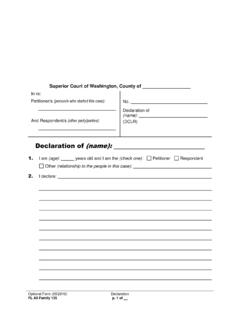
10 The other margins (left, right and bottom, and the top from the second page on) must be at least one-inch wide. Use black or dark blue ink. If your forms do not follow these rules, the court clerk may refuse to file them or may make you pay a fine. The caption. The caption has the name of the case, the case number, the name of the court, and the title of the court paper. It appears at the top of the first page of every form. Name of the court. WRITE in the name of the county where the case is filed in the blank space where the form reads "Superior Court of Washington County of.