Transcription of How to Write Program Objectives/Outcomes
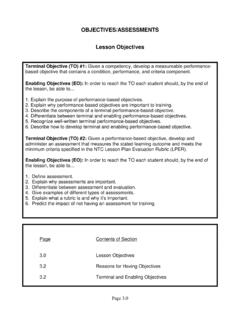
1 How to Write Program Objectives/Outcomes objectives Goals and objectives are similar in that they describe the intended purposes and expected results of teaching activities and establish the foundation for assessment. Goals are statements about general aims or purposes of education that are broad, long-range intended outcomes and concepts; , clear communication , problem-solving skills , etc. objectives are brief, clear statements that describe the desired learning outcomes of instruction; , the specific skills, values, and attitudes students should exhibit that reflect the broader goals. There are three types of learning objectives , which reflect different aspects of student learning : Cognitive objectives : What do you want your graduates to know? Affective objectives : What do you want your graduates to think or care about? Behavioral objectives : What do you want your graduates to be able to do? objectives can also reflect different levels of learning : Mastery objectives are typically concerned with the minimum performance essentials those learning tasks/skills that must be mastered before moving on to the next level of instruction.
2 Developmental objectives are concerned with more complex learning outcomes those learning tasks on which students can be expected to demonstrate varying degrees of progress. Instructional objectives describe in detail the behaviors that students will be able to perform at the conclusion of a unit of instruction such as a class, and the conditions and criteria which determine the acceptable level of performance. What are the differences between Goals and objectives ? Both goals and objectives use the language of outcomes the characteristic which distinguishes goals from objectives is the level of specificity. Goals express intended outcomes in general terms and objectives express them in specific terms. Outcomes learning Outcomes are statements that describe significant and essential learning that learners have achieved, and can reliably demonstrate at the end of a course or Program . learning Outcomes identify what the learner will know and be able to do by the end of a course or Program the essential and enduring knowledge, abilities (skills) and attitudes (values, dispositions) that constitute the integrated learning needed by a graduate of a course or Program .
3 The learning outcomes approach to education means basing Program and curriculum design, content, delivery, and assessment on an analysis of the integrated knowledge, skills and values needed by both students and society. In this outcomes-based approach to education, the ability to demonstrate learning is the key point. What are the differences between objectives and Outcomes? objectives are intended results or consequences of instruction, curricula, programs , or activities. Outcomes are achieved results or consequences of what was learned; , evidence that learning took place. objectives are focused on specific types of performances that students are expected to demonstrate at the end of instruction. objectives are often written more in terms of teaching intentions and typically indicate the subject content that the teacher(s) intends to cover. learning outcomes, on the other hand, are more student-centered and describe what it is that the learner should learn.
4 learning outcomes are statements that specify what learners will know or be able to do as a result of a learning activity; , the outcomes that students must meet on the way to attaining a particular degree. Outcomes are more precise, specific, and measurable than goals. There can be more than one outcome related to each goal and a particular learning outcome can support more than one goal. Questions which learning outcomes address include What knowledge, skills, abilities and dispositions should the ideal student graduating from our Program demonstrate? How will they be able to demonstrate these capacities? How well does our Program prepare students for careers, graduate, professional study, and/or lifelong learning ? What assessments can we use to demonstrate growth in students knowledge, skills, abilities and dispositions as they progress through our Program ? Structure of a learning outcome statement an action word that identifies the performance to be demonstrated a learning statement that specifies what learning will be demonstrated in the performance a broad statement of the criterion or standard for acceptable performance Possible formats of a learning outcome statement: Format #1: To (action verb) (object) (target) (modifiers) Format #2: The (target) (action verb) (modifiers) (object) Example: Poor: Students should know the historically important systems of psychology.
5 This is poor because it says neither what systems nor what information about each system students should know. Are they supposed to know everything about them or just names? Should students be able recognize the names, recite the central ideas, or criticize the assumptions? Better: Students should know the psychoanalytic, Gestalt, behaviorist, humanistic, and cognitive approaches to psychology. This is better because it says what theories students should know , but it still does not detail exactly what they should know about each theory, or how deeply they should understand whatever it is they should understand. Best: Students should be able to recognize and articulate the foundational assumptions, central ideas, and dominant criticisms of the psychoanalytic, Gestalt, behaviorist, humanistic, and cognitive approaches to psychology. This is the clearest and most specific statement of the three examples. It clarifies how one is to demonstrate that he/she knows . It provides even beginning students an understandable and very specific target to aim for.
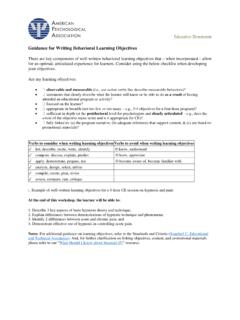
6 It provides faculty with a reasonable standard against which they can compare actual student performance. How to Write learning Objectives/Outcomes learning objectives specify both an observable behavior and the object of that behavior. "Students will be able to Write a research paper." In addition, the criterion could also be specified: "Students will be able to Write a research paper in the appropriate scientific style." Optionally, the condition under which the behavior occurs can be specified: "At the end of their field research, students will be able to Write a research paper in the appropriate scientific style." Note that the verb you choose will help you focus on what you assess. For example, consider the following Students will be able to do research. Here the verb do is vague and open to many interpretations; , Do you mean identify an appropriate research question, review the literature, establish hypotheses, use research technology, collect data, analyze data, interpret results, draw conclusions, recommend further research, or all of those?
7 Each of the verbs in those statements is appropriately specific. Characteristics of Good learning Outcomes learning outcome statements should Specify the level, criterion, or standard for the knowledge, skill, ability, or disposition that the student must demonstrate. Include conditions under which they should be able to demonstrate their knowledge, skills, abilities or dispositions. Contain active verbs Be measurable (some more easily than others) Be stated so that the outcome can be measured by more than one assessment method (ideally) Be written such that you do not join elements in one outcome statement that can not be assessed by a single method Customers will be highly satisfied with the service and requests for service will increase (Here you need to measure satisfaction separately from the number of requests for service.) Guidelines for writing student learning outcome statements (Based on material from the University of Central Florida: UCF Academic Program Assessment Handbook , 2005) Student learning outcome statements should be aligned with mission statements (and goals if applicable).
8 Student learning outcome statements should clearly indicate the level and type of competence that is required of graduates of a Program . The following information should be included in a well-defined learning outcome statement. o Areas/fields that are the focus of the assessment. o Knowledge, abilities, values and attitudes that a student in your Program is expected to have within that area/field. o Depth of the knowledge, abilities, values and attitudes expected of a student in your Program . Student learning outcome statements should be distinctive and specific. Examples of generic and distinctive outcomes are provided below: Example of a generic outcome : Students completing the Engineering Program will be practiced in design skills. Example of a distinctive outcome : Engineering graduates will demonstrate knowledge of math, science, and engineering fundamentals. Specifically, the student will have the ability to: demonstrate general design principles; use fundamental engineering techniques, skills, and tools for engineering practice; analyze and interpret data to produce meaningful conclusions and recommendations.
9 Student learning outcome statements should be framed in terms of the Program and not individual courses or students. Student learning outcome statements should be simple. Do not join elements in one objective statement that cannot be assessed by a single assessment method. Example of a bundled statement: Engineering graduates will demonstrate knowledge of math, science, and engineering fundamentals, and gain competency in basic skills as writing reports, communicating research ideas and oral presentations. Note: This would likely require two different methods of assessment. Oral presentations would require a different approach than assessing knowledge of mathematics. Student learning outcome statements should describe intended learning outcomes and not the actual outcomes. learning outcome statements should describe the abilities, knowledge, values and attitudes expected of students after completion of the Program and not the actual results. No Student learning outcome statements should be stated such that the outcome can be measured by more than one assessment method.
10 An outcome statement should not impose restrictions on the type or number of assessment methods that have to be used to evaluate the outcome . At least two measures should be identified for each learning outcome statement. Example of an outcome statement that can only be measured by one specific assessment method: Students completing the Engineering Program will score over 95% on a locally-developed examination. Note: In this outcome statement only one measure can be used to evaluate the student s performance since this is what is specified in the statement. Example of an outcome statement that can be measured by several assessment methods: Students completing the Engineering Program will demonstrate competence and the ability to apply engineering principles. Note: Specific assessment methods have not been identified in the outcome statement and thus several measures can be used to evaluate the knowledge that the students have gained as a result of the Program . How do you fix an unclear outcome ?