Transcription of Human Anatomy and Body Systems
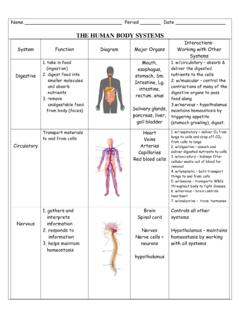
1 Human Anatomy and Body Systems Levels of Organization Remember, the Human body is organized in several levels, from the simplest to the most complex.. Cells the basic unit of life Tissues clusters of cells performing a similar function Organs made of tissues that perform one specific function Organ Systems groups of organs that perform a specific purpose in the Human body **The purpose of the 11 organ Systems is for the Human body to maintain homeostasis. 4- Cell types muscle tissue most abundant tissue controls internal movement digestion, blood through veins external movement of body epithelial tissue covering for body & organs linings of organs & vessels connective tissue holds organs in place ligaments, tendons, some keep organs in place nervous tissue receives messages from body s internal and external messages analyze data & direct response The 11 Human Body Systems The 11 Human body Systems are as follows: -- nervous system -- integumentary system -- respiratory system -- digestive system -- excretory system -- skeletal system -- muscular system -- circulatory system -- endocrine system -- reproductive system -- lymphatic (immune) system The circulatory system Purpose.
2 To deliver oxygenated blood to the various cells and organ Systems in your body so they can undergo cellular respiration Cell type - Muscle Major Organs and Their Functions Heart the major muscle of the circulatory system -- pumps deoxygenated blood into the lungs, where it gets oxygenated, returned to the heart, and then pumped out through the aorta to the rest of the body -- valve regulate the flow of blood between the chambers Organ system Interactions With lungs exchange O2 & CO2 With digestive system - pick up nutrients for transport throughout the body With excretory blood is filtered to remove toxins and some water Nervous system heart-beat regulation & blood pressure Image of the circulatory system The Nervous system Purpose: to coordinate the body s response to changes in its internal and external environment Cell type - Nerve Major Organs and Their Functions Brain control center of the body, where all processes are relayed through -- consists of cerebrum (controls though and senses) and cerebellum (controls motor functions) Spinal Cord sends instructions from the brain to the rest of the body and vice versa -- any organism with a major nerve cord is classified as a chordate Nerves conduct impulses to muscle cells throughout the body Nerves neurons clustered into bundles of fibers (axons) 3 types: carry impulses from sense organs to brain and spinal cord.
3 From brain or spinal to other organs. connects sensory and motor neurons. Synapse point at which a neuron can transfer an impulse to another cell. Human Nervous system Nervous system (CNS) the control center. A. Brain 100 billion cells neurons a. Cerebrum largest part, responsible for learning, intelligence, and judgment. b. Cerebellum coordinates and balances actions of muscles. (Posture, movement, and balance.) c. Brainstem regulates blood pressure, heart rate, breathing, and swallowing. (Thalamus, hypothalamus, midbrain, pons, and medulla oblongata.) Diagram of a Nerve Cell Nerves conduct impulses to muscle cells throughout the body Organ system Interactions Nervous system is interactive with all other Systems in the body you name it it s involved The Respiratory system Purpose: to provide the body with a fresh supply of oxygen for cellular respiration and remove the waste product carbon dioxide Cell type.
4 Epithilial Major Organs and Their Functions Nose internal entry and exit point for air Pharynx serves as a passage way for both air and food at the back of the throat Larynx your voicebox , as air passes over your vocal chords, you speak Trachea the windpipe , or what connects your pharynx to your lungs -- a piece of skin, called the epiglottis, covers the trachea when you swallow, preventing food from entering Bronchi the two large passageways that lead from the trachea to your lungs (one for each lung) -- the bronchi are further subdivided into bronchioles -- eventually, the further subdivisions lead to tiny air sacs called alveoli -- alveoli are in clusters, like grapes -- capillaries surrounding each alveolus is where the exchange of gases with the blood occurs Lungs contain the alveoli, bronchi and connective tissue The diaphragm is the muscle that causes you to breath -- hiccups are involuntary contractions of the diaphragm WHY ARE ALVEOLI SO IMPORTANT?
5 Alveoli are the air sacs of the lungs. They have thin walls made of simple cells and are surrounded by blood capillaries. Gas exchange occurs in the alveoli. Oxygen gas is in higher concentration in the alveoli than in the blood and so it diffuses into the blood through a layer of cells. Carbon dioxide is in higher concentration in the blood than the alveoli and so it diffuses into the alveoli through a layer of cells. The surface of alveoli are covered in a thin lipoprotein layer and it prevents them from collapsing during exhalation. Organ system Interactions The respiratory system directly interacts with the circulatory system Indirectly interacts with the immune system (lining of the nasal and bronchiol cavities/tubes) Nervous system (smell & taste) regulation of breathing Image of the Respiratory system The Digestive system Purpose: to convert food particles into simpler micromolecules that can be absorbed into the bloodstream and used by the body Cell Type: epithelial and muscle Major Organs and their Functions.
6 Mouth to chew and grind up food -- saliva also begins the chemical breakdown Esophagus pipe connecting mouth to stomach Stomach secretes an extraordinarily strong acid (pH = 2) that leads to breakdown of food -- once the food is broken down in the stomach and mixed with digestive juices, it is called chyme Pancreas secretes digestive enzymes, produces the hormone insulin that regulates blood sugar levels -- also help neutralize stomach acid Liver produces bile, which breaks down fats in foods Gallbladder pouch-like organ that stores bile for future use Small Intestine after digestion is complete, the chyme enters the small intestine where it is absorbed into the bloodstream -- the chyme is propelled along by folded surfaces called villi, on the intestine Large Intestine removes water from the chyme and gets the waste ready for excretion Organ system Interactions circulatory system move nutrients to other parts of body Nervous system regulation of peristaltic activity Endocrine system hormones that regulate apatite and digestive enzyme release Excretory removal of solid waste The Digestive system The Lymphatic/Immune system Purpose.
7 To remove infectious diseases and other pathogens from the Human body Cell type - Epithelial Major Organs and Their Functions Skin also called the integumentary system , the skin is the body s first line of defense White Blood Cells recognize disease agents (antigens) and create antibodies to tag and remove these antigens -- phagocytes are the white blood cell type that actually eats and destroys these antigens Lymph Nodes help restore fluid lost by the blood and return it to the circulatory system Spleen produces and stores white blood cells Thymus site of white blood cell maturation Organ system Interactions Integumentary first line of defense Respiratory mucus membranes circulatory transport of antibodies & white blood cells Endocrine chemical stimulus response Excretory & digestive elimination of pathogens White blood cells - travel in both the lymph system and the blood stream Integumentary system Purpose: temperature regulation, waste removal, sensory info, and protection Largest organ of the body = skin which has two layers.
8 Skin, Hair, Nails Cell type epithelial Hair Functions Absorbs radiation from the sun that maybe harmful Reduces loss of heat Filters out dust and dirt Shows gender Sensitive to movement Nail Functions Protects tips of fingers or toes Helps pick up small objects Enhances sensation of the finger by acting as a counterforce Scratching The Epidermis Outermost layer of skin. Made of layers of epithelial cells. Outermost layer of cells are flattened, dead, and keratin filled. Keratin makes skin tough and waterproof. Skin is continually damaged, but replaces cells instead of repairing them. Layer of actively dividing cells at base of epidermis make new cells that move up to replace old ones on surface, producing keratin as they go. Epidermal cells contain melanin, a pigment that absorbs UV radiation. Melanin ranges from reddish brown to black Epidermis Outermost Layer: keratin - tough, flexible protein; found in hair and fingernails melanocytes - cells that produce melanin Image from: Dermis Dermis - supports epidermis.
9 Contains nerve endings, blood vessel, and smooth muscles. 2 types of glands A) sweat glands - controlled by nervous system B) sebaceous glands - produce oily secretions that helps keep the epidermis flexible and waterproof. Image from: Subcutaneous Tissue Located beneath the Dermis. It s a layer of connective tissue made of fat. It s a shock absorber, insulator, and energy storage. Anchors skin to underlying organs. Thickness varies throughout the body. Organ system Interactions Immune system - first line of defense circulatory system - brings nutrients and water Excretory system sweat Nervous system touch Endocrine thermoregulation The Endocrine system Purpose: to control growth, development, metabolism and reproduction through the production and secretion of hormones Major Organs -- hypothalamus -- pituitary gland -- thyroid -- parathyroid -- adrenal glands -- pancreas -- testes -- ovaries Cell type - epithelial Endocrine system Controls all the metabolic activities of the body.
10 Made up of a series of glands organs which produce and release chemical messengers, generally into the bloodstream. The chemical messengers are called hormones and they affect the behavior of cells. Only cells with receptors respond to hormones Glands of the Endocrine system The major gland is the pituitary gland produces many of the hormones that regulate the endocrine glands. The hypothalamus controls the pituitary gland. Thyroid, parathyroid, adrenal, pancreas, ovaries and testes. Examples of Hormones Endocrine Gland Hormone Effect on Target Cells Thyroid Thyroxine Regulates metabolic rate of cells Adrenal medulla Adrenaline and noradrenaline Prepare the body for fight or flight by increasing body activities Pancreas Islets of Langerhans Insulin Regulates the amount of sugar in bloodstream Posterior pituitary Oxytocin Stimulates contractions of uterus during childbirth Organ system Interactions You name it it interacts with it for regulation especially in conjunction with the nervous system and circulatory system The Excretory system Purpose: to rid the body of wastes, including excess water and salts Cell Type.