Transcription of Human trafficking true or false questions sheet
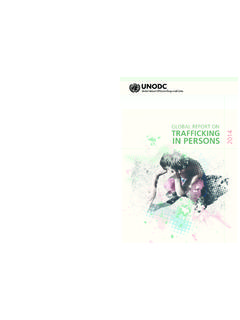
1 E4J Secondary Education: Human trafficking Teacher's Guide Human trafficking true or false questions sheet Directions: After viewing and discussing the video on Human trafficking , ask the students to read the following statements and decide if they are true or false . They should mark their answers on a piece of paper. 1. Human trafficking is primarily limited to poor countries ( false ). Explanation: Human trafficking is widespread. Data taken from the United Nations Office on Drugs and Crime Database on Human trafficking Trends documents the trafficking of persons from 127 countries, with exploitation taking place in 137 countries. Most trafficking victims are identified in their countries of citizenship. The identification of domestic victims has increased over the last 15 years. But victims are regularly trafficked to other countries, with wealthy countries a common destination.
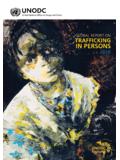
2 Learn more by reading the Global Report on trafficking in Persons (2018). 2. Human trafficking for sexual exploitation is reported more frequently than Human trafficking for forced labour ( true ). Explanation: At the global level, Human trafficking for sexual exploitation is reported more frequently than trafficking for forced labour. However, trafficking in persons for forced labour has not been traditionally viewed as a significant issue in many countries and the identification of victims trafficked for forced labour has been less successful than that of those that have been trafficked for sexual exploitation. Most identified victims of Human trafficking are women and children. Almost a third of trafficking victims are children. With regard to reported cases of trafficking involving boys, the trafficking tends to be for forced labour, while regarding cases involving girls, the purpose is most frequently for sexual exploitation.
3 Notably, the identification of adult male victims of trafficking is less common, despite the popular perception that it is men who are more likely to be trafficked for forced labour. Learn more by finding out about the Global Programme against trafficking in Human Beings and by reading trafficking in persons: Global patterns (2006). 3. The only way of addressing Human trafficking is to get rid of the markets that draw the traffickers ( false ). Explanation: Getting rid of the markets that generate profits for the traffickers is one way to address Human trafficking but it is not the only way of addressing the criminal practice. Addressing the underlying issues that give rise to trafficking , such as poverty, gender inequality, conflict, poor education and a lack of opportunities, is a long-term prevention strategy.
4 Desperate conditions produce an endless supply of potential victims. Another way to address trafficking in persons is to identify and target the traffickers and intermediaries who profit from this criminal practice. This enables law enforcement agencies to investigate, prosecute and convict offenders. United Nations Office on Drugs and Crime Vienna International Centre PO Box 500 1400 Vienna Austria Tel.: (+43-1) 26060-0 Email: | E4J Secondary Education: Human trafficking Teacher's Guide Learn more by finding out about the Global Programme against trafficking in Human Beings and by reading trafficking in persons: Global patterns (2006). 4. A smuggled migrant and a person that has been trafficked are both victims ( false ). Explanation: Persons that are trafficked are victims. Consent or the expressed approval or cooperation of the trafficked person is irrelevant.
5 In many Human trafficking cases, there is initial consent or cooperation between victims and traffickers, before traffickers use coercive, abusive and exploitive behaviour to control their victims. Note that a child under the age of 18 cannot give consent in any situation. Even if the child is not threatened, coerced, abducted or deceived, he or she still cannot legally consent to being trafficked for the purpose of exploitation. The same applies to the custodian of the child: they cannot give consent for the child in their custody to be exploited. The smuggling of migrants is a different situation. A smuggled migrant is not a victim. International law on the smuggling of migrants points out that this is a crime not against people, but against States' rights to determine migration procedures. Learn more by reading frequently asked questions about Human trafficking .
6 5. If the victim of Human trafficking gives consent to the trafficker, she or he is no longer a victim of trafficking ( false ). Explanation: Victims of Human trafficking may initially have given their consent, but their consent is rendered meaningless because of the abusive, coercive and deceptive means used by traffickers to gain it. Furthermore, a child under the age of 18 cannot give consent. The same applies to a custodial parent or guardian; they cannot give consent for the child in their custody to be exploited. Learn more by reading the Global Report on trafficking in Persons (2018). 6. Armed conflict can increase the likelihood of Human trafficking ( true ). Explanation: Armed conflict provides ideal conditions for trafficking in persons and other Human rights abuses. Living in a conflict zone increases a person's vulnerability to Human trafficking .
7 During times of conflict, there is often a weakened response to crime and lawlessness, and reduced access to basic services. This leaves people feeling desperate. Armed groups take advantage of the situation. Women and girls are abducted for sexual slavery or forced marriage. Young people are trafficked for use as armed combatants or for forced labour. Learn more by reading the Global Report on trafficking in Persons (2018). United Nations Office on Drugs and Crime Vienna International Centre PO Box 500 1400 Vienna Austria Tel.: (+43-1) 26060-0 Email: | E4J Secondary Education: Human trafficking Teacher's Guide 7. The vast majority of identified trafficking victims come from North America ( false ). Explanation: The vast majority of identified trafficking victims come from East Asia or sub-Saharan Africa. Notably, while the number of victims of trafficking identified in these regions is comparatively low, the flow of victims from these areas is relatively large.
8 Learn more by reading the Global Report on trafficking in Persons (2018). 8. Traffickers prey on the vulnerabilities of their victims, such as being poor, discriminated against or living in a conflict zone ( true ). Explanation: Studies have found that victims of trafficking often live in poverty and have little education. This allows traffickers to deceive the people that they target. For example, traffickers in persons for the removal of organs may trick their victims by claiming that kidneys grow back after being removed or that having two kidneys is abnormal. Learn more by reading the Global Report on trafficking in Persons (2018). 9. trafficking is known to be as equally as harmful to women and girls as it is to men and boys ( false ). Explanation: The 2010 United Nations Secretary-General's Report on trafficking in women and girls acknowledges that the harm related to trafficking is recognized to be worse for women and girls than for men and boys.
9 This is because of the exposure of women and girls to multiple and simultaneous forms of exploitation, such as being exploited for forced labour, forced marriage, begging and domestic servitude, while experiencing sexual violence from their traffickers as a method of control. Learn more by reading trafficking in women and girls: report of the Secretary-General (2010). 10. Traffickers use the Internet to recruit victims and accomplices ( true ). Explanation: An emerging feature of Human trafficking is the innovative use of the Internet and the online world. The Internet allows traffickers to operate on a global basis. They use social media and other online communication technologies to mask their identities and operations. Traffickers prowl social media and peruse personal profiles to identify vulnerable people and accomplices.
10 They create fake profiles, join groups and solicit applicants for lucrative jobs in order to get in contact with potential victims. The anonymous nature of the Internet facilitates their activities. Learn more by reading the Toolkit to Combat trafficking in Persons (2006). United Nations Office on Drugs and Crime Vienna International Centre PO Box 500 1400 Vienna Austria Tel.: (+43-1) 26060-0 Email: |