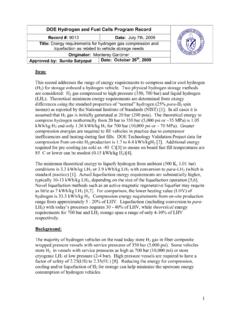
Transcription of Hydrogen Delivery Liquefaction and Compression
1 Hydrogen DeliveryLiquefaction & CompressionRaymond DrnevichPraxair -Tonawanda, NYStrategic Initiatives for Hydrogen Delivery Workshop -May 7, 20032 Agenda Introduction to Praxair Hydrogen Liquefaction Hydrogen Compression3 Praxair at a Glance The largest industrial gas company in North and South America Only Hydrogen Supplier in All Sizes (Cylinders to liquid to Pipelines) Operations in 40 countries Over 23,000 employees 3,000 active patents One million customers worldwide4 Merchant Hydrogen PlantsPraxair liquid Hydrogen PlantPraxair Tube Trailer Hydrogen PlantPraxair HGS PlantPraxair Cylinder Hydrogen Plant5 Gulf Coast Pipeline SystemTEXASLOUISIANAHYDROGEN AIR SEPARATION PLANTSNITROGEN OXYGEN INDUSTRIAL AREAGALVESTON BAYGULF OF MEXICOBAYTOWNMONT BELVIEUCHANNELVIEWLAPORTEHOUSTONGALVESTO NTEXAS CITYPORTARTHURPASADENADEER PARKBAYPORTSULPHURLAKECHARLESNEDERLANDSA BINELAKENEW ORLEANSGEISMARBATON ROUGE245 miles of pipeline serving50 major customersBEAUMONT6 Hydrogen Liquefaction There are 10 Hydrogen Liquefaction plants in North AmericazTrain size ranges from 6 to 35 TPD (5,400 to 32,000 kg/day)
2 In the 1960 s, liquid Hydrogen plants were built to support the Apollo program. Today, liquid Hydrogen is used to reduce the cost of Hydrogen a full tube trailer of Hydrogen to a customer resultsin a Delivery of less than 300 kgzA modern liquid Hydrogen trailer carries 4000 kg of liquid hydrogenNorth American liquid Hydrogen Capacity(TPD)050100150200250300196519701 975198019851990199219951997 YearAir ProductsPraxairBOCAir Liquide7 Hydrogen LiquefactionH2 SourceSMRB yproductGasificationRenewableH2 PurificationPSAC ryogenicMembraneH2 LiquefactionCryogenic(-423 F)8 Hydrogen Liquefaction The plants are very capital intensivezPraxair has started capacity expansions approximately once every5 years since 1980. The infrequent builds means it s very difficult to reproduce larger plants are more capital efficient, it s hard to take the capital risk of building the plant too large.
3 The process is very energy intensivezTypical unit powers are on the order of to 15 kWhe/kg The cost stack looks like: 0%25%50%75%100%ShareCapitalPowerO&M9 Hydrogen LiquefactionProcess ReviewExternal RefrigerationGN2to N2 LiquefierTo FeedH2 Flash CompressorH2 Recycle CompressorLN2 Storage/Fill10 Forms of liquid HydrogenOrthoParaH+-H+-H+-H+- Normal Hydrogen is 75% Ortho, 25% Para liquid Hydrogen is Ortho, Para Heat of Conversion from Normal to Para is kWhth/kg Heat of Liquefaction is kWhth/kg Conversion can cause Vaporization11 Hydrogen LiquefactionIssues for Consideration Methods to decrease capital cost:zLarger scale plants (850tpd)zPlant repeatability Methods to decrease energy requirement:zNew Compression and expansion technology High speed centrifugal compressors and possibly expanders Materials development required Something completely different?
4 ZNew approaches to low temperature refrigeration Magnetic refrigerators Acoustic refrigerators12 Challenges: More cost effective LH2 production systemszSystem modularization for traditional sized unitszLarger scale equipmentzHigher efficiency compressors and expanderszMore efficient refrigerationzLower cost high-efficiency insulation Cost effective small scale Hydrogen generationzLow cost high pressure compressors and expanderszNovel low-temperature refrigerationzLow heat leak liquid storage units13 Hydrogen CompressionH2 ProductionH2 PurificationH2 CompressionSMRB yproductGasificationRenewablePSAC ryogenicMembraneSmallLarge14 Hydrogen Compression Hydrogen is difficult to compresszVery small molecule zPositive displacement compressors are used Hydrogen compressors are expensivezMaterialszSizezRedundancy required for reliability The process is energy intensivezTypical unit powers are.
5 Inlet-Outlet(psig)Adiabatic EfficiencyCompression Energy 300 -1,000 70-80% kWhe/kg100 -7,000 50-70% kWhe/kg15 Issues Unique to Hydrogen Compression Compressor Seal and Clearance TolerancezHydrogen is the lightest of all the gases and has lower viscosity than NG. Hence, it is easier to migrate through small spaceszSpecial seals and/or tolerance standards need to be established to achieve high pressures HydrogenEmbrittlementof MetalszAt elevated pressure and temperature, Hydrogen can permeate carbon steel resulting indecarburizationzConventional Mild Steel has been used in Germany and France since 1938 as pipeline steels containing Chromium and Molybdenum have been suggested for compressor Compression for Large Scale Pipeline Delivery (Present) State of the ArtzMulti-Stage Reciprocating Machines -typical to install redundant units in order to keep on-line time between 98-99%.
6 Z700 -1000 psig Delivery pressureszAdiabatic efficiencies of 78-80%zHigh maintenance costs due to wearing components ( valves, rider bands, piston rings) Typical ManufacturerszDresser-RandzSulzer BurckhardtzArielzNeuman-Esser17 Hydrogen Compression for Small Scale Fueling Stations (Present) State of the ArtzV-Belt driven multi-stage reciprocatingzHydraulically driven multi-stage reciprocatingzV-Belt driven diaphragmz5,000 -10,000 psig Delivery pressures Typical ManufacturerszNeuman-EsserzFluitronzPDCz GreenfieldzRixzHydro-PaczCompAir18 Hydrogen Compression for Small Scale Fueling Stations (Present)Compressor Cost Comparison(6000 psig)$0$20,000$40,000$60,000$80,000$100, 000$120,000 Type A - 1 Type B - 1 Type C - 1 Type C - 10019 Hydrogen CompressionIssues for Consideration Issue of numbers -what happens if we build 100 times the units we build today:zCost impact on current technologyzPotential for new technology Reliability improvements Maintenance cost reduction Methods to decrease energy requirement:zNew mechanical conceptszNon-traditional approaches to compression20 Hydrogen Compression (Future) Newer Approaches zMechanical Guided Rotor Compressor (GRC) Linear CompressorzNon-Traditional Electrically Driven Membranes Hydride Compressors