Transcription of HYDROGEN PEROXIDE ANALYSIS INTRODUCTION
1 4-1 HYDROGEN PEROXIDE ANALYSISINTRODUCTIOND escriptionStudents determine the percent of HYDROGEN PEROXIDE in store-bought HYDROGEN PEROXIDE bytitration with potassium permanganate. The potassium permanganate is standardized by studentswith titration of solid sodium for This ExperimentThe goals of this experiment are to have students:1. perform titrations;2. work with the concepts of mean, standard deviation and relative standard deviation;3. report data to the proper number of significant figures;4. consider the concept of precision in measurements;5. experience quality control concepts in industry; and6. read and use information from Placement in the CurriculumThe HYDROGEN PEROXIDE ANALYSIS lab would be best implemented after the students have hadexperience with the use of a buret (as a volume measuring device), as well as general is a good lab to introduce the skill of OF HYDROGEN PEROXIDE SOLUTIONSCENARIOYou are a recent graduate of Miami University Middletown s associate degree program inChemical Technology and you have just begun a $29,000-job in quality control for HYPERC orporation, a local manufacturer of HYDROGEN PEROXIDE solutions.
2 Your job at HYPER is to join ateam of technicians who monitor the HYDROGEN PEROXIDE concentrations on the 3%-line toensure that the solutions continuously fall within the company specifications for concentrationsof (The industrial standard concentration range is , but your companyhas established a reputation for meeting even higher standards than the industry as a whole. Itwill be your job to help them continue to do this.) To monitor the solution concentration, youand your team members must routinely extract samples from the production line and performanalyses similar to that described PEROXIDE in aqueous solution can act either as a strong oxidizing agent or as a reducingagent. In moderate to high concentrations it can cause severe burns to skin and mucousmembrane. HYPER Corporation markets aqueous HYDROGEN PEROXIDE in concentrations between3 90% by weight.
3 For example, 90% solution is used in rocket propulsion, some professionalhair bleaching agents contain 6% HYDROGEN PEROXIDE , and 3% solutions are widely used forbleaching flour, straw, gelatin, and textile fabrics including silk. A 3% HYDROGEN PEROXIDE solutionalso has a therapeutic use as a topical anti-infective, antiseptic, and cleansing agent for bothhumans and animals. HYPER Corporation sells its 3% solution to the plastics industry, to homerenovation specialists who use it to remove old paint, to tanners for processing hides, tophotography supply houses, to wine makers, and to pharmaceutical TASKSYour tasks will be to perform the ANALYSIS of samples of HYDROGEN PEROXIDE solution from theproduction line (provided by your instructor), to evaluate the accuracy and precision of themethod, and to determine the quality of the manufactured product sold to the company this experiment you will work individually.
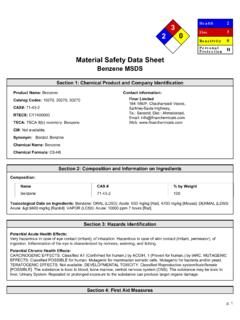
4 The other members of the class represent the othermembers of your team at HYPER. Each team member will do some statistical ANALYSIS of his/herown data and some ANALYSIS of the pooled data for the CONCERNSS odium oxalate is an antioxidant, potassium permanganate is an oxidizing agent, hydrogenperoxide can act as either, and sulfuric acid is a strong acid . Before you begin work on thisproject, find out what these terms mean and what special precautions must be taken while usingthem. The material safety data Sheets ( msds ) will be available on the class bulletin board foryou to use or you may them on the following Web sites: or4-3 (If you use the Web to find material , be sure to includethat in your written record for the experiment.)PROCEDUREI. Standardization of Potassium Permanganate SolutionPotassium permanganate solution can not be prepared accurately to a fixed concentration.
5 Thus,you must first titrate the solution with a known mass of pure, solid sodium oxalate (for which thenumber of moles can be calculated to four significant figures). This process is calledstandardization. The reaction equation is given + 5C2O42- + 16H+ 2Mn2+ + 10CO2 + 8H2 OProcedure for standardization Obtain approximately 125 mL permanganate solution from the stock bottle. Fill a buret with permanganate solution. Record the initial volume. Weigh two g samples of dry sodium oxalate (Na2C2O4) to the closest 1 mg, and transferthem to clean, labeled 250-mL Erlenmeyer flasks. Record the mass of the samples. Add 70 mL M sulfuric acid to each flask and swirl to dissolve the solid. Use a hot plate to heat one flask s contents to 80-90 C. DO NOT BOIL. You can place athermometer in the flask to determine the temperature.
6 Rinse the thermometer with a smallstream of distilled water from your wash bottle (aimed into your flask) as you remove thethermometer just before titrating. This is necessary to prevent loss of : Handle the flask with care. It will be HOT! Liquid in this temperature range cancause burns. Use tongs or have your instructor show you how to fold a paper towel for use as aprotector. While the solution is hot, titrate with the permanganate solution. The temperature should notfall below 60 C during the titration. (If it does, the mixture will turn brown and cloudyinstead of decolorizing as expected.) Record the final volume of permanganate solution. Heat the other sample solution and repeat the of the concentration of potassium permanganate solution Prepare a table to record answers to the following:1.
7 Calculate the number of moles sodium oxalate in each sample. The molar mass of sodiumoxalate is Calculate the number of moles of potassium permanganate at the endpoint of each Calculate the molarity of the potassium permanganate solution from each titration (molespermanganate/liter solution).4. Find the mean of the two If the difference between the two calculated molarities is greater than 5% of the mean, youshould titrate another sample and do the necessary calculations. Average all Once you have values for the permanganate concentration that you believe are valid, add theindividual values to the class data list on the computer. Do this before you continue so thatthe information will be ready when you are ready to do your data HYDROGEN PEROXIDE AnalysisIn acid solution, the dark purple MnO4-oxidizes HYDROGEN PEROXIDE , forming oxygen gas and verypale pink Mn2+ ions.
8 Thus, when a solution of KMnO4 is added dropwise to an acidified solutionof HYDROGEN PEROXIDE , each drop is decolorized until all the H2O2 is used up. The next drop ofpermanganate solution added colors the solution and signals the end-point of the + 6H+ + 5H2O2 5O2 + 8H2O + 2Mn2+Procedure for ANALYSIS Weigh a clean, dry (on the outside) 250-mL Erlenmeyer flask on the balance. Add about 10mL of the HYDROGEN PEROXIDE solution provided and weigh it again. Record the mass of thesample solution. Add about 50 mL distilled water. Slowly add 15 mL 3 M sulfuric acid ,swirling the flask after each : 3 M sulfuric acid is sufficiently concentrated so that this mixture might becomewarm. Add the acid to the solution slowly, while swirling. If any acid should spill, wash the areawith plenty of water.
9 Fill your buret with potassium permanganate solution. Record the initial volume. Titrate the acidic HYDROGEN PEROXIDE solution you just made, swirling continuously. Continueuntil one drop produces a pink color that lasts for at least 1 minute. The color is more readilyseen if there is a piece of white paper under the flask. Record the buret reading. Refill the buret. Repeat the titration with a duplicate of PEROXIDE Concentration 1. Calculate the number of moles of HYDROGEN PEROXIDE in the first sample, the number of grams of HYDROGEN PEROXIDE in the first sample, and the mass percentage of HYDROGEN PEROXIDE in the first sample of HYDROGEN PEROXIDE solution. 2. Repeat the above calculations for the second you leave the laboratory, make sure you have a copy of the class data for theconcentration of potassium permanganate solution, including the mean and standarddeviation for the THE QUALITY OF YOUR DATAB efore you start the following tasks, review the section A Look at Quality in Calculations MadeFrom Measurements in the front part of your lab book.
10 You will find the necessary methods,equations, and an explanation of this task you will interpret the information given by the mean and standard deviation of the class data for thepermanganate concentration, evaluate the quality of your values in relation to the class mean, judge the quality of the information obtained by the class about the PEROXIDE concentrationsin light of the statistical information known, and judge the quality of your data as a technician for HYPER Obtain a copy of the team set of data for the permanganate solution. Record this informationas mean plus/minus standard deviation. 2. Calculate the relative standard deviation of the team mean in percentage Decide whether or not any of the individual points seem to be too different from theremaining values to be considered valid.