Transcription of Hydrogenated Nitrile (HNBR, HSN) - Precision …
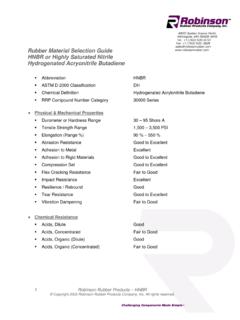
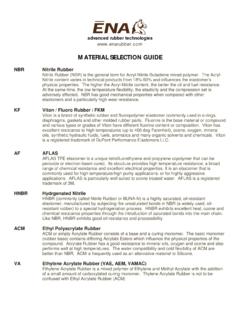
1 1 Hydrogenated Nitrile ( hnbr , HSN) hnbr seals have a very good heat resistance, high strength and excellent resistanceto oxidized fuels and sour crude. Therefore, hnbr seals should be considered forapplication generally to severe for standard Nitriles(Buna) and should also beconsidered for selected applications where fluorocarbon (Viton ) seals are currentlybeing used (applications above 250 F involving high-pressure CO2, H2S and corrosioninhibitors). hnbr is also referred to as HSN or Highly Saturated is a synthetic polymer that results from the hydrogenation ofnitrile rubber (NBR). In this process the molecular double bonds in the NBR primary polymer chain undergo a hydrogenation process and therefore the term Hydrogenated Nitrile . Hydrogenatednitrile rubbers ( hnbr ) have proven invaluable in extending the boundariesof elastomeric seals in aggressive environments.
2 These materials have the excellent oil andfuel resistance of conventional Nitrile (NBR) elastomers combined with superior mechanicalproperties and can sustain higher operating temperatures; up to 356 F when immersed inoil. They also display superior resistance to aggressive fluids such as sour crude oil or gas,lubricating oil additives and amine corrosion has been commerciallyavailable since 1983. Nippon Zeon Company manufactures hnbr under the trade nameZetpol. Mobay Chemical Corporation markets hnbr under the trade name oil wells become deeper and conditions harsher, the traditionally used nitrileand fluorocarbon elastomers may no longer give the long-term often inadequate in terms of both thermal and chemical stability, their maximumservice temperature typicallyisabout 250 F (120 C). Temperatures can reach 350 F(180 C) in deeper wells and this, in the presence of crude oil, possibly with hydrogensulphide and formation water/steam will cause degradation of the elastomer.
3 Injected oilwell media such as methanoland amine corrosion inhibitors will accelerate the deteriorationof standard exhibit very good thermal and hydrocarbon resistance butunless expensive specialized grades are used, they are attacked by a number of commonlyencountered oilfield media: amine corrosion inhibitors will cause embrittlement andhydrogen sulphide, methanol and steam will cause softening with a consequent reduction inmechanical & Associates, E ApacheTulsa, OK 74116918-665-0044 Fax of the important benefits advantages of hnbr compared to standardNitrile and Fluorocarbons are listed operating temperature-25 F (-26 C) special grades 50 F (-45 C).Maximum operating temperature +356 F (180 C) in oil+320 F (160 C) in aliphatic (not aromatic) hydrocarbon tensile and tear strengths and outstanding abrasion for use with water, steam, amine corrosion inhibitors, brines, drilling muds, for use with for use in sour environments, up to 5% Resistant to nitriles have an upper service temperature rating ofbetween 200 and 300 F depending on the compound formulation.
4 Fluorocarbonsin hot water/steam will soften with a consequent reduction in mechanical properties. Resistance to Compression compression-set resistance of HSN at hightemperatures (such as 302 F) is much better than standard nitriles. The difference isless pronounced at lower temperatures except for special grades. Fluorocarbons willexhibit compression set at temperatures as low 0 F Resistance to Sour and gas that contain hydrogen sulfide (H2S) cancause a substantial decrease in tensile, elongation and hardness in standard nitrileseals and evenfluorocarbon seals. Accelerated aging test show standard nitriles,fluorocarbon (Viton and Viton GF) and Aflas lost over 70% of their tensile strengthafter aging 168 hours at 302 F in the liquid phase of an H2S test. hnbr lost about30%. In the liquidphase, the H2S test solution-contained diesel, water and acorrosion inhibitor.
5 In the vapor phase, the test solution contained 5% H2S by weightalong with carbon dioxide and methane. Resistance to corrosion inhibitors are often added to oil wellsto prolong the serve life of metal parts. With standard nitriles and fluorocarbons,corrosion inhibitors can cause increased elongation and decreased modulus andhardness. However hnbr shows good resistance to a variety of common corrosioninhibitors. Resistance to explosive decompression occurs whengas at high pressure permeates into the elastomer. When the external gas pressureis reduced, absorbed gas expands against the elasticity of the rubber. This cancause severe internal damage, which usually takes the form of swelling withsubsequent blisters and splits in the elastomer. hnbr has shown good resistance tohigh-pressure CO2especially when compared to Nitriles and & Associates, E ApacheTulsa, OK 74116918-665-0044 Fax