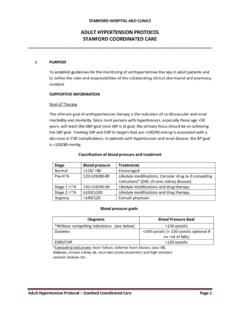
Transcription of Hyperlipidemia Management Protocol STANFORD …
1 STANFORD HOSPITAL AND CLINICS Hyperlipidemia Management Protocol STANFORD COORDINATED CARE Hyperlipidemia Protocol STANFORD Coordinated Care Page 1 PURPOSE: To enhance collaborative patient care by referral of patients with a diagnosis of dyslipidemia, coronary artery disease (CAD), diabetes (DM) or is at high risk for coronary heart disease to be co-managed by the clinical pharmacist, pharmacy resident or RN following this Protocol . SUPPORTIVE DATA: There is a strong link between serum cholesterol and cardiovascular mortality. Reductions in LDL cholesterol are followed by reductions in mortality. In general, each 1% fall in LDL cholesterol confers a 2 % reduction in cardiovascular events.
2 The goal of therapy is to decrease cardiovascular morbidity and mortality by lowering cholesterol to a target level. The target LDL cholesterol is determined by the number of patient risk factors. The goal is achieved through diet, lifestyle modification, and drug therapy. ACKNOWLEDGEMENT: This Protocol is adapted from one developed at Santa Clara Valley Medical Center in San Jose, CA by Tyler Aguinaldo, MD, Director of Diabetes & Metabolism Center; Dorleen Von Raesfeld, MSN, RN, CDE, Assistant Nurse Manager and Susan Yu, Clinical Pharmacist, CDE, Chronic Care Management . We gratefully acknowledge their willingness to share this Protocol .
3 Please feel free to utilize these protocols and please credit STANFORD Coordinated Care. I. CONTENT A. LIPID Management IN ADULTS 1. INCLUSION CRITERIA (must fulfill all) a. Adult >35 years of age. b. Non-pregnant adult. c. Hyperlipidemia with LDL above goal. 2. EXCLUSION CRITERIA a. Heavy alcohol abuse (>3 drinks/day). b. History of pancreatitis. c. Active liver disease or elevated liver enzymes (persistent, unexplained) or baseline ALT > 3 times upper limit of normal (ULN) or clinical evidence of cirrhosis (eg., GIB, ascites, hepatic encephalopathy INR > , albumin < 3, radiographic or pathological findings consistent with cirrhosis).
4 D. Active adjustment of glucocorticoid ( , prednisone, dexamethasone, hydrocortisone, triamcinolone) doses. e. Active vascular disease ( , unstable angina, stroke-like symptoms). f. Active systemic infection. g. HIV-positive patients. h. Serum creatinine level > 2 mg/dL, dialysis patients, OR patients with treatable etiology for nephrotic syndrome. i. TSH > 5 IU/mL. j. Previous hemorrhagic stroke. STANFORD HOSPITAL AND CLINICS Hyperlipidemia Management Protocol STANFORD COORDINATED CARE Hyperlipidemia Protocol STANFORD Coordinated Care Page 2 3. ASSESSMENT OF LDL-C GOAL a. If no history of CHD, count the number of major risk factors and estimate 10-year risk for men and women using Framingham Risk Score (see Attachment B).
5 B. Major Risk Factors for CHD 1) Cigarette smoking 2) Hypertension (BP 140/90 mmHg or on antihypertensive medication) 3) Low HDL (< 40 mg/dL) 4) Family history of premature CHD (CHD in male first degree relative < 55 yrs; CHD in female first degree relative < 65 yrs) 5) Age (men 45 yrs; women 55 yrs) 6) Diabetes is regarded as CHD risk equivalent in ATPIII Risk Category LDL Goal (mg/dL) LDL level at which to initiate Therapeutic Lifestyle Changes (mg/dL) LDL level at which to consider drug therapyf CHDa or CHD Risk Equivalentsb; High risk (10-year risk > 20%) < 100 (optional goal < 70 mg/dL)c 100d 100 mg/dLe (< 100 mg/dl: consider drug options)f 2+ Risk Factorsg; Moderately high risk (10-year risk 10%-20%)h < 130i 130d 130 (100-129; consider drug therapy options)j 2+ Risk Factorsg; moderate risk (10-year risk <10%)h < 130 130 160 0-1 Risk Factor.
6 Lower riskk < 160 160 190mg/dL (160-189: LDL-lowering drug therapy optional) aCHD includes history of myocardial infarction, unstable angina, stable angina, coronary artery procedures ( angioplasty or bypass surgery), or evidence of clinically significant myocardial ischemia bCHD risk equivalents include clinical manifestations of non-coronary forms of atherosclerotic disease, abdominal aortic aneurysm, and carotid artery disease (transient ischemic attacks or stroke of carotid origin or > 50% obstruction of a carotid artery), peripheral vascular disease, diabetes, and 2+ risk factors with 10-year risk for hard CHD > 20% cVery high risk favors the optional LDL-C goal of < 70 mg/dL.
7 Very high-risk patients are those who have had a recent heart attack, or those who have cardiovascular disease combined with either diabetes, or severe or poorly controlled risk factors (such as continued smoking), or metabolic syndrome (a cluster of risk factors associated with obesity that includes high triglycerides and low HDL cholesterol). dAny person at high risk or moderately high risk who has lifestyle-related risk factors (eg, obesity, physical inactivity, elevated trigylceride, low HDL-C, or metabolic syndrome) is a candidate for therapeutic lifestyle changes to modify these risk factors regardless of LDL-C level eIf baseline LDL-C < 100 mg/dL, institution of an LDL-lowering drug is a therapeutic option on the basis of available clinical trial results.
8 If a high-risk person has high triglycerides or low HDL-C, combining a fibrate or nicotinic acid with an LDL-lowering drug can be considered. fWhen LDL-lowering drug therapy is employed, it is advised that intensity of therapy be sufficient to achieve at least a 30% to 40% reduction in LDL-C levels gRisk factors include cigarette smoking, hypertension (BP 140/90 mm Hg or on antihypertensive medication), low HDL cholesterol (<40 mg/dl), family history of premature CHD (CHD in male first-degree relative < 55 years of age; CHD in female first-degree relative < 65 years of age), and age (men 45 years of age, women 55 years of age)
9 STANFORD HOSPITAL AND CLINICS Hyperlipidemia Management Protocol STANFORD COORDINATED CARE Hyperlipidemia Protocol STANFORD Coordinated Care Page 3 hElectronic 10-year calculators are available at IOptional LDL-C < 100 mg/dl jFor moderately high-risk persons, when LDL-C level is 100-129 mg/dl, at baseline or on lifestyle therapy, initiation of an LDL-lowering drug to achieve an LDL-C level < 100 mg/dl is a therapeutic option on the basis of available clinical trial results kAlmost all people with zero or 1 risk factor have a 10-year risk < 10%, and a 10-year risk assessment in people with zero or 1 risk factor is thus not HOSPITAL AND CLINICS Hyperlipidemia Management Protocol STANFORD COORDINATED CARE Hyperlipidemia Protocol STANFORD Coordinated Care Page 4 B.
10 ASSESSMENT 1. Subjective a. Review contraindications for treatment, patient s medical history, drug history, and drug interactions. b. Review medication list (including Rx, OTC, and herbal supplements) and dietary compliance and adherence. c. Assess the occurrence of any adverse reactions, including symptoms of hepatotoxicity and myopathy/ rhabdomyolysis. d. Set individualized goals for LDL. e. Medical nutrition therapy. f. Weight Management . g. Physical activity. h. Access adherence/compliance. 2. Objective a. Vital signs b. Fasting lipid panel (FLP) c. BMP d. Hepatic function panel e. TSH C. INSTRUCTIONS FOR PROTOCOLS 1.