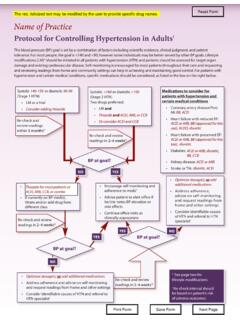
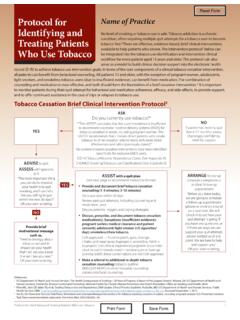
Transcription of Hypertension Control Change Package
1 Plan Act DoStudy A MILLION HEARTS ACTION GUIDE Hypertension Control Change Package Second Edition Authors The Million Hearts Hypertension Control Change Package was originally conceptualized and authored by Hilary K. Wall, MPH*; Rikita Merai, MPH*; Jerome A. Osheroff, MD, FACP, FACMI (TMIT Consulting, LLC); and Brita Roy, MD, MPH, MS (Robert Wood Johnson Foundation clinical Scholars Program at Yale University) in 2015. The 2020 revision was authored by Hilary K. Wall, MPH*; Lauren Owens, MPH (IHRC, Inc.)*; and Kaitlin Graff, MSW, MPH.* Contributors The following individuals contributed subject matter expertise, identified tools and resources, and reviewed the document: Jerome A. Osheroff, MD, FACP, FACMI (TMIT Consulting, LLC); Meg Meador, MPH, C-PHI, CPHQ (National Association of Community Health Centers); Michael Rakotz, MD, FAHA, FAAFP (American Medical Association); and Elizabeth Montgomery (National Kidney Foundation).
2 Reviewers The following individuals provided review and feedback on the document: Joseph Vassalotti, MD (National Kidney Foundation); Laurence Sperling, MD, FACC, FACP, FAHA, FASPC*; Betsy Thompson, MD, MSPH, DrPH, RADM, Public Health Service*; Judy Hannan, RN, MPH*; Salvatore J. Lucido, JD, MPA*; and Mary G. George, MD, MSPH, FACS, FAHA.* Graphic Design and Editorial Assistance Graphic and HTML design support was provided by Booker Daniels, MPH*; Susan Davis (Northrop Grumman Corporation)*; Jessica Spraggins, MPH*; and Palladian Partners, Inc. Website Hosting Assistance Website hosting support of tools and resources was provided by the National Association of Chronic Disease Directors. We would like to extend special thanks to the following organizations for developing the tools and resources that are showcased in the Change Package : Agency for Healthcare Research and Quality (AHRQ) Alexander Valley Healthcare, Cloverdale, CA Altura Centers for Health (previously Tulare Community Health Clinic), Tulare, CA American College of cardiology (ACC) American College of Preventive Medicine (ACPM) American Heart Association (AHA) American Medical Association (AMA) American Medical Group Association (AMGA) American Medical Group Foundation (AMGF) American Society of Health-System Pharmacists ARcare/KentuckyCare, Augusta, AR Association of State and Territorial Health Officials (ASTHO) Beth Israel Deaconess Medical Center, Boston, MA Broadway Internal Medicine, Queens, NY California Health Care Foundation Cardi-OH.
3 Ohio Cardiovascular Health Collaborative Cheshire Medical Center/Dartmouth-Hitchcock, Keene, NH Cigna Cleveland Clinic Community Health Centers, West Valley City, UT Consumer Reports Cornerstone Health Care (now Wake Forest Baptist Health), Winston-Salem, NC Ellsworth Medical Clinic, Ellsworth, WI Esperanza Health Centers, Chicago, IL Exercise is Medicine Family Practice Notebook Food and Drug Administration (FDA) Golden Valley Health Centers, Merced, CA Grace Community Health Center, Gray, KY Green Spring Internal Medicine, Lutherville, MD Health Resources & Services Administration (HRSA) For More Information Hilary K. Wall, MPH Division for Heart Disease and Stroke Prevention Centers for Disease Control and Prevention HealthPartners (previously Park Nicollet), Bloomington, MN Healthy Hearts Northwest HealthyHearts NYC Heart Health Now! North Carolina Cooperative Henry Ford Health System, Detroit, MI HIPxCHANGE Hypertension Canada Institute for Healthcare Improvement (IHI) Intermountain Healthcare, Salt Lake City, UT Jennifer Brull, MD, Post Rock Family Medicine, Plainville, KS Johns Hopkins University Kaiser Permanente Kaiser Permanente Mid Atlantic States Kaiser Permanente Northern California Kaiser Permanente Southern California Kansas Healthcare Collaborative La Maestra Community Health Centers, City Heights, CA Marshfield Clinic Health System, Marshfield, WI Mercy Clinics, Inc.
4 , Des Moines, IA Michael Rakotz, MD, FAHA, FAAFP, Northwestern Medical Group, Chicago, IL (now with AMA) Minnesota Board of Nursing Minnesota Department of Health Move Your Way National Association of Community Health Centers (NACHC) National Heart, Lung, and Blood Institute (NHLBI) National Institute of Diabetes and Digestive and Kidney Diseases (NIDDK) National Kidney Disease Education Program National Kidney Foundation (NKF) Neighborhood Healthcare, San Diego/Riverside Counties, CA New England QIN-QIO New West Physicians, Golden, CO New York City Department of Health and Mental Hygiene (NYC DOHMH) New York City Health & Hospitals (NYC Health & Hospitals) NorthShore Health Centers, Northwest IN Open Door Family Medical Centers, Ossining, NY Penn Medicine Department of OBGYN s Heart Safe Motherhood Program Plymouth Family Physicians, Plymouth, WI Premier Medical Associates, Monroeville, PA Quality Insights (previously West Virginia Medical Institute) Redwood Community Health Coalition, Petaluma, CA Reliant Medical Group, Worcester, MA Rush University Medical Center, Chicago, IL Sanford Health, Sioux Falls, SD Script Your Future Sharp Rees-Stealy Medical Group, San Diego, CA Sinai Urban Health Institute Target.
5 BP The Office of the National Coordinator for Health Information and Technology (ONC) ThedaCare, Northeastern WI Trinity Clinic-Whitehouse, TX University of Texas Medical Branch UVM Medical Center (previously Fletcher Allen Health Care/University of Vermont), Burlington, VT Vermont Department of Health Washington State Department of Health Whitney M. Young, Jr. Health Center, Albany, NY Zufall Health, Dover, NJ Suggested Citation Centers for Disease Control and Prevention. Hypertension Control Change Package (2nd ed.). Atlanta, GA: Centers for Disease Control and Prevention, Department of Health and Human Services; 2020. *Centers for Disease Control and Prevention Million Hearts Hypertension Control Champions are shown in red Contents Hypertension Control Change Package Quick 1 What Is the Hypertension Control Change Package ?..3 Figure 1. Hypertension Control Change Package Focus Areas ..3 What s New in This Version of the Hypertension Control Change Package ?
6 3 Figure 2. Comparison of Blood Pressure Classification Thresholds, JNC 7, and the 2017 ACC/AHA Guideline ..4 How Can I Use the Hypertension Control Change Package ?..5 Figure 3. Institute for Healthcare Improvement (IHI) Model for Improvement ..5 How Do I Measure Quality Improvement Efforts?..7 Figure 4. Example of a Run Chart Grace Community Health Center ..7 Change Concepts, Change Ideas, and Tools and Resources .. 8 Table 1. Key Foundations .. 8 Table 2. Equipping Care Teams .. 12 Table 3. Population Health Management .. 15 Table 4. Individual Patient Supports .. 18 Appendix A: Additional Quality Improvement Resources .. 22 Appendix B: Hypertension Control Case 23 24 References .. 25 Website addresses of nonfederal organizations are provided solely as a service to readers. Provision of an address does not constitute an endorsement for this organization by CDC or the federal government, and none should be inferred. CDC is not responsible for the content of other organizations web pages.
7 Change Package | 1 Hypertension Control Change Package Quick Reference Focus Areas Key Foundations Equipping Care Teams Population Health Management Individual Patient Supports Change Concepts and Change Ideas Key Foundations Make HTN Control a Practice Priority Designate a practice or health system champion, such as a head physician or quality improvement lead Ensure care team engagement in HTN Control Redesign office or exam space to support proper BP measurement technique Provide BP checks without appointment or co-pay Expand the HTN care team with community pharmacists and/or community health workers Implement a Policy or Process to Address BP for Every Patient with HTN at Every Visit Develop HTN Control policies and procedures Develop a flowchart/workflow for proactively tracking and managing patients with HTN Deploy HTN treatment protocols and algorithms Overcome diagnostic and treatment inertia Manage resistant HTN Evaluate all patients with HTN for CKD.
8 Diagnose and treat if appropriate Equipping Care Teams Train and Evaluate Direct Care Staff on Accurate BP Measurement and Documenting Adopt a clinician/staff training policy to train and retrain staff Provide guidance on measuring BP accurately Assess adherence to proper BP measurement technique Equip Direct Care Staff to Facilitate Patient Self-Management Ensure the care team is skilled in supporting patient medication adherence Put a prevention, engagement, and self-management program in place Establish a Self-Measured BP (SMBP) Monitoring Program Assign care team roles for an SMBP monitoring program and adapt the workflow accordingly Provide patients guidance on selecting a home BP monitor Develop a home BP monitor loaner program Train patients on home BP monitor use and proper preparation and positioning Develop a process for handling patient-generated BP readings Prepare the Care Team Beforehand for Effective HTN Management During Office Visits ( , via team huddles, using EHR data)
9 Use a flowchart or dashboard with care gaps highlighted in team huddles to help care teams better support patients Implement pre-visit planning into workflows and use clinical decision support tools to ensure that indicated orders/actions occur during the visit 2 | Hypertension Control Population Health Management Identify Patients with Potentially Undiagnosed HTN Compare practice HTN prevalence to national or local estimates to understand whether you might be missing patients with undiagnosed HTN Establish clinical criteria to define potentially undiagnosed HTN Search EHR data for patients who meet the established clinical criteria Implement a plan to confirm HTN status and treat those with HTN Identify Patients with Potentially Undiagnosed CKD Search EHR data for patients with HTN who have estimated glomerular filtration rate (eGFR) and/or urine albumin-to-creatinine ratio (uACR) test results; if missing one test result, order it.
10 Diagnose and treat if both labs are abnormal Use a Registry to Track and Manage Patients with HTN Implement a HTN registry Use a defined process for outreach ( , via phone, mail, email, text message) to patients with uncontrolled HTN and those otherwise needing follow-up Use Clinician-Managed Protocols for Medication Adjustments and Lifestyle Recommendations Use protocols to cover proactive outreach driven by registry use and respond to patient-submitted home BP readings Use Practice Data to Drive Improvement Determine HTN Control and related process metrics for the practice Regularly provide a dashboard with BP goals, metrics, and performance Individual Patient Supports Prepare Patients Before the Office Visit via Pre-Visit Patient Outreach Contact patients to confirm upcoming appointments and provide instructions on how to prepare for their visit Optimize Patient Intake to Support HTN Management ( , check-in, waiting, rooming) Provide patients with educational materials to help them understand HTN and its implications Provide patients with tools to support their visit agenda and goal setting Measure, document, and repeat BP correctly as indicated; flag abnormal readings Reconcile medications patient is actually taking with the EHR medication list Optimize the Patient Clinician Encounter ( , documentation, orders, education/engagement) Use documentation templates to help capture key data such as patient treatment goals and barriers to adherence Use order sets and standing orders to support evidence-based and individualized care Assess individual risk and counsel using motivational interviewing techniques.