Transcription of i HUMAN ALL-TOO-HUMAN
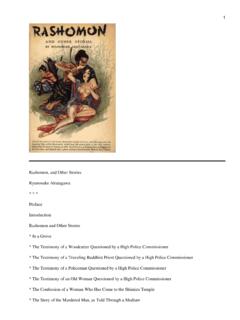
1 FRIEDRICH NIETZSCHEi HUMAN ALL-TOO-HUMANA BOOK FOR FREE SPIRITS P A R T Iif* BYHELEN ZIMMERNWITH INTRODUCTION BYJ. M. KENNEDYT. N. FOULIS 13 & 15 FREDERICK STREET EDINBURGH: a n d LONDON 1910 ALL RIGHTS RESERVEDP rinted, by Mo rriso n & Gib b Lim it e d, EIn t r o d u c t i o n - - - - viiAuthor s Preface - - - iFirst Division: First and Last Things - 13 Second Division : The History of the Moral Sentiments - - - - 53 Third Division: The Religious Lif e- h iI F o u r th D ivisio n : C o n ce rn in g t h e S o u l o f 1 A r t is t s and A u t h o r s - - - - 153 Fifth Division.
2 The Signs of Higher and Lower Culture - - - -207( Sixth Division : Man in Society - - 267 _Seventh Division : Wife and Child - - 295 Eighth Division: A Glance at the State - 317 ^Ninth Division: Man alone by Himself - 355 An Epode Among Friends - - 409247073A; S essay, R ichard Wagner in Bayreuth, appeared in 1876, and his next publication was his present work, which was issued in 1878. A comparison of the books will show that the two years of meditation intervening had brought about a great change in Nietzsche s views, his style of expressing them, and the form in which they werecast.)
3 The Dionysian, overflowing with life, givesway to an Apollonian thinker with a touch of j pessimism. The long essay form is abandoned, and instead we have a series of aphorisms, some tinged with melancholy, others with satire, several, especially towards the end, with Nietzschian wit at its best, and a few at the beginning so very abstruse as to require careful the Bayreuth festivals of 1876, Nietzsche had gradually come to see Wagner as he really was. The ideal musician that Nietzsche had pic tured in his own mind turned out to be nothing more than a rather dilettante philosopher, an opportunistic decadent with a suspicious tendency towards Christianity.
4 The young philosopher thereupon proceeded to shake off the influence which the musician had exercised upon him. He was successful in doing so, but not without , just as he had formerly shaken off the influence of Schopenhauer. Hence he writes in his autobiography# HUMAN , all-too-Hum an, is the monument of a crisis. It is entitled: A book for fr e e spirits/ and almost every line in it represents a victory in its pages I freed myself from everything foreign to my real nature.
5 Ideal ism is foreign to m e: the title says, Where you see ideal things, I see things which are only HUMAN alas ! ALL-TOO-HUMAN ! I know man better the term free spirit must here be understood in no other sense than this: a fr e e d man, who has once more taken possession of himself. The form of this book will be better under stood when it is remembered that at this period Nietzsche was beginning to suffer from stomach trouble and headaches. As a cure for his com plaints, he spent his time in travel when he could get a few weeks respite from his duties at Basel University ; and it was in the course of his solitary walks and hill-climbing tours that the majority of these thoughts occurred to him and were jotted down there and then.
6 A few of them, however, date further back, as he tells us in the preface to the second part of this work. Many of them, he says, occupied his mind even before he published his first book, The B irth o f Tragedy, and several others, as we learn from his notebooks and post humous writings, date from the period of the Thoughts out o f must be clearly understood, however, that* Ecce Homo, p. s disease must not be looked upon in the same way as that of an ordinary man.
7 People are inclined to regard a sick man as rancorous; but any one who fights with and conquers his disease, and even exploits it, as Nietzsche did, benefits thereby to an extraordinary degree. In the first place, he has passed through several stages of HUMAN psychology with which a healthy man is entirely unacquainted; eg. he has learnt by introspection the spiteful and revengeful spirit of the sick man and his religion. Secondly, in his moments of freedom from pain and gloom his thoughts will be all the more support of this last statement, one instance may be selected out of hundreds that could be adduced.
8 Heinrich Heine spent the greater part of his life in exile from his native country, tortured by headaches, and finally dying in a foreign land as the result of a spinal disease. His splendid works were composed in his moments of respite from illness, and during the last years of his life, when his health was at its worst, he gave to the world his famous Romancero. We would likewise do well to recollect Goethe s saying:Zart Gedicht, wie Regenbogen,Wird nur auf dunkelm Grund gezogen.
9 *Thus neither the form of this book so startling at first to those who have been brought up in the traditions of our own school nor the* Tender poetry, like rainbows, can appear only on a dark and sombre background. J. M. that the writer was in poor health (the average Englishman may be reminded that there may be mens nulla in corpore sand) should deter us from perusing it as carefully as we can. We may be sure of an adequate reward; for here no abstract philosopher is discoursing, no harmless dealer in isms and ologies but a man of the world, who had previously to writing come into contact with some of the best men and women of his tim e; who had travelled a great deal, and especially in the south; and who had finally even reached the much-beloved home of all great Germans: Ancient Greece.
10 From Greece Nietz sche brought back his standard measure, his infallible scales, which may be compared to those of the Goddess of Justice, and in which modern institutions, parliaments, states, and religions were weighed by him, found wanting, and severely Hellenism, however, an ideal suitable for everybody ? Does not a commercial country like ours still stand in need of the earnest gloom of Puritanism rather than of the dazzling sun of Hel lenic beauty ? The darker and more strict creed has at least the advantage of keeping men in the narrow path leading to duty and honesty, and may help to turn them away from the success-at- all-costs hunt; while, on the other hand, the more HUMAN and beautiful ideal, if preached to the wrong congregation, may destroy the smaller virtues of Christianity and render it impossible to rear the higher virtues of Hellenism in its stead.