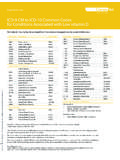
Transcription of ICD-10 diagnostic codes consistent with ORBACTIV ...
1 ICD-10 -CM Diagnosis susceptible staphylococcus aureus, unspecifi ed resistant staphylococcus aureus infection, unspecifi ed aureus as the cause of diseases classifi ed elsewhere (methicillin resistant) aureus as the cause of diseases classifi ed elsewhere (methicillin susceptible) ed staphylococcus as the cause of diseases classifi ed infection, unspecifi ed , , as the cause of disease classifi ed elsewhereOther , , local infections of skin and subcutaneous of and abscess of of orbit, abscess of Cellulitis of external and abscess of external of of upper of axilla and upper of fi ngerN61 Infl ammatory disorders of breast (includes cellulitis/abscess breast)
2 , of of of unspecifi ed part of of lower of corpus cavernosum and of of other , unspecifi edPlease see reverse for Important Safety diagnostic codes consistent with the ORBACTIV (oritavancin) IndicationINDICATION ORBACTIV (oritavancin) for injection is indicated for the treatment of adult patients with acute bacterial skin and skin structure infections (ABSSSIs) caused or suspected to be caused by susceptible isolates of the following Gram-positive microorganisms: Staphylococcus aureus (including methicillin-susceptible [MSSA] and -resistant [MRSA] isolates), Streptococcus pyogenes, Streptococcus agalactiae, Streptococcus dysgalactiae, Streptococcus anginosus group (includes S.)
3 Anginosus, S. intermedius, and S. constellatus), and Enterococcus faecalis (vancomycin-susceptible isolates only).Please see reverse for Important Safety Information.(oritavancin)for injection 1200 mgOrbactiv 2018 Melinta Therapeutics, Inc. All rights reserved. 7/2018 PP-ORB-US-0353 IMPORTANT SAFETY INFORMATIONC ontraindications Use of intravenous unfractionated heparin sodium is contraindicated for 120 hours (5 days) after ORBACTIV administration because the activated partial thromboplastin time (aPTT) test results are expected to remain falsely elevated for approximately 120 hours (5 days) after ORBACTIV is contraindicated in patients with known hypersensitivity to ORBACTIV .
4 Warnings and Precautions Coagulation test interference: ORBACTIV has been shown to artifi cially prolong aPTT for up to 120 hours, and may prolong PT and INR for up to 12 hours, and ACT for up to 24 hours. ORBACTIV has also been shown to elevate D-dimer concentrations up to 72 hours. Hypersensitivity reactions have been reported with the use of antibacterial agents including ORBACTIV . Discontinue infusion if signs of acute hypersensitivity occur. Monitor closely patients with known hypersensitivity to Related Reactions: Administer ORBACTIV over 3 hours to minimize infusion-related reactions. Stopping or slowing the infusion may result in cessation of these reactions.
5 Clostridium di cile-associated diarrhea: Evaluate patients if diarrhea warfarin use: ORBACTIV has been shown to artifi cially prolong PT and INR for up to 12 hours. Patients should be monitored for bleeding if concomitantly receiving ORBACTIV and : Institute appropriate alternate antibacterial therapy in patients with confi rmed or suspected ORBACTIV in the absence of a proven or strongly suspected bacterial infection is unlikely to provide benefi t to the patient and increases the risk of development of drug-resistant Reactions The most common adverse reactions ( 3%) in patients treated with ORBACTIV were headache, nausea, vomiting, limb and subcutaneous abscesses, and see accompanying Full Prescribing Information.
6 (oritavancin)for injection 1200 mgOrbactiv abscess of and furuncle of eyelid of external abscess of abscess of axilla and upper abscess of abscess of abscess of abscess of limb, unspecifi abscess of lower abscess of of corpus cavernosum and of of anal and rectal abscess of other abscess, unspecifi of of of axilla, upper of of of of limb, unspecifi of lower of of other , unspecifi of and furuncle of external of of axilla, upper of of of of limb, unspecifi of lower of of other , unspecifi edThis resource identifi es diagnosis codes that are likely to be most relevant to healthcare provider claims for the administration of ORBACTIV .
7 Billing and coding information is illustrative and is not intended to assist providers in obtaining reimbursement for any specifi c claim. Healthcare providers are responsible for selecting appropriate codes for in the submission of claims consistently with health plan requirements and applicable standards of care. Actual clinical diagnosis and coding should be done to the highest level of specifi city based on the patient s condition and the items and services that are actually diagnostic codes (continued) 1 HIGHLIGHTS OF PRESCRIBING INFORMATION These highlights do not include all the information needed to use ORBACTIV safely and effectively.
8 See full prescribing information for ORBACTIV . ORBACTIV (oritavancin) for injection, for intravenous use Initial Approval: 2014 _____ RECENT MAJOR CHANGES _____ Warnings and Precautions ( ) 3/2018 _____ INDICATIONS AND USAGE _____ ORBACTIV is a lipoglycopeptide antibacterial drug indicated for the treatment of adult patients with acute bacterial skin and skin structure infections caused or suspected to be caused by susceptible isolates of designated Gram-positive microorganisms. ( ) To reduce the development of drug-resistant bacteria and maintain the effectiveness of ORBACTIV and other antibacterial drugs, ORBACTIV should be used only to treat infections that are proven or strongly suspected to be caused by susceptible bacteria.
9 ( ) _____ DOSAGE AND ADMINISTRATION _____ A 1200 mg single dose is administered by intravenous infusion over 3 hours. ( ) _____ DOSAGE FORMS AND STRENGTHS _____ For injection: 400 mg of lyophilized powder in a single-use vial for reconstitution. (3) _____ CONTRAINDICATIONS _____ Use of intravenous unfractionated heparin sodium is contraindicated for 120 hours (5 days) after ORBACTIV administration. ( , ) Known hypersensitivity to ORBACTIV ( , ) _____ WARNINGS AND PRECAUTIONS _____ Coagulation test interference: ORBACTIV has been shown to artificially prolong aPTT for up to 120 hours, and may prolong PT and INR for up to 12 hours and ACT for up to 24 hours.
10 For patients who require aPTT monitoring within 120 hours of ORBACTIV dosing, consider a non-phospholipid dependent coagulation test such as a Factor Xa (chromogenic) assay or an alternative anticoagulant not requiring aPTT. ( , ) Hypersensitivity reactions have been reported with the use of antibacterial agents including ORBACTIV . Discontinue infusion if signs of acute hypersensitivity occur. Monitor closely patients with known hypersensitivity to glycopeptides. ( ) Infusion Related Reactions: Administer ORBACTIV over 3 hours to minimize infusion-related reactions. Stopping or slowing the infusion may result in cessation of these reactions.