Transcription of ICD-10 Quick Start Guide - CMS
1 Make a Plan1 Assign target dates for completing steps outlined hereH Obtain access to ICD- 10 codes . The codes are available from many sources and in many formats: Decide role(s) your clearinghouse(s) will play in your transition. Some providers and payers who are not ready could benefit from contracting with a clearinghouse to submit claims: l Clearinghouses can help by: m Identifying problems that lead to claims being rejected m Providing guidance about how to fix rejected claims ( , more or different data need to be included) l Clearinghouses cannot help you code in ICD-10 unless they offer third-party billing/coding services l code books l CD/DVD and other digital media l Online ( , go to and select 2016 ICD-10 -CM and GEMS to download 2016 code Tables and Index) l Practice management systems l Electronic health record (EHR)
2 Products l Smartphone appsThis Guide outlines 5 steps health care professionals can take to switch to ICD-10 . You may have completed some steps already as part of your transition, and you can combine or skip steps if that works best for your practice. ICD-10 Effective Date: October 1, 2015 ICD-10 Quick Start GuideICD- 10 codes for all services provided on or after October 1 ICD-9 codes for all services provided before October 1 You must use:Train Your Staff2H Identify top codes. What ICD-9 diagnosis codes does your practice see most often?
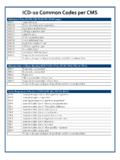
3 Target the top 25 to Start . You might want to look at common diagnosis codes available from medical specialty societies. Using the documentation available, code current cases in ICD-10 . Flag any cases where more documentation is needed. l Medical societies, health care professional associationsl Hospitals, health systems, health plans, vendors Train staff on ICD-10 fundamentals using the wealth of free resources from CMS, which include the ICD-10 website, Email Updates, National Provider Calls, and webinars. Free resources are also available from:= Crucial activityH1 Update Your Processes3H Update hard-copy and electronic forms ( , superbills, CMS 1500 forms) Resolve any documentation gaps identified while coding top diagnoses in ICD-10 Make sure clinical documentation captures key new coding concepts.
4 L Laterality or left versus right l Initial or subsequent encounter for injuries l Trimester of pregnancy l Details about diabetes and related complications l Types of fracturesTry Your Systems and Processes5H Try using your ICD-10 -ready systems to: l Generate a claiml Perform eligibility and benefits verificationl Schedule an office visitl Schedule an outpatient procedure l Prepare to submit quality datal Update a patient s history and problemsl code a patient encounterTalk to Your Vendors and Health Plans4H Call your vendors to confirm the ICD-10 readiness of your practice s systems Confirm that the health plans, clearinghouses, and third-party billing services you work with are ICD-10 readyTo learn more about getting ready.
5 Visit for free CMS Industry Resources for the ICD-10 If your systems are not ready, use alternate ways to submit ICD-10 claims. l Free billing software available from every MAC websitel Part B claims submission by online provider portal (in about of MAC jurisdictions) l Paper claims for providers who meet Administrative Simplification Compliance Act Waiver requirementsEach of these options requires you to code in ICD-10 For Medicare providers, options include:Ask other health plans you work with about the options they offer.