Transcription of ICSE SEMESTER 2 EXAMINATION SPECIMEN QUESTION …
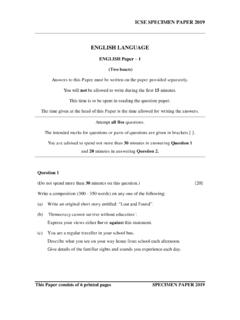
1 T22 522 S2 SPECIMEN 1 of 6 ICSE SEMESTER 2 EXAMINATION SPECIMEN QUESTION PAPER CHEMISTRY (SCIENCE PAPER 2) Maximum Marks: 40 Time allowed: One and a half hours Answers to this Paper must be written on the paper provided separately. You will not be allowed to write during the first 10 minutes. This time is to be spent in reading the QUESTION paper. The time given at the head of this Paper is the time allowed for writing the answers. Attempt all questions from Section A and any three questions from Section B.
2 The intended marks for questions or parts of questions are given in brackets [ ]. SECTION A (Attempt all questions.) QUESTION 1 Choose the correct answers to the questions from the given options. (Do not copy the QUESTION , Write the correct answer only.) [10] (i) The IUPAC name of Ethylene is: (a) Propane (b) Propyne (c) Ethene (d) Ethyne (ii) Carbon to carbon double bond is found in: (a) 2- butylene (b) Acetaldehyde (c) Acetic acid (d) Ethyl alcohol T22 522 S2 SPECIMEN 2 of 6 (iii) Fused alumina is reduced to aluminium by electrolytic reduction, since: (a) Alumina is highly stable (b) Alumina is least stable (c) Alumina is not reduced by drying agents.
3 (d) Alumina is not reduced by reducing agents. (iv) The catalyst preferred in the conversion of Sulphur dioxide to Sulphur trioxide is: (a) Finely divided iron (b) Graphite (c) Vanadium pentoxide (d) platinum (v) Substitution reaction is a characteristic property of: (a) Alcohols (b) Alkanes (c) Alkenes (d) Alkynes (vi) The gas evolved when dilute sulphuric acid reacts with iron sulphide: (a) Sulphur dioxide (b) Carbon dioxide (c) Hydrogen sulphide (d) Nitrogen dioxide (vii) An acid obtained from concentrated nitric acid on reaction with Sulphur: (a) Carbonic acid (b) Sulphuric acid (c) Nitric acid (d) Hydrochloric acid T22 522 S2 SPECIMEN 3 of 6 (viii) The hydroxide soluble in excess of ammonium hydroxide is: (a) zinc hydroxide (b) Lead hydroxide (c) Magnesium hydroxide (d) Ferrous hydroxide (ix) The chemical name of the principal ore of aluminium.
4 (a) Sodium aluminium fluoride (b) Aluminium oxide (c) Hydrated Aluminium fluoride (d) Hydrated aluminium oxide (x) A hydrocarbon which is a greenhouse gas. (a) Acetylene (b) Ethylene (c) Ethane (d) Methane SECTION B (Attempt any three questions from this Section.) QUESTION 2 (i) Define: [2] (a) Catenation (b) Alloy (ii) Name the compound formed when: [2] (a) Ethene reacts with hydrogen in the presence of a catalyst.
5 (b) Bauxite reacts with sodium hydroxide (iii) Draw the structural diagram of: [3] (a) Propanal (b) Ethanoic acid (c) 1,2 dichloroethane T22 522 S2 SPECIMEN 4 of 6 (iv) Complete and balance the following chemical equations: [3] (a) C2H6 + O2 (b) C2H2 + I2 (c) NH3 + HCl QUESTION 3 (i) Identify the anion present in the following compounds. [2] (a) Compound Z which on reacting with dilute sulphuric acid liberates a gas which has no effect on acidified potassium dichromate but turns lime water milky.
6 (b) The solution of Compound L on reacting with freshly prepared ferrous sulphate solution followed by addition of few drops of concentrated sulphuric acid to the reactants along the sides of a test tube forms a brown ring at the junction of the two liquids. (ii) State the following: [2] (a) The drying agent used in the laboratory preparation of HCl gas. (b) Products formed when ammonia is burnt in excess of oxygen. (iii) State the observation for the following, when: [3] (a) Manganese dioxide reacts with concentrated HCl.
7 (b) A glass rod dipped in concentrated HCl acid is brought near ammonia gas. (c) Concentrated sulphuric acid is added to carbon. (iv) Write balanced equation for the following conversions: [3] (a) Lead sulphate from lead nitrate and sulphuric acid. (b) Nitrogen tri chloride from ammonia. (c) Sodium chloride from sodium sulphite and dilute hydrochloric acid. QUESTION 4 (i) State the relevant reason for the following: [2] (a) A layer of powered coke is used over the electrolytic mixture in Hall Heroult s process.
8 (b) Graphite anodes are continuously replaced during the electrolysis of alumina. T22 522 S2 SPECIMEN 5 of 6 (ii) Name the alloys for the given composition: [2] (a) Magnesium and aluminium (b) Magnesium + Manganese + Aluminium + Copper (iii) Identify the terms for the following: [3] (a) The experiment which demonstrates high solubility of ammonia gas. (b) A method used to collect HCl gas. (c) The electrode where reduction takes place.
9 (iv) Complete the table given below: [3] Name of the process Reactants Acid product formed (a) _____ Nitrogen dioxide + water + oxygen (b) _____ (c) _____ Oleum + water Sulphuric acid QUESTION 5 (i) Write the balanced chemical equation to show the concentration of ore in Baeyer s process. [2] (a) Sodium aluminate to aluminium hydroxide (b) Aluminium hydroxide to alumina (ii) Select the correct answer from the brackets to complete the following statements: [2] (a) The catalyst used in the oxidation of ammonia is _____ [ zinc / platinum].
10 (b) The product formed when ammonia reacts with oxygen is _____ [nitric oxide / nitrous oxide] (iii) Name the following organic compound: [3] (a) The compound with 3 carbon atoms whose functional group is a carboxylic acid. (b) The first homologue whose general formula is CnH2n. (c) The compound formed by complete chlorination of ethyne. (iv) Answer the following questions related to the laboratory preparation of the hydrogen chloride gas: [3] (a) Why is sodium chloride preferred to other metallic chlorides?