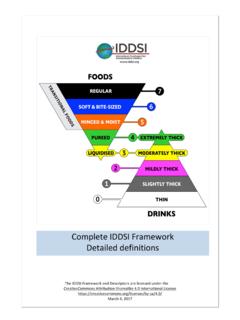
Transcription of IDDSI Consumer Handouts General info
1 About the IDDSI Consumer Handouts IDDSI has created these Handouts in consultation with clinicians and patients. The Handouts can be used by people who have feeding, chewing or swallowing problems, their caregivers and clinicians. There are separate Handouts that have been designed for adults, and Handouts that have been designed for use with babies and children. The Handouts provide easy-to-read information about the IDDSI levels and their testing methods. The food levels also include examples of foods for each level, and food textures to avoid. Some Handouts have only one page and others have 3 or 4 pages. The table below provides a list of the Handouts and the number of pages for each handout. Consumer Handouts for adults and their carers Consumer Handouts for babies and children and their carers General General Back page 1 page General Back page 1 page FAQ when to move from baby and child food piece sizes to adult food piece sizes 1 page Drinks Level 0 Thin 1 page Level 0 - Thin 1 page Level 1 Slightly Thick 1 page Level 1 Slightly Thick 1 page Level 2 - Mildly Thick 1 page Level 2 - Mildly Thick 1 page Level 3 - Moderately Thick 1 page Level 3 - Moderately Thick 1 page Level 4 - Extremely Thick 1 page Level 4 - Extremely Thick 1 page food Level 3 Liquidised 1 page Level 3 Liquidised 1 page Level 4 Pureed General information food textures to avoid 2 pages Level 4
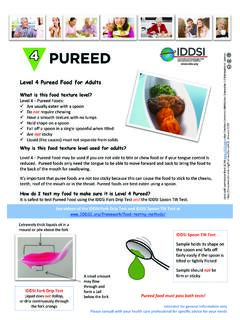
2 Pureed General information food textures to avoid 2 pages Level 5 - Minced & Moist General information Examples of for this level food textures to avoid for this level 3 pages Level 5 - Minced & Moist General information Examples of for this level food textures to avoid for this level 3 pages Level 6 - Soft & Bite-Sized General information Examples of for this level food textures to avoid for this level 3 pages Level 6 - Soft & Bite-Sized General information Examples of for this level food textures to avoid for this level 3 pages Level 7- Easy to Chew General information Examples of for this level food textures to avoid for this level 4 pages, 3 files Level 7 - Easy to Chew General information Examples of for this level food textures to avoid for this level 4 pages, 3 files Level 7 - Regular 1 page Level 7 - Regular 1 page Transitional food 1 page Transitional food 1 page Use of Level 0 Thin Liquids for Adults What is this thickness level?
3 Level 0 - Thin drinks: Flow like water Can flow through a straw or teat/nipple Why is this thickness level used for adults? Level 0 Thin liquids are most often used if you do not have a swallowing problem with liquids. Water, milk, tea, coffee, and juice are all examples of the Level 0 Thin thickness level. Thin liquids can be taken through a straw or standard cup. How do I measure my liquid or drink to make sure it is Level 0 Thin? It is safest to measure the thickness using the IDDSI Flow Test. The IDDSI Flow Test measures how thick a liquid is by how much goes through a 10mL syringe in 10 seconds. IDDSI recommends that you use a 10 mL syringe to check to make sure you have the correct thickness level using the instructions below.
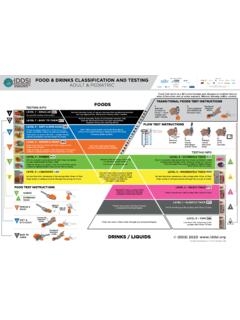
4 For Level 0 Thin thickness liquids, there should be less than 1 mL remaining in the syringe after 10 seconds of flow. See videos of the IDDSI Flow Test at IDDSI FLOW TEST INSTRUCTIONS Before you You must check your syringe length because there are differences in syringe lengths. Your syringe should look like this IDDSI Flow Test Intended for General information only. Please consult with your health care professional for specific advice for your needs Use of Level 1 Slightly Thick Liquids for Adults What is this thickness level? Level 1 - Slightly Thick drinks: Are thicker than water Can flow through a straw Why is this thickness level used for adults? Level 1 Slightly Thick is most often used if you have swallowing problems with thin liquids.
5 Slightly Thick liquids are thicker than water, but still thin enough to flow through a straw. Some drinks may naturally be slightly thick (like some fruit nectars or milks). Thin liquids like water, milk, tea, coffee, juice and others may need to be thickened to the Slightly Thick level. Your clinician will help you find a thickener to help thicken your drinks, or help you find some pre-thickened drinks. Slightly Thick drinks can be taken using a straw or from a standard cup. How do I measure my liquid or drink to make sure it is Level 1 Slightly Thick? It is safest to measure the thickness using the IDDSI Flow Test. The IDDSI Flow Test measures how thick a liquid is by how much goes through a 10 mL syringe in 10 seconds.
6 IDDSI recommends that you use a 10 mL syringe to check to make sure you have the correct thickness level using the instructions below. For Level 1- Slightly Thick liquids, there should be 1-4 mL remaining in the syringe after 10 seconds of flow. Your clinician may give you a specific number between 1-4 mL to aim for. See videos of the IDDSI Flow Test at IDDSI FLOW TEST INSTRUCTIONS Before you You must check your syringe length because there are differences in syringe lengths. Your syringe should look like this IDDSI Flow Test Intended for General information only. Please consult with your health care professional for specific advice for your needs Use of Level 2 Mildly Thick Liquids for Adults What is this thickness level?
7 Level 2 - Mildly Thick liquids: Are sippable Pour quickly from a spoon but slower than Thin drinks and Slightly Thick drinks Need some effort to drink this thickness using a standard straw Why is this thickness level used for adults? Level 2 Mildly Thick drinks may be used if Thin drinks (water, milk, and others) and Level 1 Slightly Thick liquids flow too quickly for you to swallow them safely. Some milk shakes and thick shakes may be this thickness level already, but other drinks may need thickener added to reach the correct thickness level. Use the IDDSI testing methods below to check. Mildly Thick drinks flow at a slower rate. Your clinician will help you find a thickener to thicken your drinks or help you find some pre-thickened drinks.
8 Mildly Thick can be taken using a straw or from a standard cup. How do I measure my liquid or drink to make sure it is Level 2 Mildly Thick? It is safest to measure the thickness using the IDDSI Flow Test. The IDDSI Flow Test measures how thick a liquid is by how much goes through a 10 mL syringe in 10 seconds. IDDSI recommends that you use a 10 mL syringe to check to make sure you have the correct thickness level using the instructions below. For Level 2- Mildly Thick liquids, there should be 4-8 mL remaining in the syringe after 10 seconds of flow. Your clinician may give you a specific number between 4-8 mL to aim for. IDDSI Flow Test See videos of the IDDSI Flow Test at IDDSI FLOW TEST INSTRUCTIONS Before you You must check your syringe length because there are differences in syringe lengths.
9 Your syringe should look like this IDDSI Flow Test Intended for General information only. Please consult with your health care professional for specific advice for your needs Use of Level 3 Liquidised food for Adults What is this thickness level? Level 3 Liquidised food : Can be eaten with a spoon or drunk from a cup Cannot be eaten with a fork because it drips through the fork prongs Has a smooth texture with no bits (lumps, fibers, husk, bits of shell or skin, particles of gristle or bone) Why is this thickness level used for adults? Level 3- Liquidised foods may be used if you have trouble moving your tongue. The thicker consistency gives more time for the tongue to hold and move the liquidised food .
10 It is easiest to eat liquidised food with a spoon. Seek help about nutrition when using this texture to be sure you are getting the right amount of nutrition to meet your needs. How do I measure my liquid or drink to make sure it is Level 3 Liquidised? It is safest to measure the thickness of Liquidised food using the IDDSI Flow Test and the IDDSI Fork Test. These tests measure how thick a liquid is by how fast it flows through a 10 mL syringe in 10 seconds and how quickly it flows through the prongs of a dinner fork. IDDSI recommends that you use a 10 mL syringe to check to make sure you have the correct thickness level using the instructions below. For Level 3 Liquidised foods there should be no less than 8 mL remaining in the syringe after 10 seconds of flow.