Transcription of IDEAL Discharge Planning Overview, Process, and Checklist
1 Guide to Patient and Family Engagement :: 1 IDEAL Discharge Planning overview , process , and Checklist Evidence for engaging patients and families in Discharge Planning Nearly 20 percent of patients experience an adverse event within 30 days of , 2 Research shows t hat three-quarters of these could have been prevented or Common post- Discharge complications include adverse drug events, hospital-acquired infections, and procedural Many of these complications can be attributed to Discharge Planning problems, such as: Changes or discrepancies in medications before and after discharge3, 4 Inadequate preparation for patient and family related to medications, danger signs, or lifestyle changes3,4,5 Disconnect between clinician information-giving and patient understanding3 Discontinuity between inpatient and outpatient providers3 Involving the patient and family in Discharge Planning can improve patient outcomes, reduce unplanned readmissions, and increase patient , 7 More and more, hospitals are focusing on transitions in care as a way to improve hospital quality and safety.
2 As one indicator of this, the Centers for Medicare and Medicaid Services implemented new guidelines in 2012 that reduce payment to hospitals exceeding their expected readmission rates. To improve quality and reduce preventable readmissions, [insert hospital name] will use the Agency for Healthcare Research and Quality s Care Transitions from Hospital to Home: IDEAL Discharge Planning tools to engage patients and families in preparing for Discharge to home. Key elements of IDEAL Discharge Planning Include the patient and family as full partners in the Discharge Planning process . Discuss with the patient and family five key areas to prevent problems at home: 1. Describe what life at home will be like 2. R eview medications 3. Highlight warning signs and problems 4. Explain test results 5. Make followup appointments Educate the patient and family in plain language about the patient s condition, the Discharge process , and next steps throughout the hospital stay.
3 Assess how well doctors and nurses explain the diagnosis, condition, and next steps in the patient s care to the patient and family and use teach back. Listen to and honor the patient s and family s goals, preferences, observations, and concerns. This process will include at least one meeting to discuss concerns and questions with the patient, family of their choice, and [identify staff]. What does this mean for clinicians? We expect all clinicians to: Incorporate the IDEAL Discharge elements in their work Make themselves available to the [identify staff] who will work closely with the patient and family Take part in trainings on the process Guide to Patient and Family Engagement :: 2 How do you implement IDEAL Discharge Planning ? Each part of IDEAL Discharge Planning has multiple components: Include the patient and family as full partners in the Discharge Planning process .
4 Always include the patient and family in team meetings about Discharge . Remember that Discharge is not a one-time event but a process that takes place throughout the hospital stay. Identify which family or friends will provide care at home and include them in conversations. Discuss with the patient and family five key areas to prevent problems at home. 1. Describe what life at home will be like. Include the home environment, support needed, what the patient can or cannot eat, and activities to do or avoid. 2. Review medications. Use a reconciled medication list to discuss the purpose of each medicine, how much to take, how to take it, and potential side effects. 3. Highlight warning signs and problems. Identify warning signs or potential problems. Write down the name and contact information of someone to call if there is a problem.
5 4. Explain test results. Explain test results to the patient and family. If test results are not available at Discharge , let the patient and family know when they should get the results and identify who they should call if they have not gotten results by that date. 5. Make followup appointments. Offer to make followup appointments for the patient. Make sure that the patient and family know what followup is needed. Educate the patient and family in plain language about the patient s condition, the Discharge process , and next steps at every opportunity throughout the hospital stay. Getting all the information on the day of Discharge can be overwhelming. Discharge Planning should be an ongoing process throughout the stay, not a one-time event. You can: Elicit patient and family goals at admission and note progress toward those goals each day Involve the patient and family in bedside shift report or bedside rounds Share a written list of medicines every morning Go over medicines at each administration: What it is for, how much to take, how to take it, and side effects Encourage the patient and family to take part in care practices to support their competence and confidence in caregiving at home Assess how well doctors and nurses explain the diagnosis, condition, and next steps in the patient s care to the patient and family and use teach back.
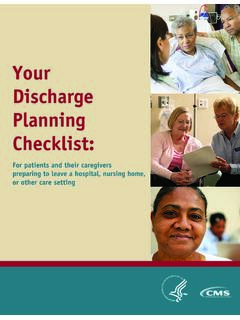
6 Provide information to the patient and family in small chunks and repeat key pieces of information throughout the hospital stay Ask the patient and family to repeat what you said back to you in their own words to be sure that you explained things well Listen to and honor the patient and family s goals, preferences, observations, and concerns. Invite the patient and family to use the white board in their room to write questions or concerns Ask open-ended questions to elicit questions and concerns. Use Be Prepared to Go Home Checklist and Booklet (Tools 2a and 2b) to make sure the patient and family feel prepared to go home Schedule at least one meeting specific to Discharge Planning with the patient and family caregivers Guide to Patient and Family Engagement :: 3 IDEAL Discharge Planning process The elements of the IDEAL Discharge Planning process are incorporated into our current Discharge .
7 The information below describes key elements of the IDEAL Discharge from admission to Discharge to home. Note that this process includes at least one meeting between the patient, family, and Discharge planner to help the patient and family feel prepared to go home. Initial nursing assessment Daily Identify the caregiver who will be at home along with potential back-ups. These are the individuals who need to understand instructions for care at home. Do not assume that family in the hospital will be caregivers at home. Let the patient and family know that they can use the white board in the room to write questions or concerns. Elicit the patient and family s goals for when and how they leave the hospital, as appropriate. With input from their doctor, work with the patient and family to set realistic goals for their hospital stay.
8 Inform the patient and family about steps in progress toward Discharge . For common procedures, create a patient handout, white board, or poster that identifies the road map to get home. This road map may include things like I can feed myself or I can walk 20 steps. Educate the patient and family about the patient s condition at every opportunity, such as nurse bedside shift report, rounds, vital status check, nurse calls, and other opportunities that present themselves. Use teach back. Who: All clinical staff Explain medicines to the patient and family (for example, print out a list every morning) and at any time medicine is administered. Explain what each medicine is for, describe potential side effects, and make sure the patient knows about any changes in the medicines they are taking. Use teach back. Who: All clinical staff Discuss the patient, family, and clinician goals and progress toward Discharge .
9 Once goals are set at admission, revisit these goals to make sure the patient and family understand how they are progressing toward Discharge . Who: All clinical staff Involve the patient and family in care practices to improve confidence in caretaking after Discharge . Examples of care practices could include changing the wound dressing, helping the patient with feeding or going to the bathroom, or assisting with rehabilitation exercises. Who: All clinical staff Guide to Patient and Family Engagement :: 4 Prior to Discharge Planning meeting When: 1 to 2 days before Discharge Planning meeting. For short stays, this meeting may occur at admission. Give the patient and family Tools 2a and 2b: Be Prepared to Go Home Checklist and Booklet. Who: Hospital to identify staff person to distribute, for example a nurse, patient advocate, or Discharge planner.
10 Schedule Discharge Planning meeting with the patient, family, and hospital staff. Who: Hospital to identify staff person to distribute, for example a nurse, patient advocate, or Discharge planner. Discharge Planning meeting Day of Discharge When: 1 to 2 days before Discharge , earlier for more extended stays in the hospital Use the Tools 2a and 2b: Be Prepared to Go Home Checklist and Booklet as a starting point to discuss questions, needs, and concerns going home. If the patient or family did not read or fill out the Checklist , review it verbally. Make sure to ask if they have questions or concerns other than those listed. You can start the dialogue by asking, What will being back home look like for you? Repeat the patient s concerns in your own words to make sure you understand. Use teach back to check if the patient understands the information given.