Transcription of IMPLEMENTING SAMHSA EVIDENCE-BASED PRACTICE …
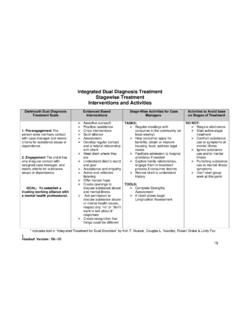
1 This is a DRAFT summary of evidence supporting the IDDT model. It is one of a series ofevidence summaries CIMH is SAMHSA EVIDENCE-BASED PRACTICE TOOLKITSI ntegrated Dual diagnosis treatment (IDDT)Brief description of the practiceTarget group:The IDDT Toolkit is designed to assist persons with both a severe mental illness and a serioussubstance abuse problem. No materials in the Toolkit focus on older adults or youth or othersubpopulations such as those with extensive criminal justice histories or persons who arehomeless. The Toolkit is not diagnosis specific, though studies in the evidence -base do focus onparticular diagnostic components:Integrated treatment basically means that both psychiatric and substance abuse treatment areprovided at the same time, at the same place, and by the same team. Specific IDDT componentsare listed in the fidelity scale and include1 Team: Case managers, psychiatrist, nurses, residential staff, andvocational specialists work collaboratively on mental health treatment team1b.
2 Integrated Substance Abuse Specialist: Substance abuse specialist workscollaboratively with the treatment team, modeling IDDT skills and training other staff inIDDT2. Stage-Wise Interventions: treatment consistent with each client s stage of recovery(engagement, motivation, action, relapse prevention)3. Access for IDDT Clients to Comprehensive DD Services: Includes residentialsupported employment, illness management and recovery and ACT or Time-Unlimited Services: Unlike many substance abuse programs, services are intendedto be : Assistance in the community with housing, medical care, crisis managementand legal Motivational Interventions: Clinicians who treat IDDT clients use techniques toincrease motivation to change and reduce Substance Abuse Counseling: Clients who are in the action stage or relapse preventionstage receive substance abuse counseling that include: Teaching how to manage cues touse and consequences to use; teaching relapse prevention strategies; drug and alcoholrefusal skills training; problem-solving skills training to avoid high-risk situations;challenging clients beliefs about substance abuse; and coping skills and social skillstraining28.
3 Group DD treatment : DD clients are offered group treatment specifically designed toaddress both mental health and substance abuse problems9. Family Education and Support on DD: Clinicians provide family members (orsignificant others) education, coping skills training, collaboration with the treatment teamand Participation in Alcohol & Drug Self-Help Groups: Clients in the action stage orrelapse prevention stage attend self-help programs in the community11. Pharmacological treatment : Psychiatrists for IDDT clients prescribe psychiatricmedications despite active substance Interventions to Promote Health: Examples include: Teaching how to avoid infectiousdiseases; helping clients avoid high-risk situations and victimization; securing safehousing; encouraging clients to pursue work, medical care, diet, and Secondary Interventions for Substance Abuse treatment Non-Responders: Programhas a protocol for identifying substance abuse treatment non-responders and offersindividualized secondary interventions, such as clozapine, naltrexone, or disulfiram;long-term residential care; trauma treatment ; intensive family intervention; and intensity services.
4 Although not in the SAMHSA toolkit, a low client to staff ratiois included by Mueser, Drake et al. in their textbook version of the fidelity for IDDT vs. evidence for integrated psychiatric and substance abuse treatmentWhat constitutes the evidence -base for Integrated Dual diagnosis treatment ? In the broad sense, onecould say it is all studies which document the effectiveness of an integrated approach to persons with co-occurring psychiatric and substance use disorders. More narrowly it should be the studies from which theIDDT fidelity scale was derived that is, those high quality random controlled trials for which goodoutcomes correlate with high fidelity ratings. However, there is only one published study of outcomesfrom a program that included all of the elements in the IDDT Toolkit model ( based on a high score on thefidelity scale), and it focuses exclusively on jail Instead the IDDT fidelity scale (unlike thescales for the ACT, SE, and Family Psychoeducation fidelity scales) is derived from principles oftreatment rather than specific successful programs.
5 Outside of the study of forensic clients mentionedabove, there is not an evidence base at this point for the specific program that is prescribed in the IDDT fidelity scale. Although there are now a number of high fidelity programs in existence (in EBP Projectstates), none of these have reported outcomes. We have, necessarily, used the broad definition ofintegrated dual diagnosis treatment (lower case) as the focus for finding and assessing literature detail on these points is available in the CIMH systematic review of the literature on dual disordersoutcomes in the of evidence for integrated psychosocial treatment of dual summary of each literature review of integrated treatment is included in the Dartmouth Psychiatric Institute group has published three major (comprehensive)reviews (in 1998, 2004 and 2005) and at least six other less comprehensive reviews usinga narrative format. There are also two well-done systematic reviews focusing specificallyon randomized controlled trials of integrated treatment (Ley and Donald).
6 There is apoorly done meta-analysis (Dumaine), and limited reviews that cover the sketchyliterature on integrated treatment for older adults and for the criminal justice , there is a systematic review from 2005 of just motivational interviewing(Bechdolf). All of the reviews except those of Ley, Donald, Bechdolf and Dumaine arenarrative rather than systematic and do not facilitate a weighting of design, extent andquality of evidence . For this reason CIMH has also done a comprehensive, of review findings New Hampshire group overall summary as of 2004-06 publications: ..Integrated treatment is merely a rubric for sensible structural arrangements to ensureaccess, rather than a specific The research on integrated treatment stilllacks specific manualized interventions, studies of specific interventions, replications ofpositive studies, and a research consensus on key elements of 4 Recentresearch offers evidence that integrated dual disorders treatments can be [Our 2004 review found] relatively strong evidence for the principle of integrating mentalhealth and substance abuse treatments.
7 Between 1994 and 2003, 26 controlled studieswere reported in this area, and most showed evidence for the effectiveness of a moreintegrated approach over a less integrated based on the current state of theevidence [in 2006], what is ethical and EVIDENCE-BASED to include in usual care forpatients with co-occurring disorders clinical case management, cognitive behavioraltherapy, referral to self-help, or illness self-management? Unfortunately, the evidence isnot yet strong enough for numerous specific dual-disorders interventions to make Although [in 2006] more than 40 controlled studies show advantages forspecific interventions, there have been few replications. In many cases, the experimentalintervention represents a closer integration of mental health and substance-abusetreatments than the control intervention, but there is little consistency across studies interms of designs, patients, interventions, and outcome measures.
8 Many of the studies arequasi-experimental rather than experimental, different types of patients are included instudies, many of the interventions are complex amalgams, and outcomes and measuresvary considerably. Thus, after 20 years of research, there remains a lack of strong andclear evidence regarding effective engagement, treatment , and rehabilitation interventionsfor people with co-occurring disorders. 64 Ley and Donald summary of randomized controlled trials:Ley (2000): There is no clear evidence supporting an advantage of any type of substancemisuse programme for those with serious mental illness over the value of standard one programme is clearly superior to Donald (2005): Only one of the 10 studies compared integrated with parallelapproaches, and none directly compared integrated with sequential , the one study that compared integrated with parallel treatment reported nosignificant differences between the two management approaches for either psychiatricsymptomatology or substance use outcomes.
9 In the seven studies based in mental healthservices, only three reported significantly improved outcome measures for psychiatricsymptomatology or reduction in substance use. Therefore, in relation to symptomatologyat the very most it can be stated that the evidence is equivocal in regards to the efficacy ofintegrated treatment within this A superior benefit of integrated treatment overstandard treatment is also not supported by the two studies that investigated the effects ofintegrated treatment based within drug and alcohol services. Note: not all of thesestudies were of seriously mentally ill persons and some were inpatient programs. Bechdolf et al summary of randomized controlled trials of motivational excellent review of four RCTs found of the four studies one had positive follow updata while two did not; for follow-up in SA treatment one was positive, one negative. Theauthors concluded: ..At present [2005] the evidence for supporting MI in DD is notclear.
10 This may be due to the methodological problems mentioned above or it may be thatthere is, in fact, no effect. Therefore, there is an urgent need for further research of MI inDD. The 2002 RCT by Hulse is not considered by Bechdolf; since results were positive itwould improve the rating given here Review Results (see Appendix for full summary or request full review from CIMH)Results are presented in relationship to 9 hypotheses:Hypothesis 1: Receiving both mental health and substance abuse care is more effective thanmental health care alone (or substance abuse care alone). Finding: Of 8 randomized controlledstudies of integrated outpatient care with SMI clients, two confirmed the hypothesis. In these,follow-up was short or differences had greatly diminished at 18 2: Integrated or comprehensive integrated services are better than non-integrated(parallel) services. Finding: Few studies have actually compared integrated and parallel the five that did, none were of high quality.