Transcription of Improving behaviour in schools report - EEF
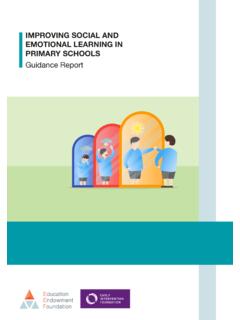
1 Guidance ReportIMPROVING behaviour IN Endowment Foundation We would like to thank the many researchers and practitioners who provided support and feedback on drafts of this guidance. We would particularly like to thank the Advisory Panel and Evidence Review Team:Advisory Panel: John d Abbro OBE (New Rush Hall Group), Jane Bateman (Underwood West Academy), Prof Neil Humphrey (University of Manchester), Dr Alex Sutherland (RAND), Jenny Thompson (Dixons Trinity Academy)Evidence Review Team: Dr Darren Moore, Simon Benham-Clarke, Ralphy Kenchington, Dr Christopher Boyle, Prof Tamsin Ford, Dr Rachel Hayes, Morwenna Rogers (University of Exeter)Guidance report authors.
2 Igraine Rhodes (EEF) and Michelle Long (Dixons Music Primary) Improving behaviour in schools1 CONTENTSF oreword 2 Introduction 3 Summary of recommendations 6 Recommendation 1 Know and understand your pupils and their influences8 Recommendation 2 Teach learning behaviours alongside managing misbehaviour16 Recommendation 3 Use classroom management strategies to
3 Support good classroom behaviour20 Recommendation 4 Use simple approaches as part of your regular routine24 Recommendation 5 Use targeted approaches to meet the needs of individuals in your school28 Recommendation 6 Consistency is key32 References 40 How was this guidance compiled? 44 Appendix I: Charlie Taylor s checklists 45 Appendix II: behaviour implementation model 472 Education Endowment Foundation Misbehaviour in lessons is something that has been documented by teachers for centuries.
4 And while most pupils in most lessons are well-behaved, it s a major cause of stress for teachers and can have a lasting impact on the outcomes of the pupils in the class. There s a clear need for school to have consistent and clear behaviour policies that promote positive behaviour in lessons. This EEF guidance report is designed to support senior leaders in primary and secondary schools to make better-informed decisions about their behaviour strategies. It includes a number of practical examples of programmes and approaches that should be helpful in schools and classrooms where behaviour is generally good as well as where there are problems.
5 The recommendations in this report focus on three areas: The first details strategies to prevent misbehaviour happening. A key theme from these recommendations is the importance of knowing individual pupils well, so that schools and teachers know which factors might affect pupil behaviour and what the school can do to address these. Focusing on developing good relationships also ensures pupils feel valued and supported, meaning they are less likely to misbehave. It is also good that many simple approaches that don t take much time or money to implement like providing breakfast clubs, or greeting pupils individually before a lesson can have a really positive impact on behaviour .
6 The second focuses on how to deal with bad behaviour when it happens. A key message is that schools should use personalised approaches like daily report cards to address problem pupils , rather than universal systems. It recommends that teachers are trained in specific strategies if they re dealing with pupils with high behaviour needs. The third focuses on the importance of consistency and coherence when it comes to behaviour policies. This means that once senior leaders have considered the rationale for putting a new behaviour strategy or approach to work, they need to spend time and care embedding it across the entire school .
7 To develop this report s six recommendations for Improving behaviour we not only reviewed the best available international research, but also consulted with teachers and other experts. As with all EEF guidance reports, its publication is just the start of how we aim to support schools in implementing these recommendations. We will now be working with the sector, including through our colleagues in the Research schools Network, to build on them with further training, resources and tools. This report is well-timed for school leaders to consider alongside the recent Timpson report on exclusions, and to be part of professional conversations around behaviour that will be central to the Department for Education s behaviour Support , as ever, we will be looking to support and test the most promising programmes that put the lessons from the research into practice.
8 Our hope is that this guidance will help to support a consistently excellent, evidence-informed education system in England that creates great opportunities for all children and young people, regardless of their family background. Sir Kevan CollinsChief Executive Education Endowment FoundationFOREWORD There s a clear need for school to have consistent and clear behaviour policies that promote positive behaviour in lessons. 3 INTRODUCTIONI mproving behaviour in schoolsActing on this guidanceMajor decisions about your school s approach to behaviour are likely to be most effective if made in conjunction with a range of stakeholders including teaching and non-teaching staff, pupils, and parents.
9 To maximise its impact, this report should be read in conjunction with other EEF guidance including Putting Evidence to Work: A school s Guide to Implementation. schools may also want to seek support from our national network of Research schools a collaboration between the EEF, the Institute for Effective Education, and the Department for Education. Research schools aim to lead the way in the use of evidence-based teaching, building affiliations with large numbers of schools in their region, and supporting the use of evidence at scale. Who is the guidance for?This guidance is applicable to primary and secondary school settings.
10 It is hoped that most of the guidance will be useful for class teachers, while all should be relevant to senior leaders who are considering school behaviour policies and approaches. Further audiences who may find the guidance relevant include other school staff, governors, parents, policymakers, and educational researchers. Some elements will also be applicable to those in Early Years settings, though they are not the main audience and the evidence literature consulted was for those aged does this guidance cover?The strategies outlined should be helpful in schools and classrooms where behaviour is generally good as well as where there are problems.