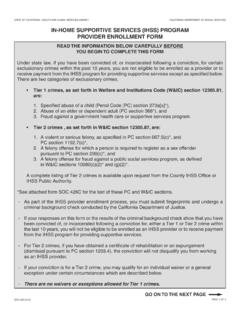
Transcription of In-Home Supportive Services Protective Supervision
1 1 California s Protection & Advocacy System Pub # In-Home Supportive Services Protective Supervision Protective Supervision is an IHSS service for people who, due to a mental impairment or mental illness, need to be observed 24 hours per day to protect them from injuries, hazards or accidents. An IHSS provider may be paid to observe and monitor a disabled child or adult when the person needs 24 -hour Supervision and can remain safely at home if it is provided. MPP 30-757; MPP (a). Protective Supervision Services can be difficult to obtain and will require clear documentation of the need for the service. This publication is meant to help you understand the eligibility criteria for obtaining Protective Supervision and help you challenge a denial when Protective Supervision Services are denied. This publication contains the attached material, which you will need in order to request Protective Supervision and prepare for a hearing.
2 1) Assessment Of Need For Protective Supervision for In-Home Supportive Services Program (SOC 821 (3/06)). - This form is to be completed by the IHSS recipient s doctor. 2) Protective Supervision Sample Doctor s Letter. This form is to be completed by the IHSS recipient s doctor. The recipient s doctor will also need to be provided a copy of the recipient s Hazard or Injury log in order to complete this form. 3) Protective Supervision 24-Hours-a-Day Coverage Plan (SOC 825 (6/06)). This form is to be completed by you. Why is Protective Supervision important? People eligible for Protective Supervision are always given the maximum number of monthly hours. The maximum number of IHSS hours for a person that is considered non-severely impaired is 195 hours per month. The maximum number of IHSS hours for a person that is considered severely impaired is 283 hours per month. To qualify as severely impaired an individual must have a need of twenty or more hours per week in the area of non-medical personal Services , meal preparation, meal 2 clean up when preparation of meals and feeding are required, and paramedical Services (MPP 30-701(s)(1)).
3 You can tell if the recipient receives 20 or more of these Services by looking at the recipient s notice of action. The notice will have a starred box, located in the middle bottom half of the form. This lists the number of hours authorized to provide these Services . When is IHSS Protective Supervision available? Individuals eligible for Protective Supervision must have: 1) A mental impairment or mental illness that causes functional limitations in: Memory ( forgetting things, people, places, to start or finish a task, etc.) Orientation ( inability to recognize and adapt to time, people, places, environment, surroundings etc., needed to live and complete tasks.) Judgment ( making decisions which put the individuals health and/or safety at risk), And 2) The impairments must cause the recipient to experience confusion and an inability to self-direct his or her behaviors so as to keep himself or herself safe and free from harm or injury.
4 MPP For example, an IHSS recipient who does not understand what he can or cannot do and, without Protective Supervision , would be at risk of injury from trying to do things beyond his capabilities. Such severe impairments may occur with mental retardation, autism, Alzheimer s, dementias, and psychiatric disabilities. However, having one of these disabilities alone does not automatically qualify an IHSS recipient for Protective Supervision . And 3) The county must also determine that the recipient needs to be observed twenty-four-hours-a -day in order for the recipient to safely remain at home . MPP This does not mean that the provider has to be present and watching the individual at all times. It can include observing an individual in some alternative way while an individual is left alone for a fixed period of time. MPP 30-172.(b)(3) and ACL 98-87. 3 County staff is also required to explain the availability and need for Protective Supervision Services and whether or not out-of- home care would be an appropriate alternative to Protective Supervision .
5 MPP When is Protective Supervision not available? Protective Supervision will be denied if the need for Protective Supervision is for: Friendly visiting or social activities When the need is caused by a medical condition and the person needs medical Supervision ( watching a recipient and suctioning or turning the recipient to prevent affixation) In anticipation of a medical emergency ( serious impairment to bodily functions or serious dysfunction of any body part of organ part. Examples include stroke, seizure or heart or asthma attack). To control and anti-social or aggressive recipient behavior ( getting into fights or destroying property). To guard against deliberate ( after careful consideration of the effect and consequences) self-destructive behavior, such as suicide, or when the individual knowingly intends to harm himself/herself. (MPP ) Is Protective Supervision available for children? Yes.
6 A child can receive Protective Supervision . However, the child must need closer Supervision than other children of the same age. County staff must assess all children s mental functioning on an individualized basis and provide Protective Supervision based on individualized need. All children with a mental impairment must be assessed for Protective Supervision . Children may not be denied Protective Supervision based on: Age alone, Because the child has not had a recent injury, Because the parent leaves the child alone for a fixed period of time, like five minutes. The county must consider all facts in determining need for Protective Supervision including things like age, lack of injuries, parental absence. The county must also talk with the child s parent or guardian about the availability and eligibility for Protective Supervision and not assume the parents or guardian can provide the Services for free. (ACL 98-87) 4 Documenting behaviors due to mental impairment or illness to show eligibility for Protective Supervision To demonstrate eligibility for Protective Supervision you will need to provide documentation that shows that because of a mental impairment or mental illness the IHSS recipient is at risk of injury if left unsupervised at any time during a twenty-four hour day.
7 The documentation must provide examples of things the recipient will do things to hurt themselves or put them in harm s way when left alone. If you cannot identify any dangerous behaviors the recipient has or things the recipient will do that will cause injury or make the recipient unsafe when left alone, it is likely your request for Protective Supervision will be denied. You should also make sure to keep a copy of all of the documentation you gather to show eligibility for Protective Supervision Services . 1) Create a hazard/Injury Log The best way to show eligibility ( a need for Protective Supervision ) is by creating a list or log to document every accident/injury or, near accident/injury the recipient had, within the past six (6) months or longer if necessary. The log or list you make should describe every action the recipient has taken that might cause injury, or has put the recipient at risk of injury or harm, and how often it happens.
8 Some examples of thes e types of behaviors include: leaving lit cigarettes throughout the home , using a SOS pad to bathe and clean himself or herself, wandering out of the house and getting lost, letting strangers in, turning the stove on and forgetting to turn it off , lighting small fires around the home , leaving water running, eating dangerous products or unhealthy foods, head banging, self-biting and scratching, using knives or other unsafe household objects, climbing onto a high place and jumping off because he or she is trying to fly, hiding in the refrigerator, sticking fingers in light bulb socket to see if electricity works, wandering into the street without regard for oncoming traffic, jumping into a swimming pool without knowing how to swim, trying to move furniture when the individual lacks balance and strength necessary, try to get out of bed when the individual lacks ability to use or control muscles in the body to do so.
9 Performing any task beyond the individuals mental or physical ability that would cause injury or harm to the recipient. If the recipient has not had an accident or put himself/herself in a dangerous situation recently, explain why. For example, the individual is watched 24 hours a day by the IHSS caregiver and family members to prevent accidents. 5 You may also want to create a note section in the hazard/injury log that talks about how the recipient s home cannot be modified or made entirely safe and/or the alternative way in which the individual is watched when the IHSS recipient must be left alone for a fixed period of time (if applicable). For example, the recipient may be left alone twice a month for the family member to go shopping for no longer than 2 hours and the recipient is watched by receiving a phone call at home every 20 minutes. 2) Obtain letters to document the need for Protective super vision Obtain a letter from the regional center or any other resources such as a day program or school program.
10 The letter should contain the following information: The recipient s age, Information about the recipient s mental impairment(s) and/or mental illness, Information about the severity of the functional limitations caused by the impairments in the area of memory, orientation, and judgment, A description of how limitations in the in area of memory, orientation and judgment cause confusion and non-self direction behaviors ( inability to identify places, time, people, etc.), Information about whether or not the individual needs to be observed and monitored to keep them safe and why ( When the recipient does things which are unsafe the individual s is verbally redirected and the behavior is stopped), Provide examples about unsafe behaviors the individual has and how often it occurs. Obtaining medical documentation of the need for Protective Supervision 1) Obtain an Assessment Of Need For Protective Supervision for In-Home Supportive Services Program (SOC 821 (3/06)) form completed by the recipient s doctor (Attachment 1) You should obtain a current SOC 821 completed by the recipient s doctor when requesting Protective Supervision Services .