Transcription of Increasing Your Child’s Reading Fluency
1 Increasing your child s Reading Fluency Today s Agenda 1. Definition of Fluency 2. How to Select Appropriate Reading Materials 3. Goals for Fluency by Grade Level 4. Research Based Guidelines for Building Fluency 5. Fluency Building Activities: Word Level Phrase Level Passage Level 6. Published Fluency Building Programs 7. Web Resources Definition of Fluency : Fluency is a critical gateway to comprehension. Fluency is Reading words with no noticeable cognitive or mental effort. It is having mastered word recognition skills to the point of overlearning.
2 Fundamental skills are so automatic that they do not require conscious attention (Big Ideas in Beginning Reading website). Examples of Automaticity: playing a musical instrument playing a sport (serving a tennis ball) riding a bike Accuracy first, then Fluency ! Must select passges that are within the learner s decoding range. Fluency does NOT equal speed Reading ! Reading prosody = the skill of Reading aloud with proper intonation, phrasing, and expression Reading Fluency refers to efficient, effective word recognition skills that permit a reader to construct meaning of text. Fluency is manifested in accurate, rapid, expressive oral Reading and is applied during and makes possible, silent Reading comprehension (Pilulski & Chard, 2005, p.)
3 3). Selecting Appropriate Reading Material Focus on accuracy! Independent Reading Level: ____ Instructional Reading Level: ____ Frustration Reading Level: ____ To determine if a book is at a child s Reading level: First, check the back of the book to see if a grade level is listed. This will be a pretty good indication of the difficulty level of the book. (You ll want to select books that match your child s instructional level not necessarily your child s current grade level.) If a grade level is not listed or if you want to double check that the book is at the right level, mark off a passage of 100 words. (This can be on any page of the book.) Ask your child to read the marked passage aloud to you.
4 Mark each error the student makes as he/she reads. Total the number of errors made and subtract from 100. This is the accuracy rate of your child for the book. Select a book that is at least at a child s instructional level (see table above). For children who are Reading at the third grade level or above, it is beneficial to include silent Reading on a regular basis. I recommend that parents begin each evening by having the child read 2 3 pages aloud. Then, the parent can assign a few pages for the child to read silently. The parent should read the pages ahead of time so they will be familiar with the content and be able to ask a couple of oral comprehension questions to check for understanding when the child has finished Reading . Providing a Reading log is a good way to track the Reading that is completed at home.
5 Parents can note the date, title of the book, pages read, and sign off after each Reading session. Offer an incentive for pages read . RReeaaddiinngg LLoogg ffoorr:: _____ Each time your child makes an error while Reading , you can correct it by saying, That word is firefly. What word? Yes, firefly. Let s start that sentence over. Date Title of Story Number of Pages Read Parent Initial
6 GradePercentileFall WCPM*WinterWCPM*SpringWCPM*Avg.
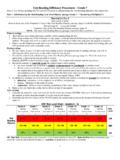
7 WeeklyImprovement** WCPM*WinterWCPM*SpringWCPM*Avg. WeeklyImprovement** Hasbrouck & Tindal Oral Reading Fluency DataJan Hasbrouck and Gerald Tindal have completed an extensive study of oralreading Fluency . The results of their study were published in a technical reportentitled, "Oral Reading Fluency : 90 Years of Measurement," which is availableon the University of Oregon s website, ,and in The Reading Teacherin 2006 (Hasbrouck, J. & Tindal, G. A. (2006).Oral Reading Fluency norms: A valuable assessment tool for Reading Reading Teacher. 59(7), 636-644.).The table below shows the mean oral Reading Fluency of students in grades 1through 8 as determined by Hasbrouck and Tindal's data. You can use the information in this table to draw conclusions and makedecisions about the oral Reading Fluency of your students.
8 Students scoring10 or more words below the 50th percentile using the average score oftwo unpracticed readings from grade-level materials need a Fluency -building program. In addition, teachers can use the table to set the long-termfluency goals for their struggling weekly improvementis the average words per week growth youcan expect from a student. It was calculated by subtracting the fall score fromthe spring score and dividing the difference by 32, the typical number ofweeks between the fall and spring assessments. For grade 1, since there isno fall assessment, the average weekly improvement was calculated bysubtracting the winter score from the spring score and dividing the differenceby 16, the typical number of weeks between the winter and springassessments.
9 *WCPM = Words Correct Per Minute**Average words per week Research Based Guidelines for Building Fluency Modeling fluent oral Reading using teacher read alouds and as part of repeated Reading interventions (Blevins, 2001; Rasinski, 2003, Chard et al., 2002 as cited in Hudson, Lane & Pullen, 2005). Providing oral support and modeling for readers using assisted Reading , choral Reading , paired Reading , audiotapes and computer programs (Rakinski, 2003 as cited in Hudson, Lane & Pullen, 2005). Reading to an adult. Studies where students read out loud to an adult at some point during the intervention showed significantly better results than studies in which the student read to a peer (Therrien, 2004 as cited in Harn & Chard, 2008).
10 Clearly stated purpose focused on comprehension. Studies where the intervention made it clear that the student s efforts were to improve overall Reading proficiency had significantly better results than interventions where this was unclear or if it emphasized rate of Reading (Therrien, 2004 as cited in Harn & Chard, 2008). Repeatedly Reading passages 3 4 times. Interventions in which students read three of four times produced significantly better effects than interventions in which students read fewer than three times. There was no added benefit to Reading a passage more than four times (Therrien, 2004 as cited in Harn & Chard, 2008). Encouraging prosody development through cueing phrase boundaries (Rasinski, 2003; Schreiber, 1980 as cited in Hudson, Lane & Pullen, 2005).