Transcription of Individual Development Plan (IDP) Guide
1 1 Individual Development plan (IDP) Guide THE Individual Development plan (IDP) The purpose of the Individual Development plan (IDP) is to support and encourage an open dialogue between the employee and manager/leader regarding professional and career Development . The IDP document is intended to assist in this process by providing a framework with which to create focused learning objectives for enhancing job skills within a current role; establishing a strategic Development plan with learning activities focused on success for future positions; and enriching current roles. ROLES & ACCOUNTABILITIES Development planning is a shared responsibility between the employee and their manager. Through discussion and collaboration, the manager and employee establish a strategic Development plan outlining goals, learning activities and timelines. The IDP discussion is an opportunity to discover the employee s career needs and interests, strengths and growth areas.
2 Employees: Assess their abilities in relation to their current role and functions Seek regular feedback from others to improve performance in their current role Review and identify their career needs (values, motivations) and goals (interests, impact / contributions) Review various training and Development opportunities that may help in achieving the above Regularly assess Individual progress toward reaching career needs and goals Discuss career aspirations with manager and obtain feedback on career Development opportunities Managers: Realistically assess employee s strengths and Development needs in relation to employees roles and performance expectations Provide regular opportunities to discuss and review employee s progress Create a supportive environment for learning and Development by providing open and honest feedback, ongoing coaching and opportunities for growth and Development Ensure alignment of employee s career goals and Development needs to department / organizational goals / objectives Help employee identify appropriate training and initiate and support Development opportunities Review progress and results of employee training and Development efforts 2 Individual Development plan (IDP) PROCESS 1) Pre-Planning The manager and employee prepare independently for their initial meeting.
3 Preparation may include reviewing prior achievements, roles and projects, investigating requirements for short-term and long-term career goals, utilizing self- Development and assessment tools, and reviewing performance feedback. Considerations for Considerations for What specifically would you like to know about this Individual s career and professional Development aspirations? Are there current/future department challenges or objectives that could provide a developmental opportunity for employees? How has this Individual contributed to the department goals and objectives? What are some examples of successes? Where could this Individual make a greater contribution? What skills, talent, and expertise can be more fully utilized? What are Development areas for this Individual ? What projects, tasks or committees would help stretch this Individual ? What learning activities should be considered?
4 What are my goals for the Development discussion? What are my professional and career expectations? What are the future challenges that may occur in our department that could provide a Development opportunity? What are my strengths and areas of Development ? What knowledge, skills or experiences need to be strengthened for greater success in my current role or to achieve my short/long term career goals? What types of learning activities would support these Development needs? 2) Employee / Manager Meeting The manager and employee have an open and honest discussion regarding strengths, areas for Development , interests, goals and department requirements. It is important that this discussion focuses first on identifying Development needs required to strengthen the employee s skills and capabilities within their current role. Strengthening performance in the employee s current role becomes the foundation for success in future roles.
5 Conducting a Development Discussion (Manager): Examples of questions that could be used during the Development discussions with employees. EMPLOYEE CAREER PERSPECTIVE Explore Individual s overall career expectations, both short and long-term Explore multiple Development options including enrichment in current job; going forward 1 - 3 years and longer term Test your own assumptions about the Individual s interests What does the Individual enjoy most and least about their current role? What are some important career and professional Development issues for you now? What are your short & long-term career expectations? What is important to you in terms of work? How are you defining success ? 3 DEPARTMENT / ORGANIZATION CONTEXT Provide an information update about the department Review possible changes and opportunities Do you have any other questions about the department / organization? Is there anything that may impact on your professional Development ?
6 STRENGTHS TO LEVERAGE Emphasize that leveraging strengths is just as important in Development planning as identifying growth areas Provide your feedback and discuss strengths that can be further utilized Ask for employee s perspective Discuss projects, committees, job roles that would capitalize on these strengths In what ways do you think you have contributed to the goals, strategy, and objectives of the department? Organization? What are some examples of success? How would you describe your strengths? Which strengths would you like to further leverage in the organization? Development NEEDS Discuss Development needs Identify the skills, knowledge, or attributes that need Development ? Ask for employee s perspective, feedback and clarification Provide your feedback Where do you see growth opportunities? What do you consider some of your Development needs? New knowledge needed? Exposure to different functions or customers?
7 Skills to learn? Personal style to modify? Development ASSIGNMENTS Brainstorm potential Development assignments, projects, or job functions that would provide Development opportunities What work experiences will help you develop? COURSES and SEMINARS Discuss learning needs that can be served through taking courses, seminars, or attending conferences Which learning needs can be addressed by reading, taking courses, seminars, or attending conferences? Development RELATIONSHIPS Identify opportunities to work with individuals who are strong in a particular skill? From whom might you learn new skills and acquire knowledge? With whom would you like to work? FUTURE ROLE / CAREER plan Discuss next potential steps in the department What are your thoughts on this? Development plan IMPLEMENTATION Review suggestions to leverage existing strengths and work on developing needs Clarify any interim information that is needed Set time to review follow-up plan Staff member has responsibility to finalize Development plan based on initial discussion Considering both strengths and Development needs, what are your primary Development goals and activities?
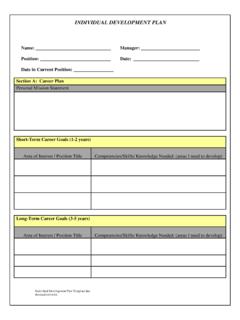
8 What resources will you need? What barriers to Development might occur? When would be a good time to review your plan ? 4 3) Prepare Individual Development plan (IDP) The employee, in consultation with manager, completes their Individual Development plan to establish goals for Development their current role and to prepare for short-term and long-term career goals. Ensure that these goals and timelines are realistic. For example, if a short-term career goal includes moving into a position which requires a Master s level education which the employee does not currently have, consider what a realistic time frame for achieving this goal would be. The Development plan should outline the specific goal as well as define the specific learning and Development activities required to achieve this goal. For example: develop strong presentation skills may be supported by activities such as attending a Presentation Skills workshop, joining Toastmasters or presenting to small groups or the employees own department.
9 Short term and long term goals do not necessarily need to be expressed as movement into a new position. In many cases, and for many reasons, some employees want to continue to grow and develop in their current role but are not interested in the more traditional forms of career progression. The IDP is intended to reflect the unique Development needs of the Individual and therefore may include opportunities to lead functional teams, become involved in cross functional committees and to gain exposure to other tasks, functions or departments. Moving UP is not the only way to develop. For some individuals the most meaningful Development plan will provide opportunities for job enrichment. 4) Implement plan The employee is responsible for completing the Individual Development plan and outlining the specific learning and Development activities agreed upon. An Individual Development plan is a joint commitment between the employee and their manager.
10 The employee is responsible for actively engaging in the training and Development activities identified in the plan and the manager is responsible for supporting this process and providing ongoing coaching and feedback. An active Development plan becomes part of a regular conversation with manager and employee with training and Development experiences supported through ongoing dialogue and coaching as needed. 5) Evaluate Outcomes Periodic formal discussions between the manager and employee should be scheduled to evaluate usefulness of training and Development experiences as well as monitor the employee s progress in achieving their short term career objectives. 5 TRAINING & Development OPPORTUNITIES Training and Development opportunities should be presented in as many formats as possible, including classroom learning, on-the-job training, coaching sessions, and technology-based learning. The learning activities do not have to be formal to be effective.