Transcription of Inductive Approach to Apologetics: Shown in Mere ...
1 Inductive Approach to Apologetics: Shown inMere Christianityby LewisBy Ruth Schafer and Katrina M. Lee (Penn State UBF) Lewis (1898-1963) was one of the most influential Christian thinkers of the 20thcentury. He decided he was an atheist at the age of 13. After fighting in World War I, hebecame a great scholar and writer at Oxford University. He was a good friend of JRRT olkien, the Christian author who wroteLord of the Rings. Through the influence ofscholarly Christians, he professedhis faith in Jesus at the age of 33. He wrote both fictionand nonfiction, including many works on the Second World War, England was under constant attack by Nazi that difficult time, he was asked by the BBC to deliver a series of radio lectures onthe basic Christian faith. These lectures were compiled and published in 1952 under thetitleMere Christianityis directed to a non-Christian audience.
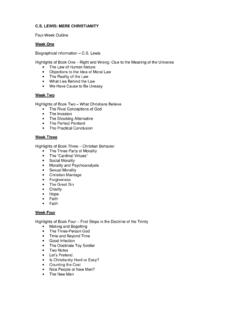
2 The purpose of this book is toshow that the basic teachings of the Christian faith. To make his case, Lewis does notrely on the authority of Scripture, because many people who do not believe have littleregard for the Bible. Instead, he uses an Inductive Approach . He relies on simpleobservations about people and common human experience, and from that, builds a casethat the Bible is christianity is divided into four and wrong as a clue to the meaning of the Christians personality (First steps in the doctrine of the Trinity)Each of these books consists of 5-12 chapters. We obviously don t have time tonight to go over every chapter. So we will just cover a few highlights from each of the four 1: Right and wrongSome people claim that right and wrong is a human invention. In Book 1, Lewis makesthe case that all people everywhere have a strong sense of right and wrong.
3 You canhear it in the way that kids argue. You re not playing fair! People demand to be treatedfairly. (Give some funny examples.) This shows that people everywhere know in theirhearts that there is a standard of right and wrong, and the standard is some people will object: How can you say that the standard is universal? Societiesare different! They point to the fact that, in some cultures, a man can have only one wife, but in other cultures they practice polygamy. Yes, cultures are different. But if you reallydo an objective study, you have to conclude that the differences are only in the details,and the major points are always the same. There is no culture that has a totally differentmoral standard from any other place. There is no place where cowardice is praised,where betrayal of family and friends is considered good, where selfishness is people disagree over how many wives you may have, but no one really believesthat it s ok for a man to have any woman he wants at any , despite all this evidence, some people will stubbornly insist thatthere is no universalstandard.
4 If you meet such a person, you can try an experiment. Treat him unfairly orcheat him out of something. Then see how long it takes for him to say, Hey, you cheated. That s not fair! Just as everyone knows there is a universal standard, they also know that they don t live up to it. People are always apologizing for what they did wrong. They make excuses forthe bad behavior, not the good. They feel guilty and ashamed and want to hide theirweaknesses. (Give examples.)This is a powerful illustration of Romans 3:23: ..for all have sinned and fall short of the glory of Book 2: What Christians believeOne of the big objections to christianity is that it s too exclusive. People say that if you are a Christian, you have to say that all other religions are wrong. But, in fact, that isn t true. Lewis says that if you are a Christian, you are free to recognize that there is a lot oftruth in other religions.
5 Most religions in fact hold some truth. It s only where they differwith christianity that you have to draw the line. If you are an atheist, on the other hand,you have to believe that every religion at its core is fundamentally wrong. It s much harder to be an atheist. Atheists are the most rigid people of few people in the world are actually atheists. The vast majority have always believedin some kind of divine being. But the conceptions of God differ. Some religions are basedon pantheism. Pantheism is the view that God is in the universe,and the universe is is in us and we are God. Hindus believe this. But most people recognize that Godand creation are distinct. Many difficult and important questions arise about the nature ofgood and evil. Some eastern religions are based on dualism. Dualism sees good andevil as two separate and equal forces, like a north and south pole.
6 Neither one isinherently stronger than the other. Neither one is inherently better than the other. Eachside thinks of itself as good and the other side as bad. It s like Star Wars, with a light side and dark side of The Force. But it s hard to reconcile dualism with human nature, because people always want to line up on one side. We distinguish good from bad andwant to align ourselves with the good. We side with Luke Skywalker, not Darth most satisfying explanation of good and evil is given by christianity . We believe thatGod is the Creator and separate from his creation. We believe that God is good. Heloves love and he hates hatred. But if God is good and created the world, then why isthere so much bad? We believe that this is a good world that has gone bad. This storybegan with Lucifer, God s angel who turned into the devil. Evil is not a separate power from good; it is a parasite.
7 God only creates good. God made us and said that we weregood. But he also gave us free will, so that we would not be robots. Free will makes evilpossible. But it is also the only way that real love, joy and goodness are chose evil. After the fall of man, God left us a conscience and spent yearsrevealing himself to his creation, so that we could know who he is and what he wants. Herevealed himself to the Jews. And then he sent Jesus, who forgives our sins and makesus right with God. This is what Christians believe. This is the only reason why we needreligion at all. We need to be saved to be right with our Creator and to have fellowshipwith him. That is why we were 3: Christian behaviorThe word morality brings different images to people s minds. A little boy often thinks that God doesn t want him to have any fun. Many adults also think of morality as something that interferes with pleasure and fun.
8 Lewis disagrees. He says, Morality is the directions for running the human machine. Morality prevents serious problems and are two ways that humans go wrong. We do damage to others. And we dodamage to ourselves. But morality is concerned with three things: harmony amongpeople, harmony within the individual, and the general purpose of human agrees that we need harmony among people. We want a fair society. We saythat what a person does is okay as long as it doesn t interfere with the wellbeing of how can a moral and upright society be attained if the people have no morals? It s no use making rules of social behavior when we know that greed, bad temper andselfishness will prevent us from keeping them. Law cannot make a bad person good. Sowe need a morality that is also inside the individual. So morality concerns harmonyamong people and within people. But the third part is where Christian morality differs fromother systems.
9 christianity says that people will live forever. If we are greedy and jealouspeople, then eternity would be hell. We must also care about the relationship betweenourselves and the power that made us. And the power that made us wants us to be thebest that we were made to be. God doesn t want people who know howto follow wants people of character. Real morality is not in the rules that we follow. We areobedient but it is for the sake of our own character. God wants to give us a happiness thatno external rules can give. He wants us to act like outstanding people. But he also wantsus to be outstanding people that can share in heaven with is the overarching principle that Lewis applies to Christian behavior. He alsogoes into detail on certain aspects of morality, including sex,marriage, forgiveness,charity, hope and 4: The TrinityThe fourth book is about theology.
10 Theology is essentially the science of God. Whengiving these talks on the radio, Lewis says that many people discouraged him fromtalking about theology. They thought that average people want plain, practical, religion . Lewis states in response that he thinks highly of people and that they need somethingmore than child s religion. Theology is no substitute for the real experience of God. But it helps us to fit the piecestogether. It comes from the learning of faithful Christians. And it strengthens our faith. Inthis day and age, some theology is necessary. People are well educated. We areexposed to million of ideas every day. Asimple understanding of christianity is notenough to help us make sense of everything that we see and most important doctrine in theology is the Trinity. The Trinity consists of God thefather, Jesus the Son, and the Holy is God but he is also God s son.