Transcription of Industry Classification Benchmark (Equity) - FTSE Russell
1 Ground Rules An LSEG Business June 2022 Industry Classification Benchmark ( equity ) FTSE Russell An LSEG Business | Industry Classification Benchmark ( equity ), , June 2022 2 of 32 Contents Introduction .. 4 Industry Classification Benchmark .. 4 FTSE Russell .. 4 Management Responsibilities .. 5 FTSE Russell .. 5 FTSE Russell Industry Classification Advisory Committee .. 5 FTSE Russell Policy Advisory Board .. 5 FTSE Russell Index Policies .. 6 Challenges and Appeals .. 6 Policy for Benchmark Methodology Changes .. 6 Classification Guidelines .. 7 Basis of Decisions .. 7 Allocation of Companies to Subsectors .. 7 Changes to the Classification of a Company .. 8 Industry Sectors .. 9 Changes to the Industry Classification Benchmark .
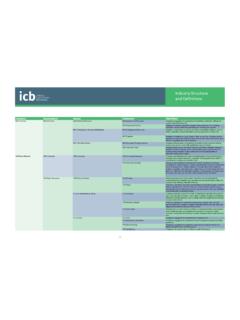
2 9 Periodic Reviews .. 10 Periodic Reviews .. 10 Classification Queries .. 10 Structure and Definitions .. 11 Technology .. 11 Telecommunications .. 13 Health Care .. 14 Financials .. 15 Real Estate .. 17 Consumer Discretionary .. 18 Consumer Staples .. 21 Industrials .. 22 FTSE Russell An LSEG Business | Industry Classification Benchmark ( equity ), , June 2022 3 of 32 Basic 25 Energy .. 27 Utilities .. 28 Appendix A: Collective Investment Schemes .. 29 Appendix B: REIT and REIT equivalent company structures .. 30 Appendix C: Further Information .. 32 FTSE Russell An LSEG Business | Industry Classification Benchmark ( equity ), , June 2022 4 of 32 Section 1 Introduction Introduction Industry Classification Benchmark The Industry Classification Benchmark (ICB) is a detailed and comprehensive structure for sector and Industry analysis, facilitating the comparison of companies across four levels of Classification and national boundaries.
3 The Classification system allocates companies to the Subsector whose definition closely describes the nature of its business as determined from the source of its revenue or the source of the majority of its revenue where available, as detailed in Rule The structure and definitions of all Subsectors of ICB are available in Section 6. FTSE Russell FTSE Russell is a trading name of FTSE International Limited, Frank Russell Company, FTSE Global Debt Capital Markets Limited (and its subsidiaries FTSE Global Debt Capital Markets Inc. and FTSE Fixed Income Europe Limited), FTSE Fixed Income LLC, The Yield Book Inc and Beyond Ratings. FTSE Russell An LSEG Business | Industry Classification Benchmark ( equity ), , June 2022 5 of 32 Section 2 Management Responsibilities Management Responsibilities FTSE Russell FTSE Russell is responsible for maintaining ICB, and for the Classification of all companies within ICB.
4 FTSE Russell will maintain a record of all changes in the Classification of companies and is responsible for ensuring the timely publication of all company Classification changes. FTSE Russell will monitor corporate events, which occur between quarterly meetings, that may affect the industrial Classification of a company. FTSE Russell Industry Classification Advisory Committee The FTSE Russell Industry Classification Advisory Committee has been established by FTSE Russell . The Committee may recommend changes to the ICB Ground Rules and the ICB structure, for approval by the FTSE Russell Governance Board. The Terms of Reference of the FTSE Russell Industry Classification Advisory Committee are set out on the FTSE Russell website and can be accessed using the following link: FTSE Russell Policy Advisory Board The FTSE Russell Policy Advisory Board, whose membership is representative of users of FTSE Russell Indices, has been established by FTSE Russell as an independent committee.
5 The FTSE Russell Policy Advisory Board provides strategic advice to FTSE Russell on the construction and maintenance of agreed indices (as stipulated in their terms of reference) and to oversee the practitioner committees established by FTSE Russell to assist in the management of the indices. The FTSE Russell Policy Advisory Board terms of reference also include the provision of strategic advice on the construction and maintenance of ICB. The Terms of Reference of the FTSE Russell Policy Advisory Board are set out on the FTSE Russell website and can be accessed using the following link: FTSE Russell An LSEG Business | Industry Classification Benchmark ( equity ), , June 2022 6 of 32 Section 3 FTSE Russell Index Policies FTSE Russell Index Policies These Ground Rules should be read in conjunction with the following policy documents which can be accessed using the links below: Challenges and Appeals FTSE Russell s Challenges and Appeals procedure can be accessed using the following link: Policy for Benchmark Methodology Changes Details of FTSE Russell s policy for making Benchmark methodology changes can be accessed using the following link.
6 FTSE Russell An LSEG Business | Industry Classification Benchmark ( equity ), , June 2022 7 of 32 Section 4 Classification Guidelines Classification Guidelines Basis of Decisions FTSE Russell will at all times approach decisions affecting the Industry Classification of companies with reference to these guidelines. Allocation of Companies to Subsectors A company will be allocated to that Subsector of ICB whose definition most closely coincides with the source of the company s revenue or the source of the majority of its revenue. The principal source of information used for the Classification of a company shall be its audited accounts and directors' report. Where a company carries out two or more lines of business that differ substantially from each other, FTSE Russell will base its decision on the accounting segmentation published in the audited accounts and directors report.
7 Interim statements will not normally be used. Changes in a company s business or structure will be considered under Rule Where revenue information is unavailable or insufficient, or where a company is new or is in the course of changing its line of business, the company will be allocated to that Subsector whose definition most closely coincides with the description of the company s business as stated in the company s annual report, or if the annual report is not available, the description of the company s business provided in the company s listing prospectus or in the company s regulatory filings or, if none of these is available, the business description provided on the company s website. Segmental reporting normally discloses revenue before tax, minority interests, extraordinary items and interest earned or incurred.
8 Unless there is audited evidence that any of these items is specifically attributable to a class of business for which revenue is disclosed, it will be disregarded in assessing the sources of revenue. Where any part of the company's business is to earn interest or incur interest, or interest expenses are central to the business, then such interest shall be taken into account in determining the company's business. A company which has businesses in two or more Subsectors is allocated to that Subsector which provides the largest part of the revenue as indicated by the latest available report and accounts, subject to Rule A company will be classified based on confirmation of majority of revenue (50% or greater) being attributed to a single sub-sector as indicated by the latest available report and accounts, subject to Rule A diversified Classification (Diversified Materials, General Mining, Multi-utilities, FTSE Russell An LSEG Business | Industry Classification Benchmark ( equity ), , June 2022 8 of 32 Diversified Retailers, Diversified Financial Services or Diversified REITs.)
9 Will result in cases where a single sub-sector does NOT contribute 50% or more and there are three or more distinct and material (material defined as 10% or greater) sub-sectors that contribute to total revenue. For a regulated bank to be classified as Diversified Financial banking revenues would have to be below 50% and there must be two additional sectors that contribute greater than 10% each. A bank with 40% banking revenue, 30% asset management revenues and 30% Investment Services would be classified as Diversified Financial. A company engaged in three or more classes of business within the Industrials Industry that differ substantially from each other, no one of which contributes 50% or more of revenue nor less than 10%, will be classified as Diversified Industrials.
10 If there is a contribution of over 50% from any other one Industry group, the Subsector of that Industry group with the highest revenue will be assigned to the company. Companies which are classified as ICB Subsectors Closed End Investments and Open End and Miscellaneous Investment Vehicles are classified based on their structure and not the source of the company s revenue. Additionally, investment holding companies will be assigned an ICB Classification based on their investment objective. Where the investment holding company is deemed to hold controlling interests in companies, the ICB will either be assigned to Diversified Financial Services or where there is a single investment theme ( infrastructure, property, biotechnology), to the subsector which it represents. Where the investment holding company is deemed to hold non-controlling interests, the company will be treated akin to an investment trust and assigned an ICB of Closed End Investments.





![Membership of the [Committee Name]](/cache/preview/9/9/6/b/7/9/b/9/thumb-996b79b98db3a1f1de093b5160b5ea4d.jpg)