Transcription of INFANCY, CHILDHOOD AND ADOLESCENCE - …
1 Normal development Textbook of Child and Adolescent Mental G Guerra, Ariel A Williamson & Beatriz Lucas-MolinaNORMAL DEVELOPMENTINFANCY, CHILDHOOD AND ADOLESCENCEThis publication is intended for professionals training or practicing in mental health and not for the general public. The opinions expressed are those of the authors and do not necessarily represent the views of the Editor or IACAPAP. This publication seeks to describe the best treatments and practices based on the scientific evidence available at the time of writing as evaluated by the authors and may change as a result of new research. Readers need to apply this knowledge to patients in accordance with the guidelines and laws of their country of practice.
2 Some medications may not be available in some countries and readers should consult the specific drug information since not all dosages and unwanted effects are mentioned. Organizations, publications and websites are cited or linked to illustrate issues or as a source of further information. This does not mean that authors, the Editor or IACAPAP endorse their content or recommendations, which should be critically assessed by the reader. Websites may also change or cease to exist. IACAPAP 2012. This is an open-access publication under the Creative Commons Attribution Non-commercial License. Use, distribution and reproduction in any medium are allowed without prior permission provided the original work is properly cited and the use is non-commercial.
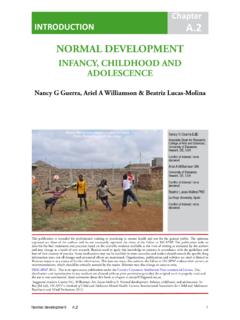
3 Send comments about this book or chapter to Suggested citation: Guerra NG, Williamson AA, Lucas-Molina B. Normal development: infancy , CHILDHOOD , and ADOLESCENCE . In Rey JM (ed), IACAPAP e-Textbook of Child and Adolescent Mental Health. Geneva: International Association for Child and Adolescent Psychiatry and Allied Professions G Guerra EdDAssociate Dean for Research, College of Arts and Sciences; University of Delaware, Newark, DE, USAC onflict of interest: none declaredAriel A Williamson MAUniversity of Delaware, Newark, DE, USAC onflict of interest: none declaredBeatriz Lucas-Molina PhDLa Rioja University, SpainConflict of interest: none declaredWatoto Wema boys enjoying a game in Kenya (Photo: Dennis Machio-Michezo Afrika)2 Normal development Textbook of Child and Adolescent Mental HealthA 15-year-old girl starts throwing nightly tantrums if she doesn t get desert after dinner.
4 Her mother is justifiably concerned and seeks the help of a mental health professional. Yet when her three-year-old son does the same thing, she sends him to his room, convinced this is a passing phase he will outgrow in due time. The mother probably is right the same behavior has very different meanings for toddlers and teenagers. Without a working knowledge of normal development the same mother might send the three-year-old to a therapist or the teenager to her room. For parents, this knowledge comes from multiple sources including experience, friends, cultural traditions, magazines and books, support networks, and more recently electronic sources such as websites and chat rooms. Parents also rely on guidance counselors, social workers, therapists, and physicians to help them understand typical and atypical behaviors.
5 Yet health professionals often are more versed in the language of abnormality and psychopathology than in the language of normal growth and development. For example, the Diagnostic and Statistical Manual for Mental Disorders (DSM-IV-TR) and the International Statistical Classification of Diseases and Related Health Problems (ICD), provide clinicians with a compendium of criteria and categories for aberrant psychological development. However, these systems provide little information about normal development, which is not simply the absence or opposite of purpose of this chapter is to give a brief overview of normal child development, defined as average or on-time growth based on the attainment of specific physical, cognitive, linguistic, social-emotional, and behavioral milestones across specific stages.
6 A focus on normal development suggests what is likely based on population averages, with clear historical, cultural, and international variations to be expected. A foundational understanding of average development can be useful to practitioners in many ways, from assisting clinicians in history taking or planning diagnostic work at intake to augmenting case conceptualization and the selection of developmentally-appropriate treatments (Holmbeck et al, 2010). This chapter begins with a review of key developmental principles or themes, including nature versus nurture , developmental timing and plasticity, critical and sensitive periods, and the role of culture and context. Following this brief introductory section, age-specific milestones in cognitive, linguistic, social-emotional, and behavioral development from infancy through ADOLESCENCE are reviewed.
7 Although it is also important to understand normative milestones in the area of physical development, this typically is covered in medical and health publications and is beyond the scope of this NORMAL DEVELOPMENT Several recurring developmental principles or themes are important to keep in mind when defining normal development and identifying growth processes and milestones. Nature versus nurture : the origins of developmentThere has been a long history of debate about the influence of nature versus nurture on development, often referred to as the nature- nurture debate. Are we born a certain way or does our behavior depend on how we are raised? A focus on nature highlights the role of genes and biology in predetermining developmental Normal development Textbook of Child and Adolescent Mental Healthoutcomes from conception onward.
8 In contrast, a focus on nurture emphasizes the role of life experiences across different contexts including the family, school, peer group, community, and culture. Recent advances in behavior genetics have provided compelling evidence for the relative contributions of both nature and nurture . In light of these scientific advances, few current theories of development embody an either/or position in this debate, but emphasize the interplay of both over time (Berk, 2006). Stated simply, a key issue is not whether development is due to nature or nurture , but how much and how each contributes to outcomes across multiple characteristics and domains. Rather than consider nature versus nurture , it is more accurate to consider both nature and nurture and how they interact (Plomin et al, 1995).
9 The empirical evidence on the relative contribution of nature and nurture comes largely from family, twin, and adoption studies, as well as from more recent DNA analyses. Much of the research on the genetic roots of behavior has focused on disorders or problem behaviors, including mental retardation, schizophrenia, autism, alcoholism, aggression, and criminality. A strong relation between biology and development has been found for chromosomal and single-gene disorders such as Trisomy 21 (Down s Syndrome). The genetic contribution for disorders involving multiple genes is more complex to determine with estimates varying widely across studies. For example, heritability estimates for alcoholism have been found ranging from to , depending on symptoms (McGue, 1994).
10 In any case, the influence of environmental factors such as parenting styles, socioeconomic status, and neighborhood characteristics on mental illness, behavioral disorders, and other individual differences looms large (Meier et al, 2008; Turkheimer et al, 2003; Tuvblad et al, 2006). What do we know about the role of nature and nurture in children s normal development? Much of this work has focused on two areas: temperament and intelligence. Studies of infants and young children have examined temperamental characteristics such as reactivity, mood, shyness, sociability, emotionality, attention/persistence, and adaptability. Because temperament is defined as stable and early appearing individual differences in behavioral tendencies, it is presumed to have strong biological roots.