Transcription of INFECTION CONTROL RISK ASSESSMENT
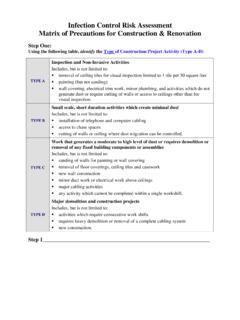
1 Quick Links to Specific Sections: Purpose Training and Education Policy Enforcement o General Definitions Additional Resources o Products and Materials Appendix A: ICRA Authorization Procedure Form o ICRA Development and Authorization Appendix B: Daily Monitoring Log o Table 1: Work Activity Types Appendix C: Supplemental o Table 2: Risk Groups Interventions o Table 3: ICRA Classification o Table 4: INFECTION CONTROL Appendix D: Mobile Dust Interventions Containment Unit Checklist o Mobilization Appendix E: Pre Dust Generating General Maintenance and Oversight Activity Checklist Demobilization and (Re)Occupancy Appendix F: Guide for Measuring and Assessing Particle Counts INFECTION CONTROL RISK ASSESSMENT . This policy effective April 1, 2018. All projects that have not been initiated (reached 20% schematic design or have a set scope and budget) prior to this date will need to comply with this policy. PURPOSE. To minimize the risk for acquisition of healthcare associated infections (HAIs) to patients that may result when fungi or bacteria are dispersed into the air via dust or water aerosolization during construction, renovation, or maintenance activities in or near the University of Virginia Health System.
2 POLICY. This policy outlines UVa Health System's program for prevention of HAIs associated with construction, renovation and maintenance activities. All parties involved in these activities are responsible for the integration of the INFECTION prevention and CONTROL principles in this policy throughout the planning, managing, and completion of the Work. This process is identified as the INFECTION CONTROL Risk ASSESSMENT (ICRA). The scope of this policy applies to all facilities that appear on the Medical Center's Joint Commission application as defined in this list as well as the Core Lab. An ICRA must be performed for all construction, renovation, and maintenance work in any facility that potentially impacts patient care activities including work vertically or horizontally adjacent to patient care areas. This includes, but is not limited to common spaces around patient care areas, medical laboratories, cafeterias, pharmacies, etc.
3 The Responsible Person for the specific project will initiate the ICRA. There will be a multidisciplinary, collaborative process for ICRA development. Facilities Management (FM) and INFECTION Prevention and CONTROL (IP&C) will have continuous involvement in the ASSESSMENT , revision, monitoring, and compliance with the ICRA. Recommended revisions to this policy and procedure will be the joint responsibility of IP&C and FM. Reviewed & Approved Hospital Epidemiology: August 2017, November 2017, June 2018, October 2018, July 2019 GENERAL DEFINITIONS. A. Area Manager: Person in charge of the area or patient care unit in which the work/project is being performed. The term Unit Manager may also be used interchangeably. An Area or Unit Manager may also choose a designee to act on his or her behalf. B. Construction Clean/Pre-Barrier Removal Cleaning: Contractor cleaning focusing on removal of dust that results from construction including, but not limited to: wiping of hard surfaces (including ICRA barrier), cleaning air vents and replacing filters, wiping all fixtures, and cleaning windows and floors.
4 Construction clean must be completed prior to the removal of the construction barrier and re-initiation of the HVAC system. C. Contractor: For the purposes of this policy Contractor is defined as any entity performing Work, including but not limited to Facilities Management personnel, Medical Center equipment technicians, consultants performing surveys and/or inspections, the General Contractor, Construction Manager, Prime Contractor, Sub Contractor, Tradesmen, Mechanics, Apprentices, Laborers, Original Equipment Manufacturer or Technician. D. Contractor's Representative: A designee of the Contractor to be responsible for the day to day oversight of ICRA compliance. If known at the time of ICRA review, this person will sign the Authorization Form in addition to the Responsible Person. E. Designated Contracted Vendor: Non-UVa vendor representative appointed by a Responsible Person to act on their behalf in initiation of, revisions to, monitoring of, and compliance with the ICRA.
5 The Designated Vendor representative will need to be approved by INFECTION Prevention and CONTROL . The Designated Contracted Vendor MAY NOT act on behalf of the Responsible Person for the purpose of approving Level I and II ICRA Authorizations. F. Discharge Clean: A clean scheduled with EVS that includes cleaning of all horizontal surfaces of the room and bathroom, spot cleaning walls, change of curtain if visibly soiled, empty trash and change linens G. Emergency Work: any unplanned event that can cause harm to patients and/or team members H. Environmental Services (EVS): A company contracted by the Medical Center or the Academic division to provide housekeeping services, including terminal cleaning of patient care areas following completion of construction activities. EVS may be arranged by the Contractor or UVa Medical Center. I. Facilities Management (FM): The Facilities Management Department at UVa. This includes the Health System Physical Plant (HSPP), Facilities Planning and Construction, and Project Services.
6 J. INFECTION CONTROL Risk ASSESSMENT (ICRA): The process of determining the potential risk of transmission of various air and waterborne biological contaminants in the facility during construction, renovation, and maintenance activities. This will be a multidisciplinary, collaborative process that evaluates Construction Activity Types and Risk Groups to determine a Classification Level and interventions. Reviewed & Approved Hospital Epidemiology: August 2017, November 2017, June 2018, October 2018, July 2019 K. ICRA Authorization (Authorization): The agreed upon results of ICRA which are documented on the ICRA Authorization Form. Refer to Appendix A. Also referred to as the Authorization. L. ICRA Team: Representatives from INFECTION Prevention and CONTROL and FM charged with oversight of the ICRA process. M. Imminent Risk: Any condition or activity which creates a hazard that could reasonably be expected to cause injury or serious INFECTION (leading to death or serious physical harm) before the imminence of such danger can be eliminated through normal notification procedures.
7 N. INFECTION Prevention and CONTROL (IP&C): Office of Hospital Epidemiology and INFECTION Prevention and CONTROL O. Maintenance Technician: UVa team member responsible for operation and maintenance of any installed system that has completed the mandatory training as described in the Training/Education section V. P. Mandatory Training: The minimum level of training, as required by this policy, to qualify a person for a specific role in the ICRA process. The level and type of training required will correlate to level of responsibility assigned to the role by this policy. (See Training/Education Section V). Q. Patient Occupancy: The point at which the following may be brought in and the space may be utilized for its intended purpose: team members and items used for patient care ( patient supplies, moveable patient equipment and furniture). R. Project Team: Responsible Persons from each entity performing Work, FP&CD Project Coordinator, EVS.
8 S. Responsible Person: UVa team member person charged with oversight of the work/project (and accountable for compliance with procedures in this policy. To qualify as a Responsible Person, the employee must have completed the associated mandatory training within one calendar year prior to the commencement of the work. Responsible Person may assign a Designated Contracted Vendor to act as the Responsible Person in all capacities with the exception of approving Class I and II ICRA. Authorization Forms. T. Restricted Area: Areas governed by AORN, AAMI or Pharmacy guidelines: Operating Rooms, Cardiac Catheterization Lab, Electrophysiology Lab, Interventional Radiology, Neuroradiology, Sterile Processing (Clean side) and Pharmacy IV med prep. U. Staff occupancy: occupancy granted at substantial completion after terminal clean is performed. Any work performed during this period will require an additional cleaning consistent with the level of work performed.)
9 V. Surgical Attire: UVa-issued gray scrubs/coveralls and hair covering to be worn in all Restricted Areas. W. TCUO: Temporary Certificate of Occupancy issued by University Building Official (UBO). Reviewed & Approved Hospital Epidemiology: August 2017, November 2017, June 2018, October 2018, July 2019 X. Terminal Clean: A clean scheduled with EVS that includes all of the components of a Discharge clean plus complete washing of walls, curtain change, complete cleaning of waste receptacles Y. Work: Any construction, maintenance or renovation related activity defined in Table 1 that has the potential to impact patient care environment, including work vertically or horizontally adjacent to patient care or patient assembly areas, and outdoors. See Table 1, Construction Activity Type Definition Guideline Grid, for further details and classifications of types of work covered by this policy. PRODUCTS AND MATERIALS. A. Construction Barriers and Doors - Examples of and/or components of barriers that may be utilized per ICRA Authorization Form: 1.
10 Existing doors and walls may be acceptable as the ICRA barrier as long as negative pressure is achieved for level II-III Work. Level IV work also requires an anteroom. 2. Poly Containment Wall System ( Zipwall , Quick-wall or equivalent) Floor length fire retardant (FR) poly that is clamped to the ceiling grid with overlapping sheets for access may be used for Type B work. For Type C work, a FR polyethylene barrier with zipper access, tightly sealed to adjacent surfaces ( zip wall with appropriate poles/clamps). These temporary Barrier systems will be permitted only when discussed with and approved by the RP or ICRA Team, as appropriate. Constraints associated with the use of this system ( duration of use) will be noted on the ICRA. Authorization form. 3. Mobile Dust Containment Units/Containment Booth A mobile booth mounted on caster wheels and enclosed on all sides with an open top that can be extended to create a seal against an existing ceiling in the area of work.