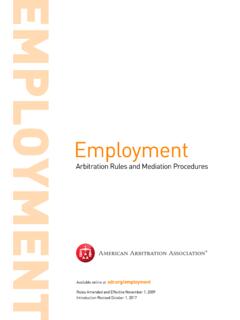
Transcription of Initial Discovery Protocols For Employment Arbitration Cases
1 1 | Discovery ProtocolsFor Employment Arbitration CasesApril 2013 Part 1: Background and Definitions BackgroundIndividual judges throughout the United States District Courts are currently piloting an early Discovery protocol project for federal Employment Cases . The Protocols were developed in 2011 by a committee led by Judge John Koeltl United States District Judge for the Southern District of New York. By design, the committee was composed of a balance of both plaintiff and defense attorneys from across the nation. The project grew out of a 2010 Conference on Civil Litigation at Duke University, sponsored by the Judicial Conference Advisory Committee on Civil Rights, for the purpose of re-examining civil procedure and collecting recommendations for their improvement. During the conference, a wide range of attendees expressed support for the idea of case-type-specific pattern Discovery as a possible solution to the problems of unnecessary cost and delay in the Discovery process.
2 There was consensus at the conference that Employment Cases would be best suited for any type of experimentation because they are regularly litigated and have recurring issues. Following the conference, the committee led by Judge John G. Koeltl, worked diligently over the course of one year to develop the Initial Discovery Protocols for Employment Cases Alleging Adverse Action to encourage parties and their counsel to exchange the most relevant information and documents early in the case, to assist in framing the issues to be resolved and to plan for more efficient and targeted Discovery . In the fall of 2012, the American Arbitration Association (AAA ) brought together seasoned New York Employment arbitrators, a Protocol committee member, and senior AAA staff to review the Protocol and assess if a similar protocol tailored to Employment Arbitration would benefit the process. While recognizing the significant differences between Arbitration and litigation, all agreed that the Arbitration process could be made more efficient and economical and generally benefit from similar Protocols tailored to Employment Arbitration .
3 The consensus of the working group was that Protocols tailored for Employment Arbitration should be drafted, and piloted in New York and other regions for one year. While Initial Discovery Protocols for Employment Arbitration Cases borrows many provisions from the Initial Discovery Protocols for Employment Cases Alleging Adverse Action, it has been carefully tailored for both promulgated and individually negotiated Employment Arbitration Cases . These Initial Discovery Protocols for Employment Arbitration Cases , while not mandatory, are presumptively applicable to all AAA Employment Arbitration Cases unless determined otherwise by the arbitrator or mutually agreed by the parties not to be applicable or Discovery Protocols FOR Employment Arbitration CASES2 | The following definitions apply to Cases proceeding under the Initial Discovery Protocols for Employment Arbitration Concerning. The term concerning means referring to, describing, evidencing, or Document.
4 The term document includes writings, drawings, graphs, charts, photographs, sound recordings, images, and other data. The term document also includes electronically stored information in any medium, including emails, text messages and similarly stored information that can be obtained either directly or, if necessary, after translation by the responding party into a reasonably usable form. c. Identify (Documents). When referring to documents, to identify means to give, to the extent known: (i) the type of document; (ii) the general subject matter of the document; (iii) the date of the document ; (iv) the author(s), according to the document; and (v) the person(s) to whom, according to the document, the document (or a copy) was sent [?]; or, alternatively, to produce the Identify (Persons). When referring to natural persons, to identify means to give the person s: (i) full name; (ii) present or last known address and telephone number; (iii) present or last known place of Employment ; (iv) present or last known job title; and, (v) relationship, if any, to the claimant or respondent.
5 Once a person has been identified in accordance with this subparagraph, only the name of that person need be listed in subsequent Discovery requesting the identification of that Initial Discovery . Initial Discovery comprises the documents and information specified below in Part 2 (for claimant) and Part 3 (for respondent). Instructionsa. For this Initial Discovery , the time period being no more than three years before the date of the matter(s) in controversy, unless otherwise This Initial Discovery is not subject to objections except with respect to (i) claims of privilege and (ii) specific limitations based on electronically stored information from sources that the party identifies as not reasonably accessible because of undue burden or cost. On a motion to compel Discovery or for a protective order, the party from whom Discovery is sought must show that the information is not reasonably accessible because of undue burden or cost. If that showing is made, the arbitrator may nonetheless order Discovery from such sources if the requesting party shows good cause.
6 The arbitrator may specify conditions for the A party or counsel is required to certify, by signature, that the Discovery provided is complete and correct at the time it is produced. If a partial or incomplete answer or production is provided, the responding party shall state the reason that the answer or production is considered partial or incomplete. d. Documents must be produced as kept in the normal course of business, and must be organized and labeled to correspond to the numbers of the requests. Electronically stored information must be produced in a form in which it is ordinarily maintained or in a reasonably usable form and must be organized and labeled to correspond to the numbers of the requests. Initial Discovery Protocols FOR Employment Arbitration CASES3 | 2: Production by Claimant(1) Timinga. The claimant s Initial Discovery shall be provided within 30 days after the respondent has submitted a responsive pleading or motion, unless the arbitrator rules otherwise.
7 (2) Documents that Claimant must produce to Respondent a. All communications concerning the factual allegations or claims at issue in the Arbitration between the claimant and the Claims, lawsuits, administrative charges, and complaints by the claimant that rely upon any of the same factual allegations or claims as those at issue in the Documents concerning the formation and termination, if any, of the Employment relationship to the extent either is relevant to the claims or issues in the Arbitration , irrespective of the relevant time Documents concerning [the terms and conditions] of the Employment relationship, to the extent relevant and material with respect to the claims or issues in the Diary, Journal, and calendar entries, whether written or electronic, maintained by the claimant concerning the factual allegations or claims at issue in the The claimant s current resume(s).g. Documents in the possession of the claimant concerning any application or claim for unemployment benefits, [unless production is prohibited by applicable law].
8 H. If mitigation of damages is an issue in the case, documents concerning: (i) communications with potential employers; (ii) job search efforts; (iii) offer(s) of Employment , job description(s), and income and benefits of subsequent Employment , and (iv) the termination of any subsequent Employment . The respondent shall not contact or subpoena a prospective or current employer to discover information about the claimant s claims without first providing the claimant 30 days notice and an opportunity to file a motion for a protective order or a motion to quash such subpoena. If such a motion is filed, contact will not be initiated or the subpoena will not be served until the motion is ruled Any other document(s) upon which the claimant relies to support the claimant s claims.(3) Information that Claimant must produce to Respondenta. Identify persons the claimant believes to have knowledge of the facts concerning the claims or defenses at issue in the Arbitration , and brief description of that Describe the categories of damages the claimant claims and the amounts of damages with respect to each category to the extent Discovery Protocols FOR Employment Arbitration CASES4 | State whether the claimant has applied for disability benefits and/or social security disability benefits after the adverse action, whether any application has been granted, and the nature of the award, if any.
9 Identify any document concerning any such 3: Production by Respondent(1) Timinga. The respondent s Initial Discovery shall be provided within 30 days after the respondent has submitted a responsive pleading or motion, unless the arbitrator rules otherwise.(2) Documents that Respondent must produce to Claimant [See comments to prior section about terminology]a. All documents concerning the factual allegations or claims at issue in the Arbitration among or between:i. The claimant and the respondent;ii. The claimant s manager(s) and/or supervisor(s), the respondent s human resources representative(s) and any other decision Respondent and any non-party (except to the extent a privilege applies).b. Responses to claims, lawsuits, administrative charges, and complaints by the claimant that rely upon any of the same factual allegations or claims as those at issue in the Documents concerning the formation and termination, if any, of the Employment relationship to the extent either is relevant to the claims or issues in the Arbitration , irrespective of the relevant time The claimant s personnel file, in any form maintained by the respondent, including files concerning the claimant maintained by the claimant s supervisor(s) and/or manager(s), respondent s human resources representative(s) and any other decision maker, irrespective of the relevant time period.
10 If not included in the personnel file, the claimant s performance evaluations and formal discipline reports or Documents relied upon to make the Employment decision(s) at issue in the Workplace policies or guidelines relevant to the claimant s claims or respondent s defenses and/or counterclaims in effect at the time of the adverse action, including policies or guidelines that address:i. Discipline;ii. Termination of Employment ;iii. Promotion; iv. Discrimination;v. Performance reviews or evaluations;vi. Misconduct;vii. Retaliation; andINITIAL Discovery Protocols FOR Employment Arbitration CASES5 | Nature of the Employment The table of contents and index of any employee handbook, code of conduct, or policies and procedures manual in effect at the time of the adverse Job description(s) for the position(s) that the claimant held if relevant to the claimant s claims or respondent s Documents showing the claimant s compensation and benefits. Those normally include retirement plan benefits, fringe benefits, employee benefits summary plan descriptions, and summaries of Documents concerning investigation(s) of any complaint(s) about the claimant or made by the claimant, if relevant to the claimant s factual allegations or claims at issue in the Arbitration and not otherwise Documents in the possession of the respondent and/or the respondent s agent(s) concerning claims for unemployment benefits unless production is prohibited by applicable Any other document(s) upon which the respondent relies to support the defenses, affirmative defenses, and counterclaims, including any other document(s) describing the reasons for the adverse action.