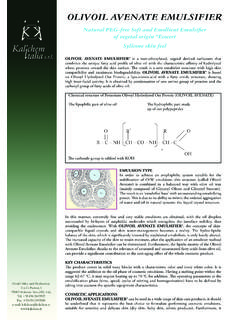
Transcription of Innovative skin lightening active ingredient …
1 Innovative skin lighteningactive ingredientIncreases the cutaneous brightnessEffective againstHyper pigmentationand skin spotsHydroxyapatites are naturally occurring mineral forms of calcium apatite, with the general formula Ca5(PO4)3(OH). Hydroxyapatite is the hydroxyl end-member of the complex apatite group, where the OH- ion can be replaced by fluoride, chloride or carbonate ions. It crys-tallizes in the hexagonal crystal system, has a specific gravity of and occupies the 5th position in the Mohs hardness scale. Pure hydroxyapatite powder is white. However, naturally occurring apatites can also be brown, yellow or green.
2 70% of the human bone is made of the inorganic mineral hydroxyl-apatite (1). Carbonated-calcium deficient hydroxyl-apatite is the main mineral of which dental enamel and dentin are composed can be found in teeth and bones in the human body. Scientific studies report its medical use as a filler in amputated bones or as a coating to promote bone ingrowth into prosthetic implants. It has been suggested that this material may promote ossification (2, 3, 4) and many modern implants are coated with hydroxyl-apatite. Recently, hydroxyl-apatite has been used as a semi-permanent filler in non-surgical options for treating wrinkles and textural changes in skin rejuvenation.
3 Moreover, as the main component of dental enamel, it is reported to protect it from acid erosion (5, 6, 7) and to exhibit enamel restoring effects, as well as an anti-plaque and anti-stain is possible to calibrate the physical and chemical properties of synthetic HAP for spe-cific biomedical applications. By developing new routes or modifications of pre-existing methods to produce HAP crystallites with reduced particle size and increased surface area of controlled morphology, or both. In particular, in order to have these biomedical applications, HAP must be produced in small size, similar to the biogenic one, it must have the same morphology, not too crystalline, the presence of carbonate ions in the crystal lattice, a comb-like morphology, and, finally, must have a fixed ratio Ca / P.
4 As far as the cosmetic field is concerned, its characteristic as a slow-release source of Phosphate and Calcium ions to the skin cells suggests its use as an anti-aging ingredient for aged skin . HAP is highly hydrophilic, but insoluble in water at pH > 5. The particles have a very great >> FUNCTIONALIZATION>> INTRODUCTIONA white, micro-fine, stable powder of activated hydroxyapatite particles is used as a biocompatible delivery system to enhance the synergy of Cysteine and Glutathione, as skin lightening andde-pigmenting 2: An image of HAP in a scanning electronFigure 1: Projection of the constituting ions of hydroxyapatite on the basal (001) planeHydroxyapatite (HAP)surface, full of irregular protrusions and cavities.
5 Moreover, it has been possible to extend and fine-tune the bioactivity of this compound by functionalization of water-soluble biomolecules. In this regard, amino acids are ideal candidates for the production of bio-inorganic HAP due to their intrinsic biocompatibility and ability of interacting with HAP surfaces (8). The affinity between protein and inorganic substrates can be due to different types of interactions: covalent and electrostatic bonds, Van Der Waals interactions. The relative predominance of one of these is closely related to protein structure and the chemical and physical characteristics of the inorganic surface.
6 In the case of biomimetic HAP the adsorption or the release of protein and amino acids is influenced by size variation, morphology, surface area, Ca / P surface ratio. Therefore, the system can be used as a biocompatible delivery system able to regulate the release of actives into the is a functionalized hydroxyapatite able to effectively deliver Cysteine and Glutathione and enhance their synergic activity and efficacy as skin lighten-ing and de-pigmenting many regions of the world, having a light and even skin colour is highly valued. There is a big number (approximately 60-75%) of women that desire to achieve a lighter skin colour.
7 In addition, many hyperpigmentary skin disorders such as melasma, postinflammatory hyperpigmenta-tion and senile lentigines can be exacerbated by sun exposure. One effective way to maintain a light and even skin colour and to ameliorate hyperpigmentation is to avoid sun exposure by using sunscreens or by wearing protective clothing. Jonker et al. ([i]) proposed that the regular use of sun protection products may lead to skin lightening , as the primary stimulus for facultative melanin synthesis is excluded and pigment that is present in the epidermis is lost through stratum corneum desquamation. The biosynthetic pathway for melanin formation in various life forms has firstly been elucidated by Raper (9), Mason (10) and recently has been modified by Cooksey et al.
8 (11) and Schallreuter et al. (12) (Figure 3). Melanogenesis is initiated at first by tyrosine oxidation to dopaquinone catalyzed by tyrosinase. This is the rate-limiting step in mel-anin synthesis because the remainder of the reaction sequence can proceed spontaneously at physiological pH value (13). The resulting do-paquinone is converted to dopa and dopachrome through auto-oxidation. Finally, eumelanin is formed through a series of oxidation reactions from dihydroxyindole (DHI) and dihydroxyindole-2-carboxylic acid (DHICA), which are the reaction products of dopachrome oxidation (14).Hyperpigmentation and Melanin PathwayRemarkable results were found, instead, in the case of skin roughness, where there is a variation of -9,5% (p<0,05).
9 Also the skin elasticity results were significant, espe-cially the Biologic elasticity : +10,3%, p<0,05 and the visco-elasticity coefficient : -17,1%, p<0,01. Interesting results show where the soft-focus effect of Hydroxyapa-tite is evident. Particularly, 6 volunteers out of 10 showed a decrease in the fine lines, while 3 volunteers out of 10 showed a decrease in the deep wrinkles EFFECT>> ROUGHNESS, ELASTICITY, ANTI-AGE AND SOFT FOCUS EFFECT OF HYDROXYAPATITESKIN ELASTICITYSKIN ROUGHNESS+ (p< ) (p< )HydroxyapatiteHydroxyapatiteplaceboplacebop = < > > ,57458,820,56455,320,63353,240,57455,53 TOTO4 weeks4 weeksMAXIMUM ROUGHNESSSKIN ELASTICITYA side from their many ascribed biological functions as antioxidants, they have also been employed in skin lightening .
10 Apparently, the main reported mechanisms of action for glutathione include: (a) direct inactivation of the enzyme tyrosinase by binding with the copper-containing active site of the enzyme; (b) mediation of the switch mechanism from eumelanin to phaeomelanin production; (c) quench-ing of free radicals and peroxides that contribute to tyrosinase activation and melanin formation; and d) modulation of depigmenting abilities of melanocytotoxic , several experiments show that the synergic addition of glutathione with another thiol, cysteine, caused inactivation of mela-noma tyrosinase in a dose-dependent manner (15, 16).