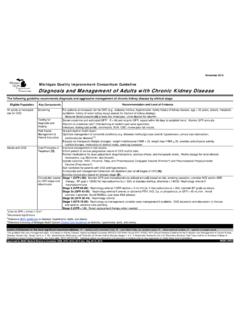
Transcription of Insights to Coding and Data Quality Chronic kidney …
1 Insights to Coding and data Quality Chronic kidney disease by Diana McWaid, MS, RHIA, CDIP, CCS, CPC, CRC, SSLP, and Carolyn S. White, CCS, CCS-P, CPC, CPMA, CGSC, CUC, CRC hronic kidney disease (CKD), also known as Chronic renal disease , usually has little or no symptoms for those who suffer from renal impairment, with the progression of loss in renal function over a period of months or years. data from the United States Renal data System (USRDS) show the incidence of kidney failure is rising among adults and is commonly associated with poor outcomes and high treatment costs. In the United States, there has been a rising incidence and prevalence of kidney failure over the last two decades, and an even higher prevalence of earlier stages of Chronic kidney disease , attributable to the aging population and the rising prevalence of co-morbidities, such as, hypertension, diabetes, and obesity. Our kidneys function to maintain an internal balance by removing waste and excess fluids.
2 If waste products accumulate in our bodies, such as urea or uric acid, serious medical conditions can Chronic kidney disease is defined as having some type of kidney abnormality, or marker, such as protein in the urine and, having decreased kidney function for three months or Because the kidneys play a vital role in maintaining the body s internal environment, Chronic kidney disease and its progression can impact every organ system in the body. As blood passes through the kidneys, waste products are filtered from the blood, leaving behind what the body needs, such as albumin and other proteins. Proteins are the building blocks for muscles, bones, hair, and nails and they help protect the body from infection, help to clot the blood, and help to balance circulating fluids in the body. Most proteins are too big to pass through the kidneys filters in the urine, but proteins from the blood can leak into the urine when the filters of the kidney , called the glomeruli, are ,3 Albumin is the main protein in the blood.
3 Proteinuria, also called albuminuria or urine albumin, is a sign of CKD, which can result from diabetes, high blood pressure, congenital causes, and diseases that cause inflammation in the kidneys, such as glomerulonephritis and ,4 People with diabetes and hypertension are at risk for proteinuria. Additional at-risk groups include American Indians, Hispanics/Latinos and Pacific Islander Americans. Other risk factors include aging and A common laboratory test used by clinicians to monitor how well our kidneys filter waste is BUN (blood urea nitrogen).The test for urine protein is the albumin to creatinine ratio (ACR), which estimates the amount of albumin in the urine. An excess amount of protein may mean the kidneys filtering units are damaged, although one positive test result could be due to fever or heavy exercise. The results for blood creatinine combined with a person s age, race, gender and other factors are used to calculate the glomerular filtration rate (GFR).
4 4 The GFR is widely accepted as the best overall measure of kidney function in health and disease and the best measure of the kidney s ability to filter blood. Other than kidney disease , the most important factor affecting GFR is age. GFR rises during infancy and declines during aging. Therefore, mild reduction in GFR may be normal at the extremes of age and, in the absence of kidney damage, is not considered to be Chronic kidney disease . Coding of Chronic kidney disease ICD-10-CM6 CIn the ICD-10-CM book, Chapter 14 covers the codes for disease of genitourinary (GU) system (N00-N99) for both female and male patients. These codes are arranged according to different sites in the genitourinary (GU) system and then by the specific site. In many instances, the codes in Chapter 14 include instructional notes indicating how a code should be assigned or sequenced. In terms of CKD the instructional notes include: Use additional code to identify transplant status, if applicable ( ) Use additional code to identify dialysis status ( ) Code first any associated: o Diabetic Chronic kidney disease ( , , , ) o Hypertensive Chronic kidney disease (I12-I13) When Coding CKD the coder should review the health record to identify the: o Stage of the CKD o Dialysis status o kidney transplant status o Whether there are any underlying associated conditions, such as diabetes or hypertension present In the ICD-10-CM Official Guidelines for Coding and Reporting, 2014, there are a few guidelines addressing Coding for CKD.
5 CKD stages for disease severity As does the current ICD-9-CM classification, ICD-10-CM classifies CKD based on severity, which is designated by Stages 1-5. The severity of CKD is designated by stages 1-5. Stage 2, code , equates to mild CKD; stage 3, code , equates to moderate CKD; and stage 4, code , equates to severe CKD. Code , End-stage renal disease (ESRD), is assigned when the provider has documented end-stage-renal disease (ESRD). If both a stage of CKD and ESRD are documented, assign code only. The code set includes notation that a patient who has CKD stage 5 and requires Chronic dialysis would be coded to End-Stage Renal disease CKD Coding for patients who are post kidney transplant status As mentioned previously, if a patient has received a transplanted kidney it is important to document the status of the transplant. In some instances, the patient may continue to exhibit symptoms of kidney malfunction.
6 It is important to tell the story of whether the Chronic disease is evidence of continued impairment of the kidney function or whether it is a complication of the transplant. Coding Guideline : Chronic kidney disease and kidney Transplant Status, addresses this issue stating: Patients who have undergone kidney transplant may still have some form of CKD, because the kidney transplant may not fully restore the kidney function. Therefore, the presence of CKD alone does not constitute a transplant complication. Assign the appropriate N18 code for the patient s stage of CKD and code for the kidney transplant status. Code be assigned for documented complications of a kidney transplant, such as transplant failure or rejection or other transplant complication. Code not be assigned for post kidney transplant patients who have Chronic kidney (CKD), unless a transplant complication such as transplant failure or rejection is documented.
7 If the documentation is unclear as to whether the patient has a complication of the transplant, query the provider. Conditions that affect the function of the transplanted kidney , other than CKD, should be assigned a code from subcategory , Complications of transplanted organ, kidney , and a secondary code that identifies the complication. Chronic kidney disease with other conditions Patients with CKD may also suffer from other serious conditions, most commonly diabetes mellitus and hypertension. The sequencing of the CKD code in relationship to codes for other contributing conditions is based on the conventions in the Tabular List. Hypertensive Chronic kidney disease o Assign codes from category I12, Hypertensive Chronic kidney disease , when both hypertension and a condition classifiable to category N18, Chronic kidney disease (CKD), are present. Unlike hypertension with heart disease , ICD-10-CM presumes a cause-and-effect relationship and classifies Chronic kidney disease with hypertension as hypertensive Chronic kidney disease .
8 O When both hypertension and CKD are present, code hypertensive CKD (I12, I13) first and assign the code from category N18 to identify the stage of the CKD as a secondary code. o If a patient has hypertensive Chronic kidney disease and acute renal failure, an additional code for the acute renal failure is required. Hypertensive Heart and Chronic kidney disease o Assign codes from combination category 113) Hypertensive heart and Chronic kidney disease , when both hypertensive kidney disease and hypertensive heart disease are stated in the diagnosis. Assume a relationship between the hypertension and the Chronic kidney disease , whether or not the condition is so designated. If heart failure is present, assign an additional code from category I50 to identify the type of heart failure. Pre-existing hypertension in pregnancy o A coder also may need to code the CKD for an obstetrical patient.
9 Category O10, Pre-existing hypertension complicating pregnancy, childbirth and the puerperium, includes codes for hypertensive heart and hypertensive Chronic kidney disease . When assigning one of the O10 codes that includes hypertensive heart disease or hypertensive Chronic kidney disease , it is necessary to add a secondary code from the appropriate hypertension category to specify the type of heart failure or Chronic kidney disease . According to the CDC, kidney disease consistently ranks among the top ten causes of death in the Due to its prevalence, its co-morbidities, and the economic burden on our health care systems, kidney disease is recognized as a public health problem and is a top priority. For correct code assignment, Coding professionals need to understand the disease process, the risk factors, the treatment options, and continue to work with physicians to ensure accurate documentation to support code capture for Chronic kidney disease .
10 _____ References 1 Your Kidneys and How They Work, http://www. page 4 2 Centers for disease Control and Prevention. National Center for Chronic disease Prevention and Health Promotion. Division of Diabetes Translation. http:// 3 Chronic kidney disease Causes, Diagnosis and Treatment Clinical Key. Pages 1-7. https://www. 4 Albuminuria. The National kidney Foundation. 5 Estimated Glomerular Filtration Rate (eGFR). National kidney disease Education Program, National Institutes of Health, Department of Health and Human Services. Publication no. 10-6286. March 2010. 6 ICD-10-CM Official Guidelines for Coding and Reporting .2014 _____ Diana McWaid, MS, RHIA, CDIP, CCS, CPC, CRC, SSLP, Co-Chair, CHIA Coding and data Quality Committee, Assistant Director, Education, Training & Quality Assurance, SCPMG Clinical Documentation & Audit Operations Carolyn S White, CCS, CCS-P, CPC, CPMA, CGSC, CUC, CRC, Senior Education Consultant, SCPMG May 2015 CHIA Journal, p 4 Copyright California Health Information Association, AHIMA Affiliate