Transcription of Installation, operation and maintenance …
1 LU-VE Sweden AB S dra Industriv gen 2-4 SE-374 50 Asarum, Sweden Tel. +46 454 334 00 Fax: +46 454 320 295 installation , operation and maintenance instructions for tube and fin heat exchanger for heating, cooling and heat recovering. 1. Description General The tube and fin heat exchanger consists of copper tubes and aluminium or copper fins. The tubes are zig-zag mounted to achieve a maximum transfer effect between the medium inside the tubes and the surrounding air. The tubes are mechanically expanded into the fins in order to obtain the most efficient exchange possible. The casing is made of aluminium as standard and meets Seal Class B in accordance with AMA VVS & KYL 12. The headers are made of copper and with connections with either internal, external threads or flanges. Connections for evaporating or condensing are done using solder. The tube and fine heat exchanger for cooling is provided with a drip tray made of aluminium for the collection of condensate.
2 Labelling There is a rating plate on the tube and fin heat exchanger with the following information: Manufacturer Order number Year of manufacture Design pressure Test pressure Dry weight 2. Safety instructions Lifting The tube and fin heat exchanger s dry weight is indicated on the rating plate. If lifting eyes are fitted these should be used when lifting. Before lifting the following checks should be done: That the lifting eyes are securely attached. That the correct lifting equipment is used and that the hooks are adapted for the lifting eyes. Operating pressure Tube and fin heat exchangers may only be connected to systems with a maximum working pressure which is 43% lower than the test pressure. Connections Tube connections on tube and fin heat exchangers must not be loaded with the tube system s own weight and any expansion forces. Connection tubes should also be protected against other external pressures that can cause damage to the heat exchanger tubes.
3 LU-VE Sweden AB S dra Industriv gen 2-4 SE-374 50 Asarum, Sweden Tel. +46 454 334 00 Fax: +46 454 320 295 Protection against freezing If mounting is done so that a risk of freezing exists any of the following actions should be taken: Fill the heat exchanger with a suitable anti-freeze. Empty the heat exchanger and tube system of all water. And to ensure that all water comes out the exchanger should be blown with air. Drainage plugs should thereafter be left unfitted until the installation is refilled. High temperatures In some operating cases components such as headers and casing may get hot. At temperatures where the heating medium is above 100 degrees C great care should be taken when opening venting and drain cocks have to be opened. Cleaning Only environmentally-cleaning agents that do not damage the exchanger should be used. 3. installation Acceptance inspection When receiving the product check that no damage has occurred during transportation or unloading.
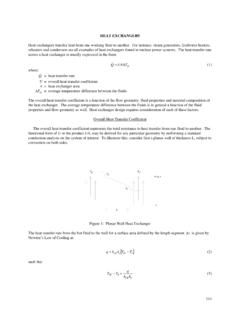
4 It is important to check the heat exchanger s fin surfaces, headers and tube elbows at the back of the exchanger . If any transport damage is suspected the haulier should be notified immediately and it must be noted on the consignment note. Assembly The exchanger should be securely anchored. Tube connections are made to the system using the connectivity options that correspond to the exchanger s connection. The exchanger should normally be connected so that the contra-flow principle is met ( air and water flow in the opposite direction). See Appendix 1. If the exchanger is equipped with a bleed nipple and drain tap these should be used when filling or draining. Disassembly When disassembling the exchanger all liquid should be drained off. If environmentally-harmful liquids are used these should be collected in a vessel for dumping or reuse. The exchanger must not be lifted until all liquid has been drained off. 4. maintenance and service General The exchanger should be inspected regularly to prevent breakdowns.
5 The following should be checked first: Fastenings- check that bearing screw joints are not defective. Fin body- check that it is not dirty or damaged LU-VE Sweden AB S dra Industriv gen 2-4 SE-374 50 Asarum, Sweden Tel. +46 454 334 00 Fax: +46 454 320 295 Cleaning In case of fouling of the exchanger air-related surfaces the transfer ability is reduced and hence the capacity. To maintain the exchanger capacity the fin surfaces should be kept free from dirt. Preventative maintenance with continuous cleaning should therefore be done since it is impossible to take the exchanger apart. The most appropriate preventative maintenance is done through the following options: Cleaning with compressed air of the fin surfaces with equal intervals. Rinsing with water (maximum of 40 degrees C for exchangers with evaporative cooling agent). In case of severe soiling any environmentally-friendly cleaning agent or degreasing agent that does not attack the material may be added to the water.
6 Agents with ammonia must not be used. If the exchanger is provided with a drip tray, ensure that drainage connections are not clogged and that the casing is free from dirt. Action against risk of freezing If the water in the exchanger freezes the tubes can burst and leakage occurs, which in turn can cause water damage. The risk of freezing exists in ventilation systems which are exposed to low exterior air temperatures in the following cases: The heating medium has a high temperature - Adjust the water temperature according to the external air temperature. Oversized exchanger - Lower the water temperature. The supply of heat ceases or reduces - The external air intake should be closed in a safe manner and all fans stopped. If the building is unheated for longer periods during the winter, all water should be drained from tubes and exchanger . To be sure that the exchanger is completely drained it should be blown with air.
7 The plugs for draining should not be fitted before the installation is refilled. In case the exchanger is too hot, ensure that the outgoing water temperature does not drop unusually and that the circulation is kept running. Vents should be open, the tubing system and the exchangers thoroughly vented and the circulation in operation , even if the heating ceases temporarily, for example during the night. Exchangers for cooling should be emptied if the air temperature falls below the cooling medium s freezing point. The drainage plugs should not be inserted, since the shutoff valves can leak and refill the exchanger with cooling agent. Repairs Repairs of exchangers should only be done by authorised personnel for the provided warranties to be valid.