Transcription of Instructions: Answer - Responding to the Complaint
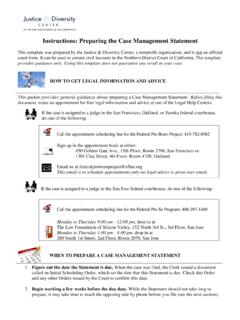
1 Instructions: Answer - Responding to the Complaint The Answer template in this packet was prepared by the Justice & Diversity Center, a nonprofit organization, and is not an official court form. It can be used in certain civil lawsuits in the Northern District Court of California. This template provides guidance only. Using this template does not guarantee any result in your case. HOW TO GET LEGAL INFORMATION AND ADVICE. This packet provides general guidance and does not tell you everything you need to know about Responding to a Complaint .
2 You can make an appointment for free legal information and advice at one of the Legal Help Centers listed below. If the case was assigned to a judge in the San Francisco, Oakland or Eureka federal courthouse, do one of the following: Call the appointment scheduling line for the Federal Pro Bono Project: 415-782-8982. Sign up in the appointment book at either: 450 Golden Gate Ave., 15th Floor, Room 2796, San Francisco or 1301 Clay Street, 4th Floor, Room 470S, Oakland Email us at This email is to schedule appointments only - no legal advice is given over email.
3 If the case was assigned to a judge in the San Jose federal courthouse, do one of the following: Call the appointment scheduling line for the Federal Pro Se Program: 408-297-1480. Monday to Thursday 9:00 am - 12:00 pm, drop in at The Law Foundation of Silicon Valley, 152 North 3rd St., 3rd Floor, San Jose Monday to Thursday 1:00 pm - 4:00 pm, drop in at 280 South 1st Street, 2nd Floor, Room 2070, San Jose 1 of 6. 2017. DECIDE HOW TO RESPOND TO THE Complaint . Most Defendants file an Answer to the Complaint .
4 If the Plaintiff did not follow the rules when serving you with the Complaint , the Complaint is missing certain information, or the Complaint shows that the Plaintiff cannot win, it may be possible to file a Motion to Dismiss the Complaint instead. If you are considering filing a Motion to Dismiss, contact one of the Legal Help Centers (see page 1). You have limited time to file a response to the Complaint . HOW TO COMPLETE THIS Answer TEMPLATE. 1. Know your deadline. You have only 21 days after being served with the Summons and Complaint to file a response.
5 If you need additional time, or have missed the deadline, it is normally best to contact the opposing side's lawyer right away and make arrangements. The Legal Help Centers (see page 1) can explain the process. 2. Fill in the case information. On the top of the first page, write your name and address. Check the box for the division to which your case has been assigned. Write in the plaintiff's and defendant's names in the middle of the front page. Then, to the right of the names, fill in the case number and write in the judge's name.
6 3. Respond to each paragraph in the Complaint . Read each sentence of the Complaint . Each paragraph should be numbered. If everything in the paragraph is false, do not write that paragraph number anywhere. The first part of this Answer denies everything unless you actually admit to it. If everything in the paragraph is true, write that paragraph number in Section B of this Answer form. If you don't know whether the paragraph is true or not, write that paragraph number in Section C. If the paragraph is partly true and partly false, write that paragraph number in Section D and explain which specific parts of the paragraph are true.
7 For example: 1. Responses to the Claims in the Complaint A. Defendant denies each and every allegation in the Complaint except those specifically admitted in this Answer . B. Defendant admits all of the allegations in the following paragraphs: 1, 3, 4, 10, 12. C. Defendant does not know or have enough information to form a belief 2 of 6. 2017. as to whether the allegations in the following paragraphs are true: 5, 6, 7, 13, 14, 15, 16. D. Defendant admits only the following parts of each paragraph listed below, and denies or does not know enough to say whether the rest of the paragraph is true: Paragraph 2 : I admit only that I am a citizen of the state of California.
8 Paragraph 11 : I admit only that I visited the Plaintiff at his house on May 3, 2014. 4. List your defenses. An affirmative defense is an argument that Plaintiff's claim should fail for some procedural or legal reason. The purpose of an affirmative defense is to give enough notice of your defenses so that Plaintiff and the Court understand your argument. In Section 2 of your Answer , include all affirmative defenses that you may have. If you leave something out, the Court may not let you argue that the defense applies later in the case.
9 If you don't know the right legal terms for your defenses, just explain your reasons clearly in your own words. If you are not sure about your defenses, contact the Legal Help Center (see page 1). Example 1: Statute of Limitations Plaintiff sued Defendant in 2010 for stealing his expensive sports car. The car was stolen in 1990 and Plaintiff has known about the theft since then. California has a three-year statute of limitations on lawsuits alleging theft of personal property, so Plaintiff only had until 1993 (three years after the theft) to file his lawsuit.
10 In his Answer , Defendant will explain that Plaintiff's lawsuit should be dismissed because the statute of limitations has expired. Example 2: Assumption of the Risk Defendant teaches surfing lessons. Before allowing Plaintiff to become a student, Defendant required Plaintiff to sign an agreement that stated, I understand that surfing is a dangerous activity and I voluntarily and knowingly assume the risk of injury during these surfing lessons. During a lesson, a big wave caused Plaintiff to hit his head on his surfboard.