Transcription of INSTRUCTIONS FOR COMPLETING DA FORM 7425, …
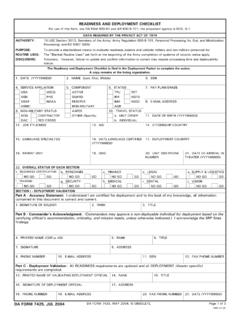
1 INSTRUCTIONS FOR COMPLETING DA form 7425, readiness AND deployment checklist 1. Purpose. a. To provide procedural guidance and information for conducting readiness and deployment processing for soldiers and civilians. readiness and deployment processing is used in support of contingency operations (CONOPS), small scale contingencies (SSC), exercises,Overseas deployment Training (ODT) and the annual Soldier readiness Processing (SRP) check. b. To supplement guidance found in AR 600-8-101, Personnel Processing (In- and Out- and Mobilization Processing), AR 614-30,Overseas Service, and revise and/or supplement guidance found in Army Mobilization Operations Planning and Execution System(AMOPES), TRADOC Mobilization Operations Planning, and Execution System (TMOPES), and Forces Command Mobilization OperationsDeployment Planning System (FORMDEPS) as applicable.
2 C. To standardize readiness and deployment processing requirements for active component, reserve component, and civilians. (The SRPrequirements have been staffed by the HQDA- level policy proponents and are applicable active, reserve component and civilian personnel). 2. References: a. AR 220-1, Unit Status Reporting. b. AR 220-10, Preparation for Overseas Movement of Units (POM) c. AR 600-8-1, Army Casualty Operation/Assistance/Insurance. d. AR 600-8-11, Reassignment. e. AR 600-8-14, Identification Cards, Tags, and Badges.
3 F. AR 600-8-20, Army Command Policy. g. AR 600-43, Conscientious Objection. h. AR 600-8-104, Military Personnel Information Management/Records. I. AR 600-8-101, Personnel Processing (In- and Out- and Mobilization Processing). j. AR 608-1, Army Community Service. k. AR 614-30, Overseas Service. l. AR 690-11, Planning for Use and Management of Civilian Personnel in Support of Military Contingency Operations. m. AR 600-110, Identification, Surveillance, and Administration of Personnel Infected with Human Immunodeficiency Virus (HIV) n.
4 DA Pamphlet 690-47, DA Civilian Employee deployment Guide. o. FORSCOM Reg. 500-3-2, deployment Guide. p. FORSCOM Reg. 500-3-3, Reserve Component Unit Commander's Handbook (RCUCH). q. FORSCOM Reg. 500-304, Installation Commander's Handbook. r. Army Mobilization and Operations Planning and Execution System, (AMOPES). s. TRADOC Mobilization and Operations Planning and Execution System, (TMOPES). t. FORSCOM Mobilization and deployment Planning System (FORMDEPS). u. Document DA form 7425, JUL 2004 Page 1 of 9 APD form 7425, JUL 2004 Page 2 of 93.
5 General. a. The underlying principles of the readiness and deployment In-Processing are as follows: (1) To ensure all administrative actions required to relocate soldiers and civilians are accomplished in a timely manner. (2) To ensure soldiers and civilians maintain a readiness posture for deployment to meet ongoing and contingency operationrequirements. (3) To effectively process the mobilizing force as it enters active duty. (4) To distinguish between readiness requirements that are required to be maintained throughout a soldier's career and deploymentrequirements that occur upon mobilization.
6 (5) To distinguish between readiness requirements that are required to be maintained for emergency essential civilians anddeployment requirements that occur upon mobilization. NOTE: IAW , any civilian that deploys in support of a contingencyis automatically considered emergency essential. b. The Soldier readiness Processing (SRP) requirements have been agreed upon by the HQDA level policy proponents and are applicableto both active, reserve component and civilian personnel. c. Soldier readiness is verified during in processing and annually thereafter.
7 Civilian and non-unit related personnel (NRP) eligibility isverified prior to deployment . To increase the shelf life of the checklist , agencies/units should forecast an individual's readiness status 90days prior to any actual deployment . d. Deploying active component (AC) members will verify the readiness requirements at their installation and validate deploymentrequirements at their deployment site (which may or may not be at the same installation). e. Mobilizing Reserve Component (RC) unit members will verify the readiness requirements at their home station and initiate andcomplete deployment requirements at their mobilization station.
8 The situation may exist where not all readiness requirements, that are alsorequired for deployment , can be done at the home station. In those situations, the gaining installation (mobilization station) will check andcomplete any readiness requirements as well as complete all deployment requirements. f. Mobilized RC individuals will verify their readiness requirements at their mobilization station and will complete their deploymentrequirements at their deployment site, which may or may not be at the same installation. g.
9 For any RC individual or unit member that is mobilized, but not tasked for deployment will complete only the In-processing/ Readinessrequirements. h. Civilians supporting CONUS based operations will complete only the In-processing/ readiness portion of the checklist at their assignedinstallation/mob station. i. Civilians scheduled for deployment will initiate the readiness portion of the checklist at their losing command (if applicable). Civilianswill complete the deployment portion of the checklist at the deployment site.
10 If the individual travels directly from home of record withoutinitiating the checklist , then the gaining deployment site (DS) will initiate and complete the checklist . j. The DS is responsible for COMPLETING any portion of the checklist that the individual/unit members were unable to complete prior tohis/her arrival. k. An annual SRP check is required for all AC and RC unit members. According to the unit's mission this requirement may be moreoften. Participation in a mobilization exercise such as CALL FORWARD, an Operational readiness Evaluation (ORE), ODT or a commandinspection satisfies the requirement for an annual SRP check for RC units.