Transcription of INSTRUCTIONS FOR: Completing the 2004 Version of the ...
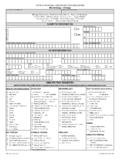
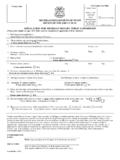
1 INSTRUCTIONS FOR: Completing the 2004 Version of the Certificate of Death These INSTRUCTIONS provide information on the proper completion of the certificate of death form as revised for use in the reporting of deaths that occur on or after January 1, 2004. This new form is identified as form number DCH-0483 (10/03) in the lower left hand corner of the certificate. The form is an 8 inch by 11 inch form. All certificate of death forms dated earlier than 10/03 should be retained for use in reporting of deaths occurring in 2003 and earlier, until all are reported. The supplies of pre 10/03 forms will then become obsolete and must be destroyed. If reporting a 2003 death in 2004, it is important to properly match the form used with the death being recorded, as deaths reported on an incorrect form cannot be accepted for filing.
2 When a death occurs in this state, the responsibility to report the death rests with the funeral director who first takes charge of the body. A certificate of death must be prepared and filed for each individual that dies within the state as well as for individuals whose place of death is not known but the body is found and pronounced dead in this state. The death certificate must be prepared and filed within 72 hours after the death or the finding of a body. The document must be filed with the local registrar for the place where the descendent was pronounced dead. The certificate of death that is completed and filed is retained in the state vital records repository as a permanent legal record of the event. The document will be available for the issuance of certified copies to permit establishing the facts of death in settling the affairs of the decedent and will serve as a historical record of interest to descendants into the future.
3 Great care should be taken in the preparation of these documents to insure each is complete, accurate and legible. By exercising care in Completing the death certificate, the intended purposes of supplying data on the mortality of people in Michigan and serving as a permanent legal record of the event can be accomplished. The immediate family of the deceased realizes the most direct value of a death certificate. Certified copies of the filed document will be an important part of handling pension and insurance claims, probating the estate, obtaining social security MICHIGAN DEPARTMENT OF COMMUNITY HEALTH Bureau of Epidemiology Vital Records & Health Data Development Section Approved by: //s// Glenn Copeland Glenn Copeland, State Registrar INSTRUCTION LETTER NUMBER 14 Effective Date January 1, 2004 Replaces Letter Number 14 Dated November 1, 1992 Page 1 of 20 Date March 1, 2004 (last revised) INSTRUCTIONS FOR: Completing the 2004 Version of the Certificate of Death EFFECTIVE DATE.
4 January 1, 2004 INSTRUCTION LETTER NUMBER: 14 PAGE 2 OF 20 benefits and other uses in the weeks and months just following the death. The document will become of historical and genealogical interest with time, as well. At the same time, the information on certificates of death will collectively be used in the study of mortality within the state in general as well as in very specific ways. The mortality data is an integral part of evaluating many public health and medical problems, program planning and evaluation and other valuable uses. Responsibilities of the Funeral Director in Death Registration The funeral director is the keystone in the death registration system. The funeral director or his/her authorized agent is responsible for seeing to the preparation and filing of the death certificate.
5 In general, the duties of the funeral director are: 1. Obtaining the personal data on the deceased and Completing the form. 2. Obtaining the physician s or medical examiner s certification of death. Note: The medical certification must be completed and signed no later than 48 hours after death by the certifying physician or within 48 hours after taking charge of the case by the medical examiner. 3. Securing all necessary signatures on the certificate. 4. Notifying the medical examiner of any death that is believed to fall within the medical examiner s jurisdiction. 5. Obtaining and recording information on final disposition. 6. Reviewing the certificate for legibility, completeness and accuracy. 7. Filing the properly completed death certificate with the appropriate local registrar within 72 hours after death.
6 8. Obtaining all necessary permits. The funeral director should also be familiar with the laws, rules and regulations governing the handling of death certificates and related permits. Note: In accordance with Section 2651 of Act 368, 1978 as amended, an anatomy board member or a person acting under his/her directions may act as a funeral director in the handling of unclaimed bodies or bodies designated for scientific use. Note: Medical examiner s cases are defined by law. Michigan Compiled Laws of 1970, Section reads: County medical examiners or deputy county medical examiners shall make investigations as to the cause and manner of death in all cases of persons who have come to their death by violence; or whose death was unexpected; or without medical attendance during the 48 hours prior to the hour of death unless the attending physician, if any, is able to determine accurately the cause of death; or as the result of an abortion, whether self-induced or otherwise.
7 If any prisoner in any county or city jail dies while so imprisoned, the county medical examiner, upon being notified of the death of the prisoner, shall make an examination upon the body of the prisoner. INSTRUCTIONS FOR: Completing the 2004 Version of the Certificate of Death EFFECTIVE DATE: January 1, 2004 INSTRUCTION LETTER NUMBER: 14 PAGE 3 OF 20 Section 2844 of Act 368, 1978, as amended reads: (1) When death occurs more than 10 days after the deceased was last seen by a physician, if the cause of death appears to be other than illness or conditions for which the deceased was being treated, or if the attending physician cannot accurately determine the cause of death, the case shall be referred to the county medical examiner for investigation to determine and certify the cause of death. If the county medical examiner determines that the case does not fall within his or her jurisdiction the county medical examiner shall refer the case back to the deceased s physician within 24 hours for completion of the medical certification.
8 (2) When an investigation is required under Act No. 181 of the Public Acts of 1953, as amended, being sections to of the Michigan Compiled Laws, the county medical examiner shall determine the cause of death and shall complete and sign the medical certification within 48 hours after taking charge of the case . General INSTRUCTIONS Death registration is required for each individual who dies in this state. If the place of death is unknown, but the body is found in this state, the death certificate shall show this fact and shall be completed and filed in this state. The place where the body is found shall be shown as the place of death. When death occurs in a moving conveyance in the United States and the body is first removed from the conveyance in this state, the death certificate shall show this fact and the place where the body is first removed from the conveyance shall be shown as the place of death.
9 When the death occurs in a moving conveyance while in international waters or air space or a foreign country and the body is first removed from the conveyance in this state, the death shall be registered in this state but the certificate shall show the actual place the death occurred insofar as the place can be determined. The key words in Completing a certificate of death are complete, accurate, and legible. Use only the current Michigan Department of Community Health form DCH-0483 Certificate of Death . Completion of the Certificate of Death The documents must be completed using a typewriter with a black ribbon and clean keys or, if not typewritten, must be printed in black permanent ink. If the documents are to be computer generated, a high quality printer that is of letter quality must be used. Signatures must be hand written in black unfading ink.
10 Rubber stamp signatures or computer facsimiles are not acceptable. The names of the individuals recorded on the document, including the decedent, a spouse and the parents must be written in English alphabetic characters, except that surname suffixes may be entered as Roman or Arabic numerals. INSTRUCTIONS FOR: Completing the 2004 Version of the Certificate of Death EFFECTIVE DATE: January 1, 2004 INSTRUCTION LETTER NUMBER: 14 PAGE 4 OF 20 The document must not be corrected or altered in any way so as to damage the document or make the document appear altered. Minor changes or alterations must be made carefully so that the alteration cannot be detected on a copy of the document. The use of correcting fluid, image overlay or correcting tapes are not acceptable. Use of a correcting typewriter with a lift off process for correction is permitted, if the correction is not detectable upon copying.