Transcription of INTAKE POLICY PROTOCOL AND GUIDANCE
1 CPS INTAKE POLICY , PROTOCOL , AND GUIDANCE CPS INTAKE POLICY , PROTOCOL , and GUIDANCE (May 2020) Page 1 NC CHILD WELFARE MANUAL Return to INTAKE TOC Return to Manual TOC Purpose In North Carolina, any person who has cause to suspect a child is being maltreated (abused or neglected, or is dependent), is required by law to report their concerns to a county child welfare services agency. Child Protective Services (CPS) INTAKE is the first stage of the child welfare process and involves screening child protective services reports to determine what further action is required. Careful, detailed, and thorough work at CPS INTAKE lays the foundation for making well-informed decisions throughout the life of the case. The quality and consistency of the information gathered at CPS INTAKE directly impacts the safety of the alleged victim children and any subsequent intervention. The goal of CPS INTAKE is to make consistent screening decisions using a structured INTAKE process based on specific criteria.
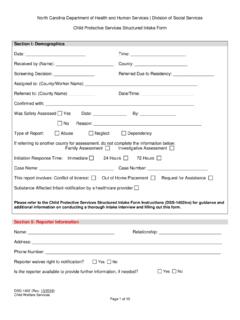
2 The steps of CPS INTAKE are: 1. Complete a new CPS INTAKE in NC FAST or the Structured INTAKE Report tool, using a strengths-based approach with the reporter. 2. Consult the Maltreatment Screening Tool(s) that correspond to the allegations. 3. Determine the county responsible for completing the CPS Assessment. 4. Consult the Response Priority Decision Tree. 5. Determine the appropriate Assessment Response Type (Investigative or Family). Following the steps above, the CPS INTAKE process determines whether the reported information meets the statutory guidelines for child maltreatment. When a report is screened in ( , it meets the statutory requirements), CPS INTAKE determines the county responsible for the assessment, the response time, the response type, and then the report is assigned for CPS Assessment. CPS INTAKE Table of Contents CPS INTAKE POLICY , PROTOCOL , and GUIDANCE (May 2020) Page 2 NC CHILD WELFARE MANUAL Return to INTAKE TOC Return to Manual TOC Description Page POLICY / Legal Basis 3 Definitions 6 INTAKE Steps 8 PROTOCOL & GUIDANCE Anonymous Reporters/Reporter Confidentiality 9 Collection of Information and Assessing Agency History 10 Substance Affected Infants 14 Human Trafficking 15 Establishing the Authority to Intervene 17 Juvenile and Caretaker Determination 17 Reports Involving a Child Fatality with Suspicion that Maltreatment Contributed to the Death 19 Reports Involving Child Caring Agencies 21 Duty to Report Allegations of Maltreatment in Child Care 21 Out-of-Home Care Provider CPS Reports 22 Residence or Alleged Maltreatment Is Out-of-State 22 Requests/Reports from Out of State 23 Reports Involving Open Child Placement Cases 25 Reports Involving Institutional Placements 25 Reports Involving Children Living in an
3 Institutional Setting Where a Child Has Died Due to Suspected Maltreatment 26 Multiple Reports Involving the Same Child or Family 27 Open In-Home Services Cases CPS Reports 28 Reports Creating a Conflict of Interest for the Agency 29 INTAKE Decision Making 30 Consultation with Maltreatment Screening Tools 30 Determination of County or State Assignment 31 Determination of Response Priority 32 Determination of Assessment Approach 33 Assignment of Assessment Approach 36 Two-Level Decision Making 37 Notifications 38 Maltreatment Type Screening Tools Attachment A 42 Response Priority Screening Tools Attachment B 87 CPS INTAKE POLICY /Legal Basis CPS INTAKE POLICY , PROTOCOL , and GUIDANCE (May 2020) Page 3 NC CHILD WELFARE MANUAL Return to INTAKE TOC Return to Manual TOC POLICY Legal Basis North Carolina requires that anyone who suspects child abuse, neglect, or dependency must report their concerns to the county child welfare services agency.
4 A person who makes a report of suspected child abuse, neglect, or dependency is immune from civil or criminal liability if the report was made in good faith. County child welfare agencies must receive, and screen all reports of abuse, neglect, or dependency, regardless of residency. Each county child welfare services agency must have written procedures for receiving CPS reports and for providing supervisory decision-making 24 hours a day. 7B-101 provides the definitions to determine a county child welfare services agency s authority to intervene and includes the following sentence in the definition of neglected juvenile: "In determining whether a juvenile is a neglected juvenile, it is relevant whether that juvenile lives in a home where another juvenile has died as a result of suspected abuse or neglect or lives in a home where another juvenile has been subjected to abuse or neglect by an adult who regularly lives in the home.
5 " Relevance in this instance is a legal term that means that the court can find a child neglected on the basis that he or she was living with a victim child. 153A-257, Legal residence for social service purposes: (a) Legal residence in a county determines which county is responsible (i) for financial support of a needy person who meets the eligibility requirements for a public assistance or medical care program offered by the county or (ii) for other social services required by the person. Legal residence in a county is determined as follows: (1) Except as modified below, a person has legal residence in the county in which he resides. (2) If a person is in a hospital, mental institution, nursing home, boarding home, confinement facility, or similar institution or facility, he does not, solely because of that fact, have legal residence in the county in which the institution or facility is located. (3) A minor has the legal residence of the parent or other relative with whom he resides.
6 If the minor does not reside with a parent or relative and is not in a foster home, hospital, mental institution, nursing home, boarding home, educational institution, confinement facility, or similar institution or facility, he has the legal residence of the person with whom he resides. Any other minor has the legal residence of his mother, or if her residence is not known then the legal residence of his father; if his mother's or father's residence is not known, the minor is a legal resident of the county in which he is found. (b) A legal residence continues until a new one is acquired, either within or outside this state. When a new legal residence is acquired, all former legal residences terminate. (c) This section is intended to replace the law defining "legal settlement." Therefore, any general law or local act that refers to "legal settlement" is deemed to refer to this section and the rules contained herein. (d) If two or more county departments of social services disagree regarding the legal residence of a minor in a child abuse, neglect, or dependency case, any one of the county departments of social services may CPS INTAKE POLICY /Legal Basis CPS INTAKE POLICY , PROTOCOL , and GUIDANCE (May 2020) Page 4 NC CHILD WELFARE MANUAL Return to INTAKE TOC Return to Manual TOC POLICY Legal Basis The screening process requires knowledge of the statutory definitions of child abuse, neglect, dependency, and caretaker.
7 The county child welfare services agency has the authority to intervene only when the allegation, if true, would meet the legal definitions. Reports accepted for CPS Assessment must clearly invoke the statutory authority to provide Child Protective Services. refer the issue to the Department of Health and Human Services, Division of Social Services, for resolution. The Director of the Division of Social Services or the Director's designee shall review the pertinent background facts of the case and shall determine which county department of social services shall be responsible for providing protective services and financial support for the minor in question. 7B-300, Protective Services: The director of the department of social services [county child welfare services agency] in each county of the state shall establish protective services for juveniles alleged to be abused, neglected, or dependent. Protective services shall include the screening of reports; the performance of an assessment using either a Family Assessment response or an Investigative Assessment response; casework; or other counseling services to parents, guardians, or other caretakers as provided by the director.
8 These services will help the parents, guardians, other caretakers, and the court to prevent abuse or neglect; to improve the quality of childcare; to be more adequate parents, guardians, or caretakers; and to preserve and stabilize family life. 7B-301, Duty to report abuse, neglect, dependency, or death due to maltreatment: (a) Any person or institution who has cause to suspect that any juvenile is abused, neglected, or dependent, as defined 7B-101, or has died as the result of maltreatment, shall report the case of that juvenile to the director of the department of social services in the county where the juvenile resides or is found. The report may be made orally, by telephone, or in writing. The report shall include information as is known to the person making it including: the name and address of the juvenile; the name and address of the juvenile's parent, guardian, or caretaker; the age of the juvenile; the names and ages of other juveniles in the home; the present whereabouts of the juvenile if not at the home address; the nature and extent of any injury or condition resulting from abuse, neglect, or dependency; and any other information which the person making the report believes might be helpful in establishing the need for protective services or court intervention.
9 If the report is made orally or by telephone, the person making the report shall give the person's name, address, and telephone number. Refusal of the person making the report to give a name shall not preclude the department's assessment of the alleged abuse, neglect, dependency, or death because of maltreatment. CPS INTAKE POLICY /Legal Basis CPS INTAKE POLICY , PROTOCOL , and GUIDANCE (May 2020) Page 5 NC CHILD WELFARE MANUAL Return to INTAKE TOC Return to Manual TOC POLICY Legal Basis (b) Any person or institution who knowingly or wantonly fails to report the case of a juvenile as required by subsection (a) of this section, or who knowingly or wantonly prevents another person from making a report as required by subsection (a) of this section, is guilty of a Class 1 misdemeanor. 7B 302(b) states: "When a report of a juvenile's death as a result of suspected maltreatment or a report of suspected abuse, neglect, or dependency of a juvenile in a non-institutional setting is received the director of the department of social services shall immediately ascertain if other juveniles remain in the home, and, if so, initiate an assessment in order to determine whether they require protective services or whether immediate removal of the juveniles from the home is necessary for their protection.
10 7B-309, Immunity of persons reporting and cooperating in an assessment. Anyone who makes a report pursuant to this Article; cooperates with the county department of social services in a protective services assessment; testifies in any judicial proceeding resulting from a protective services report or assessment; provides information or assistance, including medical evaluations or consultation in connection with a report, investigation, or legal intervention pursuant to a good-faith report of child abuse or neglect: or otherwise participates in the program authorized by this Article; is immune from any civil or criminal liability that might otherwise be incurred or imposed for that action provided that the person was acting in good faith. Child Abuse Prevention and Treatment Act (CAPTA) requires health care providers involved in the delivery and care of infants born with and identified as being affected by substance abuse, withdrawal symptoms resulting from prenatal drug exposure, or a fetal Alcohol spectrum Disorder to notify the child protective services system of the occurrence.