Transcription of Intensive Community Based Services - Introductions
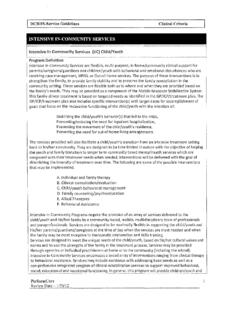
1 Admin Offices: 3587 Heathrow Way Medford, OR 97504 Phone: Robert C. Beckett, Executive Director Intensive Community Based Services ColumbiaCare Services , Inc. ColumbiaCare offers a team of professionals who deliver flexible and responsive Services Based on an individual s circumstances and need in whatever setting the person happens to be in. Often times it is this ability to provide immediate support and care that can make the biggest difference, potentially changing the trajectory from a negative and costly one, to one of healing and a positive outcomes. ColumbiaCare s Intensive Community - Based Services include the following: Hospital Assessment/Diversion: On-call response to ER when a CCO member is experiencing a psychiatric crisis.
2 Crisis Stabilization: Less restrictive and more appropriate treatment option for persons in psychiatric crisis but who do not need the medical capabilities of an acute care hospital. Transitional Supportive Housing: Temporary housing complete with support Services and periodic staff check-ins. Intensive Case Management: Flexible Services provided in a person s home or other Community setting, continuing on a short or long-term basis to maintain them safely in the Community without hospitalization Post Hospitalization Follow-Up Appointments: Therapeutic contact within 7 days of discharge to significantly reduce subsequent hospitalization or crisis, and to encourage access to, and continuation of care.
3 For more information, please contact Ben Solheim, Community Based Program Manager at or How can we help. Hospital Assessment & Diversion. We understand that diverting individuals from unnecessary hospitalization can be extremely clinically beneficial for a person experiencing a mental health crisis. It also saves money. Our ICM staff are available on-call to respond when an individual is experiencing a psychiatric crisis and has been taken to a hospital in the tri-county area. ColumbiaCare staff provide assistance upon request by performing a mental health assessment and review to determine what the clinical and safety needs of the Member are; and whether or not they can be safely treated in a less Intensive and medically necessary level of care as an alternative to inpatient hospitalization.
4 Next steps may include referring them to the closest crisis center. Transitional Supportive Housing Services . Transitional Supportive Housing programs are non-licensed residential programs that can offer safe short-term housing along with varying levels of support depending on the needs of the Member. ColumbiaCare has contracted with a Health Plans to provide exclusive use of in-home, transitional Services at our Rosebud facility to their Members who have a mental health concern; who need temporary or transitional housing and support Services ; and who are not in need of hospital or Crisis Resolution Center level of care. Tenants are identified and referred through the contracting agency, and admission is a collaborative process between ColumbiaCare and the referring entity.
5 Unless otherwise arranged, tenants provide their own food, clothing, transportation, personal items, and medication. ColumbiaCare staff provide 4 periodic health and safety visits per 24-hr period that, whenever possible, coincide with medication schedules. ColumbiaCare provides a layer of safety and supervision--through documented visits, as well as on-call availability. Professional staff may provide therapy, skills training, psychiatric Services , health Services , case management, and other therapeutic Services as requested and pre-authorized by the CCO. ColumbiaCare also provides food Services (delivery of up to 3 meals per day plus snacks) when needed and pre-arranged.
6 This type of program can be accessed or duplicated in your area. Post Hospital Follow-Up. Post-Hospital Follow-Up Contact (PHFC) is another innovative way that ColumbiaCare is helping CCOs meet performance metrics, while helping people avoid unnecessary, traumatic, and costly re-admits to hospital settings. National studies show that a person who receives a follow-up contact from a mental health representative within 7 days of a hospital discharge are significantly less likely to be decompensate and be readmitted to the hospital. ColumbiaCare uses Qualified Mental Health Associates and Qualified Mental Health Professionals from our ICM Team to ensure those contacts are made, and that the Member is either connected to their own service provider (a follow up appointment made), or are seen by one of our treatment professionals.
7 Intensive Case Management (ICM). ColumbiaCare ICM Services are a flexible, Community - Based package of care that includes assessment, strengths- Based treatment planning, and recovery oriented case management that helps identify the individual s service needs, and establishes and maintains Community support systems and service coordination. ColumbiaCare s professional ICM Team will deliver high-quality, evidence- Based Services that are flexible; provided in the individual s home or other Community setting; and may continue on a short or long-term basis. The purpose of ICM Services is to maintain the client safely in the Community without hospitalization. ColumbiaCare s Intensive Community - Based Services are a package of care from which a CCO can access Services on behalf of their members to help them transition out of more Intensive and expensive levels of treatment, and when possible, avoid psychiatric hospitalization.
8 It can also be used to help them maintain stability in their current living situation. We can essentially help solve some of the most difficult behavioral health problems a person can face, in the least intrusive way, while reducing costs to the system. ColumbiaCare has been partnering with other CCOs to meet their service needs, which has resulted in excellent outcomes for the individuals we jointly serve. We are able to contract with CCOs for a flat fee that covers all of the Services their Members may need, or according to a case rate schedule, or a combination thereof. We provide a safety net of Services so that people with a mental illness do not fall through the gaps.
9 Crisis Centers. A Crisis Resolution Center (CRC) is a 24/7 facility that provides an important link in the continuity of care between long-term hospitalization and independent living. It can serve as a less restrictive and more clinically appropriate treatment option for persons who are in psychiatric crisis but who don t need the medical capabilities of an acute care hospital. Treatment is intended to keep the person safe, stabilize their acute psychiatric symptoms, and return them to their familiar living situation and treatment as soon as possible. Treatment usually entails a combination of Milieu Therapy, Psychotropic Medications, Solution Focused Brief Therapy, and Assertive Case Management.
10 Crisis programs can be used to stabilize a person in an emergency, provide an intermediary transition step from a higher level of care to the Community , act as a cooling off place when a home situation has become intolerable, provide a resource where a person can be monitored during medication changes, and/or be used as an after care environment for a person with suicide attempts or ideation. Crisis programs are one of the most valuable resources a Community can have.