Transcription of International Space Station Basics
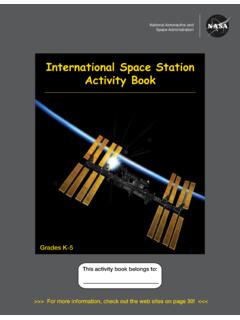
1 National Aeronautics and Space Administration International Space Station Basics The International Space Station (ISS) is the largest orbiting laboratory ever built. It is an International , technological, and political achievement. The five International partners include the Space agencies of the United States, Canada, Russia, Europe, and Japan. The first parts of the ISS were sent and assembled in orbit in 1998. Since the year 2000, the ISS has had crews living continuously on board. Building the ISS is like living in a house while constructing it at the same time. Building and sustaining the ISS requires 80 launches on several kinds of rockets over a 12-year period.
2 The assembly of the ISS will continue through 2010, when the Space Shuttle is retired from service. When fully complete, the ISS will weigh about 420,000 kilograms (925,000 pounds). This is equivalent to more than 330 automobiles. It will measure 74 meters (243 feet) long by 110 meters (361 feet) wide. This is equivalent to a football field, including the end zones. The pressurized volume will be 935 cubic meters (33,023 cubic feet), larger than a five-bedroom house. The solar array surface area will be 2,500 square meters (27,000 square feet), which is an acre of solar panels and enough to power 10 average-sized homes with 110 kilowatts of power.
3 The ISS orbits between 370 and 460 kilometers (230 286 miles) above Earth s surface. The average distance is similar to the distance between Washington, DC, and New York, NY. The ISS orbits at a inclination around Earth. This angle covers 90 percent of the populated area of Earth. When fully assembled, the ISS will be the third brightest object in the sky, after the Sun and Moon. Every 3 days, the ISS passes over the same place on Earth. To find out when the ISS will be visible from any given city, visit It takes about 90 minutes for the ISS to circle Earth one time. The ISS orbits Earth 16 times per day, so astronauts can see 16 sunrises and 16 sunsets each day!
4 During the daylight periods, temperatures reach 200 C, while temperatures during the night periods drop to -200 C. The view of Earth from the ISS reveals part of the planet, not the whole planet. In fact, astronauts can see much of the North American continent when they pass over the United States. To see pictures of Earth from the ISS, visit Components of the ISS The components of the ISS include shapes like canisters, spheres, triangles, beams, and wide, flat panels. The modules are shaped like canisters and spheres. These are areas where the astronauts live and work. On Earth, car-bonated drinks come packaged in small canisters to hold the pressurized liquids efficiently.
5 Similarly, the Laboratory Destiny holds a pressurized atmosphere. Russian modules like Zvezda (which means star ) and Zarya (which means sunrise ) consist of a combination of spheres and canisters. Triangles and beams are used for strength on Earth in structures like bridges. The truss that forms the backbone of the Station is made up of many triangular structures and beams. Panels are wide, flat surfaces used to cover large areas. On the ISS, the solar panels are used to collect sunlight and convert this energy into electricity. Likewise, radiators are waffle-shaped panels used to get rid of extra heat that builds up in the Station .
6 The ISS also has a robotic arm known as the Remote Manipulator System. It is used to help construct the Station by grappling and moving modules or by moving astronauts into position to work on the Station . The robotic arm was built by Canada and is called Canadarm 2. The first Canadarm is on the Space Shuttle and is used to retrieve cargo from the Shuttle bay. National Aeronautics and Space Administration Components of the ISS (continued) Module Length Launched Module Length Launched Zarya m (42 ft) 1998 Node 2 m (21 ft) To be launched Unity m (18 ft) 1998 Columbus m ( ft) To be launched Zvezda m (43 ft) 2000 Experiment LogisticsZ1 Truss m (15 ft) 2000 Module (ELM) P6 Truss m (60 ft) 2000 Pressurized Section (PS) m (12 ft) To be launched Solar Array m (240 ft) 2000 Dextre m ( ft) To be launched Destiny m (28 ft) 2001 Kibo m ( ft) To be launched Canadarm 2 m (56 ft) 2001 S6 Truss m (45 ft) To be launched Quest Airlock m (18 ft)
7 2001 ELM Exposed Section m ( ft) To be launched Pirs Airlock m (16 ft) 2001 Kibo Exposed Facility m ( ft) To be launched S0 Truss/MobileRussian Multi-Purpose Transporter m (44 ft) 2001 Laboratory Module m (42 ft) To be launched Mobile Base m (19 ft) 2002 Node 3 m (21 ft) To be launched S1 Truss m (45 ft) 2002 Cupola 3 m ( ft) To be launched P1 Truss m (45 ft) 2002 Russian Research P3/P4 Truss m (45 ft) 2006 Module m (42 ft) To be launched P5 Truss m (15 ft) 2006 Soyuz 7 m ( ft) Ongoing S3/S4 Truss m (45 ft) To be launched Progress m (24 ft) Ongoing S5 Truss m (15 ft) To be launched National Aeronautics and Space Administration Four Easy Ways To Obtain NASA Educational Materials The NASA Office of Education works collaboratively with NASA s Mission Directorates to promote education as an integral component of every major NASA research and development mission.
8 These efforts result in innovative and informative educational materials that engage student interest in science, technology, engineering, and mathe-matics. NASA makes these resources available in four convenient ways: Access educational resources online from NASA s Web site. Visit a NASA Educator Resource Center (ERC). Order select materials through OfficeMax. Purchase materials from the Central Operation of Resources for Educators (CORE). NASA s ERC Network The NASA ERCs are located throughout the United States, the Virgin Islands, and Puerto Rico. ERCs offer information about NASA and its educational resources and services.
9 Personnel provide inservice and preservice training using NASA curriculum support materials. ERC team members also collaborate with educational organi-zations to foster systemic initiatives at local, state, and regional levels. OfficeMax NASA and OfficeMax have partnered to provide educators with a print-on-demand service to acquire NASA curriculum support materials. Using the Internet, educators can search an online database of NASA materials, preview them, order online, and pick them up at the nearest OfficeMax all for a nominal fee. If educators reside more than 50 miles from an OfficeMax, the materials can be shipped to them for an additional postage charge.
10 The NASA Web Site The NASA portal at serves as the gateway for information on missions, research, programs, and services offered by NASA. The educational sections provide educators with access to curriculum support materials and resources produced through collaborations with NASA s Mission Directorates. Materials may be down-loaded and printed from the following locations: Educator Guides, Classroom Activities, Posters, Litho-graphs, Brochures, and Bookmarks Themed Collections of Online Resources schedule/ Classroom Subject Matter Topics subjects/ NASA Education Express Mailing List Sign up for announcements about NASA products and activities.