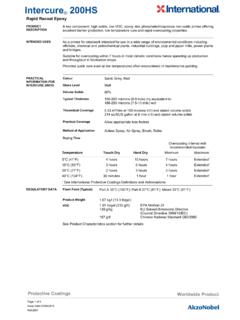
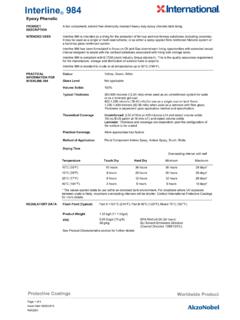
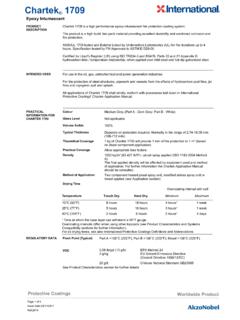
Transcription of Interthane 990 - AkzoNobel
1 Interthane 990. Polyurethane PRODUCT A two component acrylic polyurethane finish giving excellent durability and long term recoatability. DESCRIPTION. INTENDED USES Suitable for use in both new construction and as a maintenance finish which can be used in a wide variety of environments including offshore structures, chemical and petrochemical plants, bridges, pulp and paper mills, and in the power industry. PRACTICAL Colour Wide range via the Chromascan system INFORMATION FOR. Interthane 990 Gloss Level High Gloss Volume Solids 57% 3% (depends on colour).
2 Typical Thickness 50-75 microns (2-3 mils) dry equivalent to 88-132 microns ( mils) wet Theoretical Coverage m /litre at 50 microns and stated volume solids 457 gallon at 2 mils and stated volume solids Practical Coverage Allow appropriate loss factors Method of Application Airless Spray, Air Spray, Brush, Roller Drying Time Overcoating Interval with recommended topcoats Temperature Touch Dry Hard Dry Minimum Maximum -5 C (23 F) 8 hours 60 hours 60 hours Extended . 5 C (41 F) 5 hours 24 hours 24 hours Extended.
3 15 C (59 F) 150 minutes 10 hours 10 hours Extended . 25 C (77 F) 90 minutes 6 hours 6 hours Extended . 40 C (104 F) 60 minutes 3 hours 3 hours Extended . See International Protective Coatings Definitions and Abbreviations REGULATORY DATA Flash Point (Typical) Part A 34 C (93 F); Part B 49 C (120 F); Mixed 35 C (95 F). Product Weight kg/l ( lb/gal). VOC lb/gal (420 g/lt) EPA Method 24. 341 g/kg EU Solvent Emissions Directive (Council Directive 1999/13/EC). See Product Characteristics section for further details Protective Coatings Worldwide Product Page 1 of 4.
4 Issue Date:27/04/2015. Ref:2484. Interthane 990. Polyurethane SURFACE All surfaces to be coated should be clean, dry and free from contamination. Prior to paint PREPARATION application all surfaces should be assessed and treated in accordance with ISO 8504:2000. Primed Surfaces Interthane 990 should always be applied over a recommended anti-corrosive coating scheme. The primer surface should be dry and free from all contamination and Interthane 990 must be applied within the overcoating intervals specified (consult the relevant product data sheet).
5 Areas of breakdown, damage etc., should be prepared to the specified standard ( Sa2 (ISO. 8501-1:2007) or SSPC-SP6, Abrasive Blasting, or SSPC-SP11, Power Tool Cleaning) and patch primed prior to the application of Interthane 990. APPLICATION Mixing Material is supplied in two containers as a unit. Always mix a complete unit in the proportions supplied. Once the unit has been mixed it must be used within the working pot life specified. (1) Agitate Base (Part A) with a power agitator. (2) Combine entire contents of Curing Agent (Part B) with Base (Part A) and mix thoroughly with power agitator.
6 Mix Ratio 6 part(s): 1part(s) by volume Working Pot Life -5 C (23 F) 5 C (41 F) 15 C (59 F) 25 C (77 F) 40 C (104 F). 26 hours 12 hours 4 hours 2 hours 45 minutes Airless Spray Recommended Tip Range mm (13-18 thou). Total output fluid pressure at spray tip not less than 155 kg/cm (2204 ). Air Spray Recommended Gun DeVilbiss MBC or JGA. (Pressure Pot) Air Cap 704 or 765. Fluid Tip E. Air Spray Recommended Use suitable proprietary equipment (Conventional). Brush Suitable Typically 40-50 microns ( mils) can be achieved Roller Suitable Typically 40-50 microns ( mils) can be achieved Thinner International GTA713 Do not thin more than allowed by local (or International GTA733 environmental legislation or GTA056).
7 Cleaner International GTA713 (or International GTA733 or GTA056). Work Stoppages Do not allow material to remain in hoses, gun or spray equipment. Thoroughly flush all equipment with International GTA713. Once units of paint have been mixed they should not be resealed and it is advised that after prolonged stoppages work recommences with freshly mixed units. Clean Up Clean all equipment immediately after use with International GTA713. It is good working practice to periodically flush out spray equipment during the course of the working day.
8 Frequency of cleaning will depend upon amount sprayed, temperature and elapsed time, including any delays. All surplus materials and empty containers should be disposed of in accordance with appropriate regional regulations/legislation. Page 2 of 4. Interthane 990. Polyurethane PRODUCT Interthane 990 is available in a range of metallic finishes - please consult the separate Interthane CHARACTERISTICS 990 Metallic Working Procedures document for further information. Level of sheen and surface finish are dependent on application method.
9 Avoid using a mixture of application methods whenever possible. Best results in terms of gloss and appearance will always be obtained by conventional air spray application. For brush and roller application, and in some colours, two coats of Interthane 990 may be required to give uniform coverage, especially when applying Interthane 990 over dark undercoats, and when using certain lead free bright colours such as yellows and oranges. Best practice is to use a colour compatible intermediate or anticorrosive coating under the Interthane 990.
10 When overcoating after weathering or ageing, ensure the coating is fully cleaned to remove all surface contamination such as oil, grease, salt crystals and traffic fumes, before application of a further coat of Interthane 990. Absolute measured adhesion of topcoats to aged Interthane 990 is less than that to fresh material, however, it is adequate for the specified end use. This product must only be thinned using the recommended International thinners. The use of alternative thinners, particularly those containing alcohols, can severely affect the curing mechanism of the coating.