Transcription of INTESTACY - Bergen County Surrogate
1 [HOME] [ABOUT US] [THE Surrogate ] [PROBATE] [WILLS] [POWER OF ATTORNEY] [ADVANCE DIRECTIVES] [ INTESTACY ] [NOTICE OF PROBATE] [OUTREACH] [SATELLITE OFFICES] INTESTACY It is estimated that almost one third of Bergen County residents who die this year, will die without a Will. While I encourage County residents to execute a Will and strongly recommend a Will for every Bergen County adult this article provides the estate procedure when a Bergen County resident dies without a Will. (Another pamphlet setting forth the procedure for "How to Probate a Will in Bergen County " can be obtained, without charge, by contacting the Bergen County Surrogate 's Court at (201) 336-6700.)
2 The estate of every Bergen County resident must be settled with the Bergen County Surrogate 's Court unless the deceased owned no assets individually (in his or her name alone) in New Jersey. Except in that limited circumstance, an estate must be presented to the Bergen County Surrogate before transfer and disbursement of the deceased's assets can occur. This estate settlement requirement applies whether the person died with or without a Will. The estate of a person who dies without a Will is called an "intestate" estate. Whoever is to take charge of the assets of an intestate estate must appear at the Bergen County Surrogate 's Court to make application to be designated as the estate's "Administrator".
3 Those who are first entitled to be appointed the administrator are the closest surviving next of kin. The Administrator's responsibilities include assembling the estate's assets, paying any outstanding debts of the deceased from those assets and disbursing those remaining assets according to law. The applicant is not required to hire an attorney; this is the individual choice of the applicant. In fact, most applicants complete the entire Surrogate 's Court process without the need for an attorney. However, you may bring an attorney to the Surrogate 's Court if you would feel more comfortable.
4 To apply to be the Administrator of an intestate estate, a person must bring the following to the Bergen County Surrogate 's Court: (1) The original death certificate with a raised seal; (2) An estimate of the gross value (but not an item-by-item description) of the estate covering all real estate and non-real estate (personal) assets; (3) The complete names and addresses of the deceased's next of kin; (4) A blank New Jersey check or cash for fees--the average fees, excluding bonding costs, are $125-$150; and (5) If applicable, a formal written Renunciation of the right to serve as the estate's Administrator signed (in the presence of a Notary Public) by every person, if any, who has prior or equal right to the applicant to serve as the estate's Administrator.
5 You may telephone the Surrogate 's Court at (201) 336-6700 in advance and we will mail you the appropriate Renunciation Forms, without charge. As a matter of law, the family members of the deceased have the first right to serve as the Administrator, in the following order of preference: spouse, surviving partner of a civil union, domestic partner, children, grandchildren, parents, brothers, sisters, nieces, or nephews. Should no family member seek appointment, then a creditor or any interested party may apply. A person who renounces the right to serve as Administrator may do so without disclaiming the right to receive any of the deceased's assets.
6 In contrast, by having a Will, a person can choose the individual(s) ( , "Executor(s) ) he or she wishes to take charge and distribute his or her estate's assets. Once the above described items have been received, the Surrogate will appoint the applicant as the Administrator of the intestate estate. In most cases, the Administrator must be bonded until the estate has been properly assembled and distributed. This bonding fee is in addition to the $125-$150 in average fees paid by the person seeking to be appointed as Administrator. Bonding is required to protect the creditors and beneficiaries of the estate from the possibility that the Administrator will misuse his or her authority to their financial detriment.
7 There are, however, exceptions to the bonding requirement for intestate estates. These exceptions depend on when the death occurred, prior to February 27, 2005 or after this date (see description of these exceptions in the applicable section A or B ). After the Administrator has been bonded and appointed, the Surrogate 's Court will then issue Surrogate 's Certificates (also known as Letters of Administration) that are used to assemble and transfer the intestate estate's assets. It is recommended that you order several extra copies of these Certificates, especially if assets are held at several banks, brokerage firms, with insurance companies and/or are pension plans.
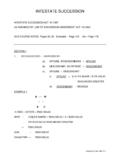
8 They will also be needed to sell or transfer motor vehicles and all real estate assets. Along with the Certificates, a General Information Brochure regarding the New Jersey Inheritance Tax and Estate Tax is sent by the Surrogate 's Court to the Administrator by mail within 5-7 business days of his or her appointment. The laws of the State of New Jersey provide for the assets of the intestate estate, if the deceased died on or after February 27, 2005, to be distributed to the next of kin by "intestate succession", as follows: Section A IF DECEASED DIED ON OR AFTER FEBRUARY 27, 2005: The intestate share of the surviving spouse, surviving partner of a civil union, or domestic partner is: ** NO BOND REQUIRED FOR THE FOLLOWING CIRCUMSTANCES ** i.
9 The entire estate if: a) No descendant or parent of the deceased survives him or her; b) All of the deceased surviving descendants are also descendants of the surviving spouse, surviving partner of a civil union, or domestic partner and there is no other descendant of the surviving spouse, surviving partner of a civil union, or domestic partner who survives the deceased. ** BOND REQUIRED FOR THE FOLLOWING CIRCUMSTANCES ** ii.) The first 25% of the intestate estate, but not less than $50, nor more than $200, , plus three-fourths of any balance of the intestate estate, if no descendant of the deceased survives the deceased, but a parent of the deceased survives the deceased.
10 Iii.) The first 25% of the intestate estate, but not less than $50, nor more than $200, , plus one-half of the balance of the intestate estate: If all of the deceased s surviving descendants are also descendants of the surviving spouse, surviving partner of a civil union, or domestic partner and the surviving spouse, surviving partner of a civil union, or domestic partner has one or more surviving descendants who are not descendants of the deceased; If one or more of the deceased s surviving descendants is not a descendant of the surviving spouse, surviving partner of a civil union, or domestic partner.

![[HOME] [ABOUT US] [THE SURROGATE] …](/cache/preview/4/9/9/c/3/3/f/9/thumb-499c33f99d9d352d7566efad58b416c1.jpg)