Transcription of Introduction – it’s as simple as A, B, C, D
1 Risk Management in Facility Management Mercury Computer Systems P/L Page 1 of 6 Introduction it s as simple as A, B, C, D .. A. Identify B. Document C. Plan D. Deploy The whole purpose of Risk Management Plan in Facility Management is to LOWER the likelihood of accidents or failure events and to MINIMIZE the consequences of accidents or failure events. No one can guarantee that equipment will not fail, or that humans will not make mistakes, or that accidents will not happen. But you can put a process in place that when these events do occur that the result will be fail safe or have minimum impact on the operation of the organisation. What I will outline in this paper is not rocket science but rather common sense.
2 The usefulness of this paper is that it can be used as a starting point or outline to develop your own risk management plan. I have also created a data collection document that can be used for the identification, documentation and planning process. This document Risk Assessment & Planning Form is available, at no cost, from the author. My objective is to discuss and document a Risk Management framework so that organisations can initially identify risks, collect and document information, plan and setup a risk management strategy and deploy the plan and continue to assess new risks. A. Identify Perhaps the first step in setting up a risk management procedure is to IDENTIFY what the possible risks are or the Risk Classes.
3 The reason for having a Risk Class checklist is to guide people in the assessment process to check things that may not normally occur to them. For example if I were given a clipboard and told to identify the risks associated with a power distribution board. It may not occur to me to check if the distribution board could be invaded by insects, birds or rodents. Just some of these Risk Classes are: Asset Failure The sudden unexpected failure of an asset. A steam pipe bursts in a public access corridor. Asset Degradation The relative slow degradation of an asset s performance over time which is not noticed. A lift car not stopping level with the floor level. Asset Invasion In this class, the asset may continue to work perfectly normally, however the asset itself gets invaded or colonised.
4 For example Legionaries bacteria happily growing in the nice warm cooling tower water does not affect the cooling ability of the tower, but the asset becomes deadly. Bird nests or insect invasion can lead to asset failure or other unexpected problems. Risk Management in Facility Management Mercury Computer Systems P/L Page 2 of 6 Unexpected Human Behaviour Humans behaving in a totally unexpected way. For example someone becomes very upset and attacks or damages equipment, power distribution switchboards etc. Possible misinterpretation by humans Poorly worded instructions or signs can lead people to do things that are dangerous to themselves or others or contribute to dangerous conditions developing. Identify the Risk: The reason for having a Risk Class checklist is to guide people in the assessment process to check things that may not normally occur to them.
5 B. Document The collection of information about risk management is a very time consuming process, but the collection of this information is itself a powerful risk management strategy. What I mean is that it is better to have known about a risk and not yet done anything about it than not to have even been aware of the risk or made no attempt to document the risk. The collection of information can be done by many people at the same time and should be done by people with knowledge about the specific asset class or area. My recommendation is for the specific trade staff to do the collection because they probably know more about the asset classes they work with and would be more accepting of risk management procedures for which they had some input.
6 For example a Refrigeration Mechanic would be able to assess the risks associated with equipment that they normally work on. Document the Risk: Specific trade staff to do the collection because they probably know more about the asset classes they work with and would be more accepting of risk management procedures for which they had some input. Refer to the example Risk Assessment Collection & Planning Form that follows on the next page. This document can be used by trade staff to go out and begin the collection of information. The document can of course be used in an ongoing capacity during the commissioning of new equipment or the take on process of managing another building or facility.
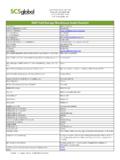
7 Risk Management in Facility Management Mercury Computer Systems P/L Page 3 of 6 The suggested Risk Assessment Collection & Planning Form: (use or to indicate if the item is applicable): (a) Asset + description or location (enter an asset no + description or a physical location eg. loading bay) (b) Risk Class(s) involved (select the risk classes that apply to this asset or location) ! Asset Failure ! Asset Degradation ! Asset Invasion ! Unexpected Human Behaviour ! Misinterpretation by Humans (c) What could go wrong? (describe in words what could go wrong with the asset or location) (d) Failure mode(s)? (select the mode(s) catastrophic, slow degradation, intermittent) ! Catastrophic ! Slow degradation ! Intermittent failure Evidence of failure !
8 No external evidence ! Visual, sound or smell (e) What are the consequences of failure? (describe in words) (f) Critically of failure (choose a value 1, 2, 3, 4, 5) ! Level 1 life threatening ! Level 2 major disruption ! Level 3 minor disruption ! Level 4 inconvenience ! Level 5 almost no impact (g) What is the likelihood of this failure in the next 12 months? (enter a value 0% to 100%) (h) What can we do to minimise damage when this happens? (describe in words) (i) What can we do to recover from the event? (describe in words) (j) What can we do to prevent the event? (describe in words) Risk Management in Facility Management Mercury Computer Systems P/L Page 4 of 6 (k) Agreed risk minimisation action (describe in words or identify specific CMMS Task Id) (l) Agreed frequency of action (how often the risk minimisation action is to be carried out, for example every 2 weeks) Every _____ !
9 Once only ! Days ! Weeks ! Months ! Years C. Plan Now that some of the Risk Assessment Collection & Planning Forms have been filled in and returned, the planning process can take place. Of course in some cases the plan will be very straight forward and very obvious. For example suppose an Automatic Sliding Door was assessed and was located in the ambulance entry for the Emergency Room area. If the assessment showed some possible risks such as Door remains closed if power failure occurs and cannot be opened manually and Door has no visual markings on glass and could be mistaken for being open when it was closed . These two risks can be dealt with by a one off door modification that allows the door to be manually opened during a power failure and the application of some decals to give some visual indication that the door is closed.
10 The location of this door and any failure of the door can make this a relatively high risk asset. Using the Risk Assessment Collection & Planning Form, every asset or location can have a structured and well thought out risk plan. ! This plan would address what items of equipment spares need to be carried if the risk event occurs and thus the duration and extent of the event can be reduced. ! The plan can make sure that clear instructions exist on how to respond to the risk event, for example electrical isolation process, shutdown sequences for computer driven systems etc. A well setup CMMS would provide this alert function. ! The plan should define an inspection (checklist) or task and have this task carried out regularly at some recurrent interval such as every 3 months.