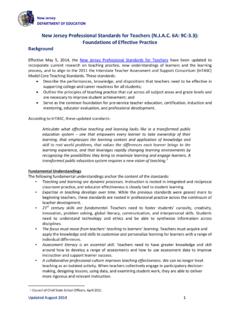
Transcription of Introduction SNAKES OF
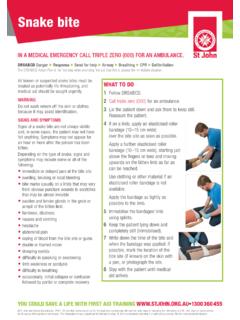
1 Wash the bite with soap and water. Introduction Throughout history, no other group of animals has undergone and sur- SNAKES : Descriptions, Pictures and 4. Corn snake (Elaphe guttata guttata): Immobilize the bitten area and keep it lower than your SNAKES have been around for over 100,000,000 years and despite the vived such mass disdain. Today, in spite of the overwhelming common Range Maps 24 -72 L. The corn snake is a heart. What not to do if bitten by a SNAKES OF odds, historically, 23 species of SNAKES existed in New Jersey. However, most herpetologists believe the non-venomous queen snake is now extirpated (locally extinct) in New Jersey. 22 species of SNAKES can still sense and the biological facts that attest to the snake's value to our environment, a good portion of the general public still looks on the snake as something to be feared, destroyed, or at best relegated to 1.
2 Northern water snake (Nerodia sipedon sipedon): 22 -53 L. This is one of the most common SNAKES in NJ, inhabit- state endangered species found in the Pine Barrens of NJ. It inhabits sandy, forested areas preferring pine-oak forest with venomous snake glassed-in cages at zoos. ing freshwater streams, ponds, an understory of low brush. It Do not attempt to draw venom from a wound by sucking. Attempts to draw venom from a wound should only be done with a snake-bite venom -extractor kit. NEW JERSEY be found in the most densely populated state in the country. Two of our snake species are venomous, the timber rattlesnake and the northern copperhead, and the remaining twenty species are non-venomous. New Jersey's snake populations have declined during the past 50. All SNAKES can swim, but only the northern water snake and queen snake rely heavily on waterbodies.
3 Northern water SNAKES are frequently found swimming in waterways and bask- lakes, swamps, marshes, and bogs throughout the state. Commonly observed basking communally on logs and rocks may also be found in hollow logs, railroad ties, and founda- tions of old build- ings as well as Do not cut the wound or apply ice to the bite. years for a number of reasons. Habitat destruction in the form of ing on embankments, and are often mistaken for water moc- along stream banks, this snake under boards Do not apply a tight bandage. If medical assistance will take urbanization has been a primary cause, but pollution, changing land casins, which do not occur in New Jersey. is often misidentified as NJ's and logs. This snake is locally called the red rat snake.. longer than 30 minutes to reach you, wrap a bandage 2-4 use, commercial collecting and human persecution have all contributed SNAKES do not chase people.
4 Male SNAKES may defend their northern copperhead. The The ground color is variable, ranging from orange to mates during the breeding season by moving towards a preda- ground color is brown or gray with darker brown, reddish, brown to gray. Orange, red, or brown blotches outlined in inches above the wound to attempt to slow the venom trans- to the reduction of our snake populations. The copperhead is a state or black bands on the neck and back. The darker pattern black extend the down the length of the back and some fer through the bloodstream. Be careful not to tie the band- species of special concern and the rattlesnake is listed as endangered. tor, including people, while the female escapes by moving in color forms wider bands along the back and slightly nar- individuals may have stripes rather than blotches. They age too tightly, constricting blood flow.
5 You should be able In fact, the timber rattlesnake is listed as endangered or threatened in the opposite direction. Otherwise, SNAKES will try to move away rower bands on the sides, resembling a reverse hour- have weakly keeled scales. Five to 18 eggs are laid in to slip a finger beneath the tied bandage. all but one northeastern state. Aside from the listed venomous SNAKES , from people. glass pattern. Older water SNAKES are much darker, usual- July or August, hatching in late August September. additionally listed state species include the threatened pine snake and SNAKES do not prefer to be around people. To SNAKES , people are ly brown or black with faint remnants of pattern while juve- predators and should be avoided. niles' patterns are typically more vivid. They have keeled 5. Northern scarlet snake (Cemophora coccinea copei): Requesting assistance with a the state endangered corn snake.
6 14 -321/4 L. The northern scarlet All SNAKES can bite if handled .. just as all animals can bite if scales. They give birth to live young in late summer. The venomous snake All SNAKES perform an integral ecological role in their control of handled. Animals bite to protect themselves when they feel water snake often exhibits a highly defensive disposition snake is an uncommon snake in rodents and insects and are food to other animals such as raccoons, and can inflict a painful, non-venomous bite if handled. NJ. It inhabits sandy soils usually The Division of Fish and Wildlife's Endangered and Nongame threatened. hiding under logs, boards, or Species Program (ENSP) has developed the Venomous Snake opossums, black bears, coyotes, bobcats, other SNAKES , hawks and owls. Even mice will nibble on SNAKES when they are inactive during Rattlesnakes do not travel in pairs.
7 Although rattlesnakes den 2. Eastern milk snake (Lampropeltis triangulum triangulum): debris. It may also be found in or Response Team (VSRT) to respond to human/venomous snake communally and may share early-season basking areas, they 24 -52 L. The milk snake is a near damp woodlands. It resem- interactions and increase an awareness of our responsibilities for hibernation. common species found in NJ. It bles the poisonous coral snake of SNAKES are not slimy or wet as some people think, but are actually spend much of their active season alone. inhabits various habitats includ- the southern , however, the living in venomous snake country. The VSRT is a group of trained The Division of Fish and Wildlife did not re-establish rat- ing fields, wooded areas, river- dry to the touch. Most have a small head compared with the rest of the northern scarlet snake is not poi- volunteers that includes animal control officers, park rangers, local tlesnake populations in New Jersey.
8 Timber rattlesnake popula- banks, and rocky hillsides. It sonous. Its red bands do not and state police, and other select individuals that are on-call to body, but the jaws are loosely hinged so that the mouth can be extend- may be found in barns or other Adult above; Juvenile below ed to swallow objects several times larger than the snake's own head. tions have been steadily declining due to wanton killing, illegal extend all the way around the remove venomous SNAKES from private lands upon request. They collection, and more recently, habitat destruction and encroach- buildings that house rodents. It body and are bor- also educate landowners about SNAKES and instruct them on how to The non-venomous SNAKES in New Jersey have a single row of small, is often mistaken for NJ's north- dered by black with even-length teeth which point slightly backward to help hold prey.
9 The ment. Rattlesnakes, copperheads, and many of our non-ven- ern copperhead or timber rat- white or creamy- live safely in snake country. SNAKES are removed from harms way omous SNAKES can not be relocated as they have a strong affin- venomous rattlesnake and copperhead have two large, hinged, hollow tlesnake. The yellow interspaces. and returned to nearby areas away from human habitation. ity to their home ranges and most likely will not survive in ground color is They have smooth Landowners that encounter timber rattlesnakes or northern cop- fangs, one on each side of the upper jaw, which may inject venom when they strike. The venom is used to immobilize and kill small prey, unfamiliar territory. creamy gray with scales. This snake perheads on their property and wish to have them removed should red or brown rarely comes above mostly rodents.
10 Both of the venomous SNAKES are members of the pit blotches outlined contact ENSP immediately. viper family, which have (an) elliptical pupils and the characteristic Controlling snake presence in black along the ground except at Monday Friday (8:30 am 4:30 pm) night. heat-sensing pit that is located between the eye and the nostril. Keep your lawn mowed short to deter snake presence and so back and sides. Northern Region Office: 908-735-8975, 735-9281 or you can view potential snake activity at a glance. Commonly, a Y- or V-shaped light patch can be found on 6. Eastern kingsnake (Lampropeltis getula getula): 735-2931 The venomous SNAKES of New Jersey are feared the most due to mis- information and misunderstanding. Each year many non-venomous Keep your property free of mulch and debris piles. Mulch is the nape of the neck.