Transcription of Introduction to Comprehension Question B
1 Introduction to Comprehension Question B. Question B, the short writing task, is worth 50 marks. This is the same as the marks given for the prescribed poetry section, so it is well worth taking the time to prepare for this task. It is a relatively simple exercise to prepare for and students should be aiming for high marks here. Unfortunately, many students do not take this short writing task seriously enough, and fail to get a good grade. You must answer Question A from one Comprehension and Question B from another. It is a good idea to check all the Question Bs first and choose one that suits you, and then decide which Comprehension you will use for Question A.
2 Typically, Question B asks for a response in one of the following forms: Letters Short Talks Reports Diary Entries Reviews Newspaper or Magazine Articles Interviews Advertisements Aoife O'Driscoll Page 1 Points to Note This is a short piece of writing, roughly a page or two of foolscap. Keep an eye on the length: this is not a composition so don't make your answer too long. (300 words is about a page of foolscap, assuming an average of ten words per line.) Check to see if a particular length is specified. Plan your answer. You should get into the habit of doing this for every section of Paper 1 and Paper 2.
3 A plan need not be detailed or contain more than a few words per paragraph. If you write a plan, it will ensure that you do not wander off the point and will also show you at an early stage whether you have enough material to sustain an entire assignment. If this is the case, better to abandon the task at this point and try another, rather than wasting time and trying to start again after fifteen minutes of writing. When you are planning the short writing task, think of the following five steps: I, E, E, S, C. These letters stand for Introduction , Elaboration, Exploration, Summary and Conclusion.
4 Think about the target audience for the piece. If you are writing a letter to your friend the tone can be chatty and informal whereas if you are writing a letter to a government minister, the tone must be formal. Which language genre are you going to use? Will you be using more than one? You don't have the time or the space to ramble on so make sure your points are organised before you write. It can help to ask yourself the following four questions before you begin your Question B: 1. What form should this task take? 2. What should the content be? 3. Who is my audience?
5 4. What register should I use? Aoife O'Driscoll Page 2 Themes Each year, a theme is chosen which reflects some aspect of the lives of teenagers today. Always check the theme, which is given to you in capital letters on the first page of the exam papers. Be aware of the theme when you are answering your Comprehension questions. The theme and the texts can be an aid to your planning. 2015 CHALLENGES. 2014 INFLUENCES. 2013 STORY-TELLING. 2012 MEMORY. 2011 MYSTERY. 2010 THE FUTURE. 2009 DECISIONS. 2008 IDENTITY. 2007 CHANGE. 2006 PRETENCE. 2005 ORDINARY LIVES.
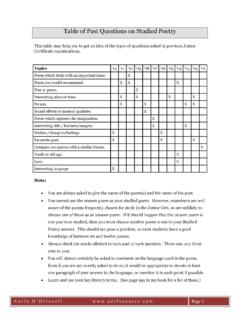
6 2004 WORK AND PLAY. 2003 JOURNEYS. 2002 FAMILY. 2001 IRISHNESS. This table may help you to get an idea of the types of questions asked in previous Leaving Certificate examinations. Topics 15 14 13 12 11 '10 '09 '08 '07 '06 '05 '04 '03 '02 '01. Letter X X X X X X X X X X X X. Talk / Speech X X X X X X X X X. Diary entries X X X X X. Report X X. Article in newspaper/ magazine X X X X X X. Interview X X. Advertisement X. Dialogue X X. proposal to a relevant authority X. Presentation on radio show X X. News report on radio show X. Introduction to a book X X. Aoife O'Driscoll Page 3 Letter Writing - Formal (Sender's address).
7 Address Line 1, Address Line 2, Address Line 3. (Recipient's address). Address Line 1, Address Line 2, Address Line 3. 2nd May 2012. Dear , In the first paragraph you should state the purpose of the letter. Think of the tone: if you are asking for money, you will want to be persuasive. Ask yourself who will be reading the letter and keep this person in mind throughout. Avoid using contractions in formal writing, don't' instead of do not'. In the second paragraph, you should expand on the subject of the letter. Make sure you have made a plan and that there is a logical sequence to the paragraphs.
8 When writing formal letters, skip a line before beginning each new paragraph. In the third and subsequent paragraphs, you should continue to develop the theme of the letter, giving any facts that you think relevant. Four or five points should be sufficient for the Leaving Cert letter. Remember to avoid slang, exaggeration, deeply personal anecdotes and any remarks which may be racist, sexist or otherwise prejudiced. Keep the tone as formal as possible. The final paragraph is usually quite short, thanking the person for taking the time to deal with your complaint or consider your request.
9 If you wish them to take some action on your behalf, this is the time to ask what they intend to do. You may also tell the recipient not to hesitate to contact you if they have any further queries. Yours faithfully, (if you have opened with Dear Sir or Madam). Yours sincerely, (if you have used the recipient's name at the start of the letter). Aoife O'Driscoll Page 4 2012 Text 1 Comprehension Question B. Write a letter to Margaret Laurence, in response to Text 1, commenting on what you find interesting in the extract, and telling her about your home place and its impact on you.
10 Remember to ask yourself these four questions every time you plan your answer: 5. What form should this task take? This is a letter. It is to a person you do not know personally, so it is a formal letter. 6. What should the content be? Note the word and' in the Question . You are required to do two things: tell Margaret Laurence what you found interesting about her description of her home place, AND tell her about your home place. 7. Who is my audience? Your audience in this case is a writer who is not personally known to you but whose work you admire. 8. What register should I use?