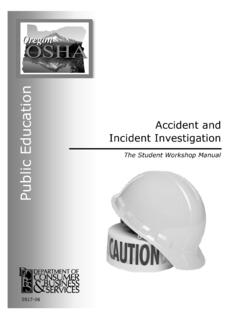
Transcription of Introduction to effective Incident/Accident Analysis
1 Introduction to effectiveIncident/ accident Analysis OSTN incident / accident Analysis Program management2 This material is for training use only OSTN incident / accident Analysis Program management3 This material is for training use onlyThe three primary tasks of the accident investigator is to gather useful information, analyze the facts surrounding the accident , and write the accident report. The intent of this workshop is to help you gain the basic skills necessary to conduct an effective accident investigation at your workplace. Only experience will give you the expertise to fine-tune those of the information about conducting an accident investigation will come directly from the class as we discuss issues, answer basic questions and complete group activities.
2 If you have prior experience in accident investigation, we hope you will participate actively so others may benefit from your valuable input. Ultimately, we want you to leave this workshop knowing how to conduct an accident investigation and properly complete an accident investigation report with confidence using our systematic attending this workshop you should be able to:1. Describe the primary reasons for conducting an accident Discuss employer responsibilities related to workplace accident investigations. 3. Conduct the six step accident investigation procedure IntroductionObjectives OSTN All rights material, or any other material used to inform employers of compliance requirements of OSHA standards through simplification of the regulations should not be considered a substitute for any provisions of the Occupational Safety and Health Act of 1970 or for any standards issued by OSHA.
3 The information in this publication is intended for training purposes only. OSTN incident / accident Analysis Program management4 This material is for training use onlyThe basicsWhat s the definition of an accident ?_____What two key conditions must exist before an accident occurs?H_____ and E_____What causes the most accidents? Hazardous conditions account for 3 % of all workplace accidents. Unsafe/inappropriate behaviors account for 95 % of all workplace accidents. Uncontrollable acts account for 2 % of all workplace accidents Management is able to control, to some degree, the factors that produce 98 % of all workplace is the purpose of an OSHA accident investigationand and employer's accident Analysis ? Why are they different?_____No-Fault accident AnalysisIf someone deliberately sets out to produce loss or injury, that is called a crime, not an accident .
4 Yet many accident investigations get confused with criminal Whenever the investigative procedures are used to place blame, an adversarial relationship is inevitable. The investigator wants to find out what actually happened while those involved are trying to be sure they are not going to be punished for their actions. The result is an inadequate investigation. (Kingsley Hendrick, Ludwig Benner, Investigating Accidents with STEP, p 42. Marcel Dekker, Inc. 1987.)No-Fault accident AnalysisIf someone deliberately sets out to produce loss or injury, that is called a crime, not an accident . Yet many accident investigations get confused with criminal Whenever the investigative procedures are used to place blame, an adversarial relationship is inevitable. The investigator wants to find out what actually happened while those involved are trying to be sure they are not going to be punished for their actions.
5 The result is an inadequate investigation. (Kingsley Hendrick, Ludwig Benner, Investigating Accidents with STEP, p 42. Marcel Dekker, Inc. 1987.)We like to think that accidents are unexpectedorunplannedevents, but most of the time, that s not so. Most accidents result from unsafe conditions and work practices that have been ignored or tolerated for weeks, months, or even years. In such cases, it s not a question of if the accident is going to happen: it s only a matter of when. But unfortunately, the decision is made to take the risk. OSTN incident / accident Analysis Program management5 This material is for training use onlyThe first two steps in the procedure help you gather accurate information about the accident . What are the basic steps for conducting an accident investigation?Step 1 - _____Step 2 - _____Step 3 - _____Step 4 - _____Step 5 - _____Step 6 - _____The six-step processSecure the accident sceneCollect facts about what happenedDevelop the sequence of eventsDetermine the causesRecommend improvementsWrite the reportYour primary goal in this step is to gather information accident that can give critical clues into the causes associated with the accident .
6 To do that you must firstsecure the accident scene. When is it appropriate to begin the investigation?_____What are effective methods to secure an accident scene?_____Step 1: Secure the accident sceneAccidentinvestigationis fact-finding not fault-finding. Gather the first two steps ensure the accident scene does not change and information is gathered immediately. Analyze the three and four break the Incident/Accident "process" into distinct steps so that each of them may be analyzed for surface and root causes. Implement final two steps recommend and communicate corrective actions and management solutions to make sure similar incidents/ accident do not recur. OSTN incident / accident Analysis Program management6 This material is for training use onlyList methods to document the accident scene and collect facts about what happened. _____In this step, you will use various tools and techniques to collect pertinent facts about the accident to determine the: Direct cause of injury.
7 Hazardous conditions and unsafe employee/management behaviors (surface causes) that produced the accident . System weaknesses (root causes) that produced the surface causes for the accident . Step 2: Collect facts about what happenedWhat documents will you be interested in reviewing? Why?_____When is it best to interview? Why?_____Who should we interview? Why? _____Where should we conduct the interview?_____Interviewing OSTN incident / accident Analysis Program management7 This material is for training use onlyCooperate, don t intimidateWhat are effective interviewing techniques? What should we say?.Why?_____ _____ _____ _____ _____What should we do?Why?_____ _____ _____ _____ _____What should we notsay?Why?_____ _____ _____ _____ _____What should we notdo? Why?_____ _____ _____ _____ _____What should we say?
8 Why?_____ _____ _____ _____ _____What should we do?Why?_____ _____ _____ _____ _____What should we notsay?Why?_____ _____ _____ _____ _____What should we notdo? Why?_____ _____ _____ _____ _____ OSTN incident / accident Analysis Program management8 This material is for training use onlyTeam Exercise: Cooperation is the KeyPurpose. Gaining as much information as possible about an accident is extremely important. Interviewing witnesses is both a science and an art, and can make the difference between a failed or a successful accident investigation. This exercise will help you gain a greater awareness of those interviewing techniques that will help ensure your success as an investigator. Remember, you must communicate a message of cooperation, not instructor has had an accident . Your team and the instructor are located at the scene of the accident (classroom) and your job now is to ask follow-up questions to gather information about the accident .
9 Use the space below for your notes. _____ OSTN incident / accident Analysis Program management9 This material is for training use onlyAn accident is the final event in an accident processIn this step, we take the information gathered in step 2 to determine the events prior to, during, and after the accident . Once the events are clearly understood, we can then continue to examine each event for hazardous conditions and/or unsafe behaviors. accident investigations to place blame may not place adequate emphasis on this step. But, developing the sequence of events is critical in the accident Analysis process to fix the event in the unplanned accident process identifies one:Actor - Individual or object An actor initiates a changeby performing or failing to perform an action. An actor may participate in the process or merely observe the process. Action Behavior the actor accomplishes Actions may or may not be observable.
10 An action may describe something that is done or not done. Step 3: Develop the sequence of eventsThe next two steps help you organize and analyze the information gathered so that you may accurately determine the surface and root causes. 1. Dale slipped on a banana. _____2. As Dale lay on the floor, a brick fell on his head . _____3. Larry discovered Dale unconscious on the floor and immediately began initial first aid procedures. _____Circle the actor and action. OSTN incident / accident Analysis Program management10 This material is for training use onlyTeam Exercise: What happened next?Use the information gathered about the accident your instructor described in the interview exercise to construct a sequence of events. Instructions. Identify the events leading up to and including the injury event. Be sure that you include only one actor and one action in each event.