Transcription of INTRODUCTION TO FINITE ELEMENT ANALYSIS SYLLABUS
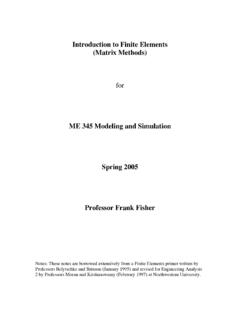
1 ME173 Course SYLLABUS Spring Semester 2015. CALIFORNIA STATE UNIVERSITY SACRAMENTO. The Department of Mechanical Engineering ME173 INTRODUCTION TO FINITE ELEMENT ANALYSIS . SYLLABUS . DESIGNATION: Mechanical Design and Mechatronic Systems INSTRUCTOR: Prof. Jos J. Granda Riverside 5002, 916- 278-5711. Email: OFFICE HOURS: 2:00 3:00 T, TH or by appointment TIME: 12:00 1:15 PLACE: Riverside 4001. TECHNOLOGY USED: Exchanges of materials will all be electronic. Notes, assignments, etc. WEB Course documents will be posted on the instructor's web site or on the Web CT. site. OBJECTIVES: It is an introductory course in FINITE ELEMENT ANALYSIS for the solution of design problems. While the emphasis will be on fundamentals, the use of the computer to solve engineering problems is essential.
2 A final project using the software used in class or other FINITE ELEMENT programs used by students is required. Lecture three hours. PREREQUISITES: E110 UNITS: TEXT: APPLIED FINITE ELEMENT ANALYSIS by Larry J. Segerlind , John Wiley and Sons, Inc (second edition). Software Documentation REFERENCES: FINITE ELEMENT ANALYSIS and Design. Kim, Shankar Wiley, 2009. KNOWLEDGE, SKILLS, AND ABILITIES STUDENTS SHOULD HAVE BEFORE. ENTERING THIS COURSE: Communicate technical information accurately and concisely . both orally and in writing, use ANALYSIS , computer software, word processors, etc., to define and develop solutions to technical problems. The skills learned in dynamics courses are a good basis.. The student will be expected to study the assigned reading assignments and homework following the schedule.
3 Students are responsible for ALL material presented in class. This includes any announcements, due dates, changes or clarifications made in class. The instructor and the materials available to you will be your guidance, but the real learning process takes place on your own going 1. ME173 Course SYLLABUS Spring Semester 2015. over examples in class and in communication with the instructor. KNOWLEDGE, SKILLS, AND ABILITIES STUDENTS GAIN FROM THIS COURSE: The objective of this course is to provide the student with the necessary skills to understand and use the FINITE ELEMENT Modeling technique for designing parts and complete assemblies. After taking this class students will be able to: 1) To solve problems involving the basic concepts of FINITE elements for static and dynamics FINITE ELEMENT problems.
4 2) To use the computer and generate FINITE ELEMENT Models in two and three dimensional. 3) To use two and three dimensional Solidworks models and transform them in FINITE ELEMENT models. 3) To perform computer simulations using the FINITE ELEMENT Modeling technique to study stress, strain. Deformations and loading conditions. 4) Understand the concepts of FINITE elements for one, two and three dimensions. IMPACT ON SUBSEQUENT COURSES IN CURRICULUM: For those enrolled students, who have not yet participated in the capstone design course, provides a foundation for modeling and simulation of the subsequent course topics of ME190, ME191. For students who want to learn more about automatic control, this class is an excellent basis for ME114. ABET CRITERIA 2000 OUTCOMES ACHIEVED: This course contributes to the following EC2000 Criterion 3 outcomes and those specific to the EAC accredited _ program.
5 Outcome Outcome a. An ability to apply knowledge of mathematics, g. An ability to communicate effectively . science, and engineering b. An ability to design and conduct experiments, as h. The broad education necessary to understand the . well as to analyze and interpret data impact of engineering solutions in a global/societal context c. An ability to design a system, component, or i. A recognition of the need for and an ability to process to meet desired needs engage in life-long learning d. An ability to function on multi-disciplinary teams j. A knowledge of contemporary issues . e. An ability to identify, formulate, and solve k. An ability to use the techniques, skills, and modern . engineering problems engineering tools necessary for engineering practice f.
6 An understanding of professional and ethical l. Begin list of any other outcomes unique to the responsibility program. 2. ME173 Course SYLLABUS Spring Semester 2015. ABET PROGRAM CRITERIA OUTCOMES ACHIEVED: Program criteria outcomes are unique to each degree program and are to be compiled from the program criteria given for each degree program and listed in bullet format below. Criterion Criterion Criterion A. Aerodynamics G. Orbital Mechanics M. Preliminary/Conceptual Design . B. Aerospace Materials H. Space Environment N. Other Design Content . C. Structures I Attitude Determination and O. Professionalism . Control D. Propulsion J. Telecommunications P. Computer Usage . E. Flight Mechanics K. Space Structures F. Stability and Control L. Rocket Propulsion COMPUTER USAGE: Computers are used for writing reports (WORD) and presentations (PowerPoint).
7 Spreadsheets are used as appropriate in doing multiple trade studies. Computational tools such as PATRAN, NASTRAN, ADAMS. CLASS FORMAT: This course follows a lecture format. Assignments will be both individual and group. Groups will be approximately 4 people, and pre-assigned by the instructor. Students are responsible for reading the assigned material prior to the scheduled class. Class participation is required and part of the course grading. Students are encouraged to actively participate and to ask questions freely. Students will be expected to present their work periodically. COURSE GRADING: Quizzes/Exams .. 40%. Homework Assignments .. 10%. Lab assignments .. 30%. Individual Project .. 10%. Final Exam .. 10%. _____. 100%. Exams and assignments will be graded balancing the procedure used and the correctness of your answer on an equal basis.
8 Presentation and organization of your assignments will also be considered in grading. Midterm exams and final will be closed book exams. It is important that students realize they are responsible for the reading assignments, readings specified in this outline and reading the lab manual. That material can be on an exam. Students should not rely only on the lectures in class or lab but also on the readings. Exams and assignments will be graded balancing the procedure used and the correctness of your answer on an equal basis. Presentation and organization of your assignments will also be considered in grading. There will be Quizzes approximately one to two weeks apart, including the last week of class. Quizzes and final exam will be closed book exams. If there is a discrepancy in 3.
9 ME173 Course SYLLABUS Spring Semester 2015. grading, you have two weeks from the date you received it to bring up for discussion. After that period grades are final. Projects are due on the last day of class. Work turned in after the deadlines will not be computed in your final grade. HOMEWORK, COMPUTER ASSIGNMENTS POLICY: Assignments are issued each week and students work is due in one week unless otherwise noted in the accompanying class schedule. Assignments are due at the start of class on the due date. Late assignments may be accepted, but at a loss of 20% of the grade per 24 hours late. Homework assignments will be returned to students post grading. There will be reading homework and computer assignments. Students are responsible for ALL material presented in class.
10 This includes any announcements, changes, clarifications on assignments, or due dates. It is expected that the assignments will be completed and turned in before or on the specified deadlines. There will be no make up tests except in cases of confirmed and documented illness or emergency. As the semester goes on and you realize "things" are not going well for you in this class or you become frustrated with the computer, be aware of the policy on drops and incomplete. To drop the class you must meet deadlines and an incomplete is rarely granted and can not be used to "bail out" of the class. EXAMINATIONS: There will be quizzes and exams. These will be announced to cover specific modules of the course. The final exam will be administered in accordance with the University scheduled time.