Transcription of Introduction to German World War 2 Patterns
1 Introduction to German World War 2 PatternsBy Michael FarnworthThe German armed forces (Wehrmacht) were the first military to issue camouflage widely. Starting from 1932, all units received some camouflaged items. Between 1931 and 1945, the Germans created at least 14 different Patterns and produced many of them in two or more colour variants. To complicate matters further, each pattern has many different names. There are several books on the subject but few introductory articles. This article attempts to give an overview of the Patterns and identify which pattern was used for which garments. Several examples are shown.
2 Most of these are digital paintings made from reproduction garments. Some are based on actual garments in militaria Farnworth works for Mammut Sports Group where he is responsible for the purchasing mountaineering and camping equipment. Previously, he was designer of Karrimor Special Forces Collection and created military backpacks and camouflage clothing. Mick is a war gamer and model maker. He is a regular contributor to TMP under the name Mick in Switzerland German Army and Airforce PatternsThe German Army was not the first to issue camouflage to soldiers but they were the first to issue it to every soldier.
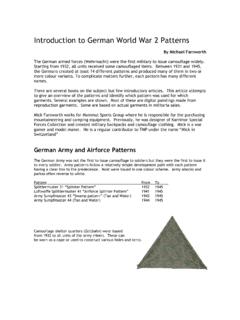
3 Army Patterns follow a relatively simple development path with each pattern having a clear link to the predecessor. Most were issued in one colour scheme. Army smocks and parkas often reverse to From To Splittermuster 31 Splinter Pattern 1932 1945 Luftwaffe Splittermuster 41 Airforce Splinter Pattern 19411945 Army Sumpfmuster 43 Swamp pattern (Tan and Water)19431945 Army Sumpfmuster 44 (Tan and Water)19441945 Camouflage shelter quarters (Zeltbahn) were issued from 1932 to all units of the army (Heer).
4 These can be worn as a cape or used to construct various hides and tents. Splittermuster 31 Also Known as Splinter Pattern, Heeressplittermuster, Splinter A, Buntfarbenaufdruck 1931 First Issue 1932 Used until1945 Known itemsZeltbahn, Helmet Cover, Smock, Reversible winter Parka, Overtrousers, plus several informal items made using zeltbahn ByArmy (Heer), Airforce (Luftwaffe), Paratroopers (Fallschirmjager)This was the main army pattern from 1932 to 1942. The pattern dates from First World War paint schemes used on ships and land installations. It was issued to all units except Waffen SS. Uniform items for Luftwaffe were updated in 1941 and army uniforms were updated to new Patterns from 1943, but zeltbahns continued in this pattern up to 1945.
5 It consists of green and brown geometric shapes printed onto a grey or beige ground. An additional rain pattern of fine green lines is printed on top of the pattern. There are two colour variants but they are very similar. Zeltbahns usually had the light colour version on one side and the darker one on the other side. The pattern was printed using rollers and repeats every rare variation in brown and beige shades with no green is also known but was possibly only experimental. In 1945, a variation was made with a black infra red reflective overprint but it does not appear to have been used in 41 Also Known as Splinter B, LuftwaffesplittermusterFirst Issue 1941 Used until1943 Known itemsHelmet Cover, Paratroopers smock, grenade bag and bandoleers, Field jacketUsed ByAirforce (Luftwaffe), Paratroopers (Fallschirmjager)This is a development of Splittermuster 31 for use on Luftwaffe smocks.
6 The geometric shapes are smaller and more numerous. It was first used for the Invasion of Crete in 1941. A rare diffused version similar in colours to Sumpfmuster 43 is probably a transitional item as production changed over to 43 Also Known as Swamp camouflage, Tan and Water 43 First Issue 1943 Used until1945 Known itemsHelmet Cover, Reversible winter Parka, Overtrousers, Paratroopers smock and bandoleers, Field jacket, Apron, Chemical warfare ByArmy (Heer), Airforce (Luftwaffe), Paratroopers (Fallschirmjager)This was a very widely used pattern. It is a development of Splittermuster 31. The pattern is enlarged and open.
7 The base colour is dark beige or even tan with maroon and dark green overprints. The edges of the geometric shapes are slightly diffused. The pattern is often referred to as tan and water Tip > Paint the garment in coffee, and then use dilute flesh ink and PVA wash to create shadows. Add green stripes and maroon blobs. If you are careful, you will get angular shapes with sharp edges. If not, paint over the edges of the green and maroon sections with coffee to make the angles sharper. On small scale figures ignore the rain 44 Also Known as Tan and Water 44 First Issue 1944 Used until1945 Known itemsHelmet Cover, Reversible winter Parka, Overtrousers, Paratroopers smock and bandoleers, Reversible smock with hood, Apron, Chemical warfare suit, M1944 ByArmy (Heer), Airforce (Luftwaffe), Paratroopers (Fallschirmjager)This was a very widely used pattern.
8 It is a further development of Sumpfmuster 43. The colours are similar but the pattern is more diffused. The base colour is tan and the overprints are maroon and dark green . Colours are almost identical to late war tank camouflage. The edges of the geometric shapes are blurred. The pattern is often referred to as tan and water 44. Parkas and overtrousers are often reversible with white as the other Tip > Paint the garment in tan, and then use dilute flesh ink and PVA wash to create shadows. Add green stripes and maroon blobs. On small scale figures ignore the rain SS PatternsThere are seven distinct sets of Waffen SS Patterns and many of them were made in a variety of colour schemes.
9 To complicate matters further, they each have many different names. There are many books on this subject so a short article can only offer an , helmet covers and zeltbahns were issued to Waffen SS soldiers from about 1937. The early Patterns were issued as reversible garments with a predominantly green spring colour scheme on one side and a predominantly brown autumn colour on the other side. The Waffen SS Patterns were developed along different lines to the army Patterns . They are organic shapes based on sunlight Patterns in woodland. They were developed by a team lead by Professor Otto Schick.
10 Pattern From To Platanenmuster Plane Tree Pattern 19371943 Rauchtarnmuster Smoke Camouflage Pattern 19391944 Palmenmuster Palm Pattern 19401943 Eichenlaubmuster Oak Leaf Pattern 19411945 Telo Mimetico 1929 (captured from Italians)19431945 Erbsenmuster Pea Pattern 19441945 Leibermuster Body Pattern 19451945 Plane Tree pattern (Platanenmuster) was the first to be used. There were several colour schemes and three pairs of pattern variations. The first Patterns 1 and 2 were hand printed on huge zeltbahn sized screens with no pattern repeat.