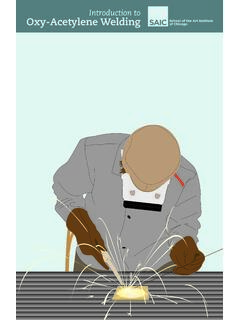
Transcription of Introduction to Oxy-Acetylene Welding
1 Introduction to Oxy-Acetylene Welding Welcome to the Columbus Metal Shop! The School of the Art Institute's rk! spa Columbus Metal Shop is one of four Instructional Fabrication shops at SAIC. The Columbus Metal Shop is a general access facility set up to provide instruction and material resources for the School's students, faculty, and staff. The Metal Shop's facilities and unique instructional programs have been structured to meet the needs of students working on a wide range of projects. The metal shop facilities include a wide range of hot and cold metal working equipment. Cold working Hot working capabilities include capabilities include drilling forging/annealing INSTRUCTIONAL. FABRICATION punching plasma cutting mechanical fastening oxy-fuel Welding roll forming & cutting Instructional Fabrication's mission is to serve the bending shielded metal contemporary art making needs of the School of the Art shearing ARC Welding Institute of Chicago by providing instruction and technical assistance to students and faculty using the School's shops cutting gas metal arc Welding (MIG).
2 And fabrication facilities. Our staff work collaboratively grinding across artistic and academic disciplines to support all gas tungsten arc manners of fabricating art objects. sanding Welding (TIG). abrasive blasting Instructional Fabrication is a division within the department of Instructional Resources & Facilities Management (IRFM). Instructional Fabrication |3. Table of Contents 6 Getting Ready 8 Equipment for Process : Check Out From Cage 10 Material Concerns 11 Material Handling 12 Welding Anatomy & Capability 14 Turning on Fuel Introduction to 16 Turning on Fuel continued Oxy-Acetylene Welding Oxy-Acetylene , commonly known as Oxy-fuel, is one of the 18 Process : Welding oldest Welding processes, though in recent years, it has become less popular in industrial applications. However, it is still widely 20 Process : Cutting used for a variety of applications. Oxy-fuel equipment is versatile, lending itself to Welding , brazing, braze- Welding , silver soldering, 22 Closing Down : Leaving Station metal heating (for bending and forming) and oxy-fuel cutting.
3 This book will highlight the Welding and cutting processes. 4| The School of the Art Institute of Chicago Instructional Fabrication |5. Getting Ready Personal Preparation: Arrive Properly Attired Authorizations Physical & Mental Condition In order to work in the Metal Shop, you must first attend Stress, anxiety, sleep deprivation, low blood sugar, an Authorization. Authorization Sign Up Sheets and and drugs (prescription & recreational) will interfere Authorization Request Forms are posted adjacent to the with your ability to work safely. tool checkout area in the Columbus Wood Shop, Room 024. It is highly recommended that new patrons complete the Introduction to Metal Working Authorization before Accessories participating in the Welding authorizations. Remove all accessories that could conduct heat or get caught in moving parts of equipment: rings, piercings, watches, ID card lanyards, etcetera. Hair Planning Your Project Tie hair back, tuck hair in jacket, or hold hair back (See also Material Concerns, page 10) with a bandanna.
4 A cap is also a good idea. We encourage patrons to speak with the shop's staff about making material choices that best suit your projects before committing to a purchase your choice of materials may Shirts limit what equipment will be available to you. Choose natural fibers like cotton, hemp and wool to weld in. Synthetic fibers (polyester, nylon) are not recommended. You will be required to wear a Welding jacket for all Welding processes. Pants Flammable Combustibles Prohibited Choose natural fibers, no synthetic fibers (polyester, nylon). Holes or loose, frayed areas are prohibited. Flammable Liquids are prohibited in the Metal Shop, including but not limited to butane lighters, propane, aerosol Cuff or roll in pant legs that touch the ground. cans, and solvents. Use extreme caution when working near flammable materials (sketchbooks, backpacks, etcetera). Flames, sparks, and hot surfaces can cause fires. Shoes Sturdy, closed-toe shoes. Leather shoes are highly recommended.
5 No synthetic material, like material found on running shoes. 6| The School of the Art Institute of Chicago Instructional Fabrication |7. REQUIRED. Equipment For Process: Check out from cage Welding Goggles Welding Jacket Overview Personal Protection Equipment Eye Protection Oxy Goggles are shaded to prevent radiation exposure shade value Welding Gloves Welding Tip or of 5 for Oxy, 10 for other Welding Cutting Attachment processes. Do not observe other Welding processes with oxy goggles other than oxy fuel. Welding Jacket Flame Retardant Jacket is required for Striker Filler Material all Welding processes. Hand Protection Welding Gloves are available in small, medium, and large. Gauntlet style Welding gloves protect your hands RECOMMENDED. from radiant heat do not use these gloves for handling material. Ear Muffs Magnetic Clamps & Fixtures Hearing Protection Hearing protection is not required for oxy fuel. However, you may need them when someone near is noisy. In that case, use ear muffs.
6 Foam plugs are not recommended. NO HEADPHONES. Locking Pliers Wire Brush Respiratory Protection A Welding Fume Respirator is highly recommended for persons with respiratory concerns. The metal shop is equipped with an exhaust system that must be activated before using Welding equipment. Slaghammer Welding Fume Respirator 8| The School of the Art Institute of Chicago Instructional Fabrication |9. Material Concerns Material MaterialHandling Handling The Columbus Metal Shop sells steel in a variety of shapes and dimensions. Rod stock and tubing is available in rounds and squares, How to Carry angle iron is available in a variety of dimensions, and sheet metal is A separate pair of gloves for material available in common gauges (thickness). handling is recommended DO NOT. use Welding Gloves. Also, it is very important for your Welding gloves to Linear material is sold by the foot length or in some cases full lengths remain oil-free. averaging 12 feet. Sheet metal is sold by the square foot, with a minimum purchase requirement of 4 square feet (24 X 24 ).
7 Types of Steel Hot Rolled Use caution when entering & exiting Do not try to carry long lengths doorways or blind intersections. or heavy material without help. Grayscale on surface Avoid walking in front of or behind Clean with wire brush before materials, walk alongside. Welding Cold Rolled Shiny, oily surface Clean with orange soap and paper towels before Welding . Dispose of Keep hand one paper in red fire-proof can. hand-length from end of material. Before Welding , make sure to remove all oil used during the preparation and fabrication of materials. DO NOT weld on materials, including hardware, that contain: Reuse Bin Recycle Bin Material for the Reuse Bin must Please refrain from tossing Paint Lead be approved by management. unusable material, recycle it. Wax Rust Chrome Plated or Grease or Oil (burned oil is Galvanized Surfaces a carcinogen). Magnesium 10 | The School of the Art Institute of Chicago Instructional Fabrication | 11. Welding : Anatomy & Capability Torch Head A.
8 Mixer C. Cutting Attachment There are 8 mixing stations The cutting attachment simply functions as Barrel attached to the wall. This is a convenient and economical approach to your source for oxygen and cutting steel. The cutting attachment can be acetylene fuel. used for material up to 3/4 of an inch thick. The mixer is where you will Oxygen Control Valve Mixing Chamber attach Welding tips, cutting attachment, and the rosebud acetylene Control Valve heating torch. Control Valve Close up of acetylene Hose (red) Cutting Attachment Oxygen Control Attachment Oxygen Hose (green). B. Welding Tips D. Rosebud Heating Tip There are 3 types of Welding The Rosebud Heating Tip is used for specific tips available: 1, 3, 5, and 9. Tip heating applications. The Rosebud is a fuel size will depend on type of filler intensive attachment that should be used material used, see below chart. with discretion. Please check with shop staff to see if it might be right for your project. REGULATOR SETTINGS.
9 Material Tip Size acetylene Oxygen Filler Rod 22-18 gauge 1 8 psi 8 psi 1/16". 16-14 gauge 3 8 psi 8 psi 3/32". 12-10 gauge 5 8 psi 8 psi 1/8" Close up of Rosebud Heating Tip 1/4"-3/8" 9 8 psi 8 psi 3/16" *. * 3/16" filler rod is not available through Resale. 1 3 5 9. 12 | The School of the Art Institute of Chicago Instructional Fabrication | 13. Turning On Fuel 1. Before you begin, perform Hover Test. 4. Install tip into mixer, hand tighten nut on top with touch tip facing to the left (for right hand use). Place the back of your bare hand close to a work or facing right (for left-hand use). surface or tool before touching or setting down something heat sensitive. A B. Welding tables, stationary equipment, tools, and scrap material might not appear hot, but may be hot enough to injure you or damage equipment. 2. Take enough hose off hanger carefully so the mixer reaches the Welding table without 5. Check torch handle to make sure it is closed by creating a tripping hazard.
10 Gently turning knobs counter clockwise to open and then clockwise to completely close. A B. 3. Inspect the hose for wear or damage by making your way from the torch handle to 6. Check regulator keys to make sure they are backed out (disengaged) and approximately inch the regulators. of threads are exposed. approximately inch 14 | The School of the Art Institute of Chicago steps continue to next page 15. Turning On Fuel continued 7. Standing to the side of regulators, open both oxygen and acetylene shut-off valves slowly by turning counter-clockwise until 9. Before the torch is lit, put on Welding gloves and oxygen- acetylene goggles. fully opened, then close turn clockwise. A B. Open: Counter-clockwise Close turn: Clockwise Oxygen Number Increments: 5, 10, 15, 20. 800 12000. 10. 00 00. 80. 16. 00. 1500 20. 0. 0 00. 60. 0. 100 12 140 1000 25. 1200. 400 0. 80 160 00. 20000. 500. 180. 8. 30. 400. 60 00. Open acetylene (red) and oxygen (green) mixer valves turn 200 35.