Transcription of IRIS Staging of CKD (modified2015)
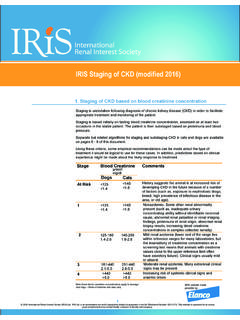
1 1 Eli Lilly and Company, its subsidiaries or af liates. Elanco and the diagonal bar are trademarks owned and licensed by Eli Lilly and Company, its subsidiaries or af Staging of CKD (modified 2015)1. Staging of CKD based on blood creatinine concentration Staging is undertaken following diagnosis of chronic kidney disease (CKD) in order to facilitate appropriate treatment and monitoring of the is based initially on fasting blood creatinine concentration, assessed on at least two occasions in the stable patient. The patient is then substaged based on proteinuria and blood but related algorithms for Staging and substaging CKD in cats and dogs are available on pages 6 - 9 of this these criteria, some empirical recommendations can be made about the type of treatment it would be logical to use for these cases.
2 In addition, predictions based on clinical experience might be made about the likely response to creatinine mol/l mg/dlCommentsDogsCatsAt risk<125< <140< suggests the animal is at increased risk of developing CKD in the future because of a number of factors (such as, exposure to nephrotoxic drugs, breed, high prevalence of infectious disease in the area, or old age). 1<125< <140< Some other renal abnormality present (such as, inadequate urinary concentrating ability without identifiable nonrenal cause, abnormal renal palpation or renal imaging findings, proteinuria of renal origin, abnormal renal biopsy results, increasing blood creatinine concentrations in samples collected serially).
3 2125 140 Mild renal azotemia (lower end of the range lies within reference ranges for many laboratories, but the insensitivity of creatinine concentration as a screening test means that animals with creatinine values close to the upper reference limit often have excretory failure). Clinical signs usually mild or absent. 3181 251 Moderate renal azotemia. Many extrarenal clinical signs may be present. 4>440> >440> Increasing risk of systemic clinical signsand uraemic crisesNote these blood creatinine concentrations apply to average size dogs those of extreme size may varyIRIS Staging of CKD (modified 2015)2 Eli Lilly and Company, its subsidiaries or af liates.
4 Elanco and the diagonal bar are trademarks owned and licensed by Eli Lilly and Company, its subsidiaries or af dimethylarginine (SDMA) and iris CKD guidelinesIRIS CKD Staging is based currently on fasting blood creatinine concentrations, but there are indications that SDMA concentrations in blood plasma or serum may be a more sensitive biomarker of renal function. Accordingly, if blood SDMA concentrations are known, some modification to the guidelines might be considered, as follows:A persistent increase in SDMA above 14 g/dl suggests reduced renal function and may be a reason to consider a dog or cat with creatinine values < or < mg/dl, respectively, as iris CKD Stage iris CKD Stage 2 patients with low body condition scores, SDMA 25 g/dl may indicate the degree of renal dysfunction has been underestimated.
5 Consider treatment recommendations listed under iris CKD Stage 3 for this iris CKD Stage 3 patients with low body condition scores, SDMA 45 g/dl may indicate the degree of renal dysfunction has been underestimated. Consider treatment recommendations listed under iris CKD Stage 4 for this comments are preliminary and based on early data from the use of SDMA in veterinary patients. We expect them to be updated as the veterinary profession gains further experience using SDMA alongside creatinine, the long-established marker in diagnosis and monitoring of canine and feline Staging of CKD (modified 2015)3 Eli Lilly and Company, its subsidiaries or af liates.
6 Elanco and the diagonal bar are trademarks owned and licensed by Eli Lilly and Company, its subsidiaries or af Substaging by ProteinuriaThe goal is to identify renal proteinuria having ruled out post-renal and pre-renal urine dipsticks can give rise to false positives therefore practitioners should consider using a more specific screening test such as the sulphosalicylic acid turbidometric urine protein to creatinine ratio (UP/C) should be measured in all cases, provided there is no evidence of urinary tract inflammation or hemorrhage and the routine measurement of plasma proteins has ruled out dysproteinemias.
7 Ideally Staging should be done on the basis of at least two urine samples collected over a period of at least 2 valueSubstageDogsCats< < to to proteinuric> > that are persistently borderline proteinuric should be re-evaluated within 2 months and re-classified as appropriate. UP/Cs in the non-proteinuric or borderline proteinuric range may be categorized as microalbuminuric . The significance of microalbuminuria in predicting future renal health is not understood at present. iris recommendation is to continue to monitor this level of may decline as renal dysfunction worsens and so may be less frequent in animals in Stages 3 and 4.
8 Response to any treatment given to reduce glomerular hypertension, filtration pressure, and proteinuria, should be monitored at intervals using Staging of CKD (modified 2015)4 Eli Lilly and Company, its subsidiaries or af liates. Elanco and the diagonal bar are trademarks owned and licensed by Eli Lilly and Company, its subsidiaries or af Substaging by Arterial Blood PressurePatients should be acclimatized to the measurement conditions and multiple measurements taken. The final classification should rely upon multiple systolic blood pressure determinations, preferably done during repeated patient visits to the clinic on separate days, but acceptable if during the same visit with at least 2 hours separating determinations.
9 Patients are substaged by systolic blood pressure according to the degree of risk of target organ damage, and whether there is evidence of target organ damage or most dogs, the iris blood pressure substages are as follows:Systolic Blood Pressure mm HgBlood Pressure SubstageRisk of Future Target Organ Damage<150 NormotensiveMinimal150 159 Borderline hypertensiveLow160 179 HypertensiveModerate 180 Severely hypertensiveHighHowever, some breeds, particularly sight hounds, tend to have higher blood pressure than other breeds. It is preferable to use breed-specific reference ranges if available.
10 The classification of risk of future target organ damage in high-pressure breeds might be adjusted as follows:Minimal risk systolic pressure <10 mm Hg above the breed-specific reference rangeLow risk systolic pressure 10-20 mm Hg above the breed-specific reference range Moderate risk systolic pressure 20-40 mm Hg above the breed-specific reference rangeHigh risk systolic pressure >40 mm Hg above the breed-specific reference range. As with proteinuria, in the absence of evidence of existing target organ damage, demonstration of persistence of blood pressure readings within a particular category is important.