Transcription of ISMP Canada Safety Bulletin
1 The Institute for Safe Medication Practices Canada (ISMP Canada ) is an independent national nonprofit agency established for the collection and analysis of medication error reports and the development of recommendations for the enhancement of patient Safety . The Healthcare Insurance Reciprocal of Canada (HIROC) is a member-owned expert provider of professional and general liability coverage and risk management support. ISMP Canada Safety BulletinVolume 6, Issue 4 July 16, 2006C A N AD AThe use of some abbreviations , symbols , and dose designations has been identified as an underlying cause of serious, even fatal medication errors.
2 The following three examples illustrate abbreviations in common use that were involved in medication errors reported to ISMP Canada . ISMP Canada , the Canadian Council on Health Services Accreditation, and the Canadian Patient Safety Institute will be undertaking joint initiatives to eliminate the use of dangerous abbreviations , symbols and dose designations in health care to enhance the Safety of Canadian first steps toward eliminating dangerous abbreviations , symbols and dose designations are (i) identifying those known to be prone to errors and (ii) widely disseminating this information.
3 The Hospital Medication Safety Self-Assessment (MSSA), adapted for use in Canada in 2001, identifies the need for hospitals to establish a list of prohibited, error-prone abbreviations and unacceptable methods of expressing The ISMP Canada MSSA database with responses from 268 hospitals suggests that many hospitals still need to develop a list of prohibited terms. To date, no definitive Canadian list has been proposed. Several lists have been developed by various organizations in the United States ( , the Institute for Safe Medication Practices [ISMP],3 the Joint Commission on Accreditation of Healthcare Organizations [JCAHO],4 the National Coordinating Council for Medication Error Reporting and Prevention,5 and the United States Pharmacopeia6).
4 Of interest, ISMP (US) has recently embarked on a joint campaign with the US Food and Drug Administration (FDA) to eliminate the use of potentially confusing abbreviations by health care professionals, medical students, medical writers, the pharmaceutical industry, and FDA The campaign references the ISMP List of Error-Prone abbreviations , symbols and Dose Designations 3 and the JCAHO official Do Not Use the need for a Canadian reference list, ISMP Canada proposes the following minimum list of dangerous abbreviations , symbols .
5 And dose designations as a starting point and proposes that they be eliminated from use by Canadian health care providers. Although other abbreviations are known to have caused errors, those selected for inclusion in this list have been implicated in medication errors causing harm. This list has been adapted from the ISMP (US) list, with consideration of medication errors reported to ISMP errors related to the use of dangerous abbreviations and unclear dose designations have involved handwritten orders or medication administration records; however, misinterpretation is not limited to handwritten information.
6 These problematic abbreviations and dose designations should be eliminated from all documentation involved in the medication use process, including labelling and packaging, preprinted orders and clinical pathways, computer order entry screens, electronic medication administration records, automated dispensing cabinets, and infusion pump screens, as well as pharmaceutical advertising and medication-related articles in health care Use of Dangerous abbreviations , symbols , and Dose DesignationsThe use of drug name abbreviations increases the likelihood of confusion between drugs with look-alike or sound-alike names.
7 In this example, although the order was also communicated verbally, as morphine , the widespread practice of abbreviating drug names ( , morph for morphine ) was found to be one of the contributing factors in a fatal event where hydromorphone was given instead of morphine. This example also emphasizes the need for legible u , representing the whole word units has often been misinterpreted as a 0 (zero), leading to a 10-fold dose error. Here, the intended 6u was misinterpreted as 60 and the patient received 60 units of regular (short-acting) insulin.
8 Of note, insulin is the most commonly reported medication identified as causing harm in the ISMP Canada database of voluntarily reported medication this third example, an octreotide infusion was administered at 25 mL/h instead of 5 mL/h as intended. Whether handwritten or computer-generated, the @ symbol can be misread as the number 2 or 5 , leading to substantial overdoses of medication. The abbreviations , symbols , and dose designations found in this table have been reported as being frequently misinterpreted and involved in harmful medication errors.
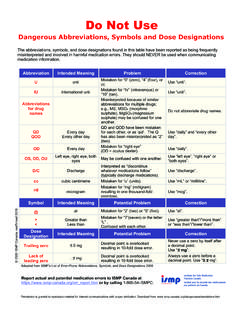
9 They should NEVER be used when communicating medication information. Abbreviation Intended Meaning Problem Correction U unit Mistaken for 0 (zero), 4 (four), or cc. Use unit . IU international unit Mistaken for IV (intravenous) or 10 (ten). Use unit . abbreviations for drug names Misinterpreted because of similar abbreviations for multiple drugs; , MS, MSO4 (morphine sulphate), MgSO4 (magnesium sulphate) may be confused for one another. Do not abbreviate drug names. QD QOD Every day Every other day QD and QOD have been mistaken for each other, or as qid.
10 The Q has also been misinterpreted as 2 (two). Use daily and every other day . OD Every day Mistaken for right eye (OD = oculus dexter). Use daily . OS, OD, OU Left eye, right eye, both eyes May be confused with one another. Use left eye , right eye or both eyes . D/C Discharge Interpreted as discontinue whatever medications follow (typically discharge medications). Use discharge . cc cubic centimetre Mistaken for u (units). Use mL or millilitre . g microgram Mistaken for mg (milligram) resulting in one thousand-fold overdose. Use mcg.