Transcription of ISO 22000:2018 - NQA
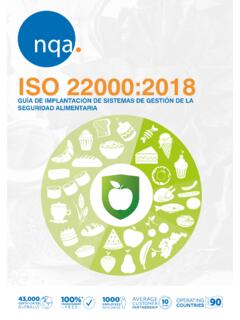
1 ISO 22000 : 2018 food safety management system IMPLEMENTATION GUIDE50,000 GLOBALLYCERTIFICATES90 TRANSPARENTISO 22000 : 2018 IMPLEMENTATION GUIDE2> ISO 22000 : 2018 IMPLEMENTATION GUIDEISO 22000 : 2018 IMPLEMENTATION GUIDE3 ContentsIntroduction to the standard P04 Benefits of implementation P05 Structural Changes on ISO 22000 : Annex SL P06 PDCA cycle P07 Process based thinking / audit P08 Risk based thinking / audits P09 The 10 Clauses of ISO 22000 : 2018 P10 SECTION 1: Scope P10 SECTION 2: Normative references P11 SECTION 3: Terms and definitions P12 SECTION 4: Context of the organization P14 SECTION 5: Leadership P16 SECTION 6: Planning P18 SECTION 7: Support P20 SECTION 8: Operation P24 SECTION 9: Performance evaluation P26 SECTION 10: Improvement P28 Get the most from your management systems P30 Next steps once implemented P32 food safety management training P34 Useful links P36 ISO 22000 .
2 2018 IMPLEMENTATION GUIDE4 INTRODUCTION TO THE STANDARDThe ISO 22000 familyIn addition to ISO 22000 redaction, other standards were created, such as ISO 22004 Guidance on the application of ISO 22000 , ISO 22005 Traceability in the Feed and food Chain and also technical specifications by sector, these include farming, food manufacturing, catering, packaging, and feed and animal food production. Currently, according to ISO Survey data, there are approximately 33,000 organizations worldwide that are ISO 22000 certified. Revision steps The revision of ISO 22000 :2005 commenced in September 2014.
3 All participants, the technical committee and national mirror committees, agreed on the need to revise the standard with the purpose of addressing emergent food safety challenges. After a long period of discussions, in June 2018 ISO 22000 : 2018 was published. One of the main motivations for its revision was the alignment of the strategic direction of an organization with its food safety management . Additionally, the adoption of the Annex SL structure allows an easy integration with other international standards such as ISO 9001, ISO 14001 and ISO 45001, making a smooth road for auditors and auditees.
4 ISO 22000 is the food safety management system that can be easily applicable to any organization in the food chain. ISO 22000 was initially developed on September 1st 2005 by the ISO/TC 34/SC 17 as the first truly international FSMS standard. A brief history of ISO 22000 ISO 22000 was initially published in 2005 as a response to: a number of successive food crises, such as the mad cow disease or adulteration of wines with ethylene glycol and its derivatives, to name a few that occurred in the preceding years. the globalisation of food supply chains creating uncertainty with regard to the origin of food products the need from the food industry to demonstrate that systems were established and operating in accordance to applicable laws and the requirements specified by the Codex Alimentarius, and a need to facilitate the harmonization of international food safety regulations 4 ISO 22000 : 2018 IMPLEMENTATION GUIDEISO 22000 .
5 2018 IMPLEMENTATION GUIDE5 BENEFITS OF IMPLEMENTATIONIMPROVED HEALTH AND safety Minimizing food risks leads to better health and safety outcomes for customers, other users, employees and others who may come into contact with CUSTOMER SATISFACTIONH aving an FSMS helps you reliably deliver products that meet customer MEETING REGULATORY REQUIREMENTSC ompliance with regulatory requirements is required to achieve certification to ISO 22000 . Having an FSMS in place can help companies meet these requirements and understand how they impact the organization and its MEETING OTHER STANDARDS AND GUIDELINESISO 22000 links to various other international standards and guidelines and can help organizations meet the requirements of these systems as TRANSPARENCYISO 22000 helps organizations improve the traceability of their products and achieve greater transparency regarding RESPONSE TO RISKSH aving an FSMS in place can help organizations respond more quickly and efficiently to issues that may compromise food safety .
6 Helping them stop potential contamination before it INVESTIGATION TIMEIf contamination does occur, an FSMS helps organizations reduce the time it takes to investigate any food safety breaches, solving the problem 22000 helps organizations minimize food risks and improve performance as it relates to food safety . It does so by providing a framework they can use to develop an FSMS, a systematic approach to addressing food safety issues. Compliance with ISO 22000 provides benefits such as:CONSISTENT STRUCTUREThe structure of ISO 22000 is similar to that of other international standards. It is designed to integrate seamlessly with other management systems from ISO, such as ISO 9001, ISO 45001 and ISO RECOGNITIONISO 22000 is a well-known, internationally recognized standard.
7 Certification to it improves an organization s reputability with customers, suppliers, investors, regulatory groups and other parties BUSINESS OPPORTUNITIESC ertification to an international standard such as ISO 22000 opens doors for a business. Some organizations require certification before they will supply or otherwise work with a standard itself also offers several advantages over other systems:5 ISO 22000 : 2018 IMPLEMENTATION GUIDEISO 22000 : 2018 IMPLEMENTATION GUIDE66 STRUCTURAL CHANGES ON ISO 22000 : ANNEX SLThe Annex SL was initially approved in 2012. This section of the ISO/IEC Directive describes the common structure of all ISO management systems standards in which the new or updated standards must be focused on when developing the relevant to the adoption of Annex SL there were many differences between the clause structure, requirements, terms and definitions used across the various management system standards.
8 This made it difficult for organizations to integrate the implementation and management of multiple standards; Environment, Quality, Health and safety and food safety being among the most structure tries therefore to eliminate confusions, duplications and conflicts from the different interpretations of management system ISO 22000 , as other recently revised international standards such as ISO 9001 and ISO 14001, has adopted the Annex SL structure during its 2018 level structureAnnex SL consists of 10 core clauses:1. Scope2. Normative references3. Terms and definitions4. Context of the organization5.
9 Leadership6. Planning7. Support8. Operation9. Performance evaluation10. ImprovementOf these clauses, the common terms and core definitions cannot be changed. Requirements may not be removed or altered, however discipline-specific requirements and recommendations may be added. All management systems require a consideration of the context of the organization (more on this in section 4); a set of objectives relevant to the discipline, in this case food safety , and aligned with the strategic direction of the organization; a documented policy to support the management system and its aims; internal audits and management review.
10 Where multiple management systems are in place, many of these elements can be combined to address more than one , ISO 22000 : 2018 has also introduced a specific introduction and annexes:0. FSMS Process Plan-Do-Check-Act Risk-based Organizational risk Hazard Analysis - Operational Relationship with other management system standardsAnnex A Cross references between the CODEX HACCP and this documentAnnex B Cross references between this document and ISO 22000 :2005 ISO 22000 : 2018 IMPLEMENTATION GUIDE7 PDCA CYCLEThe recently updated ISO 22000 requires that in addition to the organizational Plan-Do-Check-Act (PDCA) cycle, also known by the Deming Cycle wheel or Shewhart cycle, and following the high level structure, another PDCA cycle must coexist covering the operational processes within the food safety system .