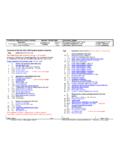
Transcription of ISO 9001:2015 Internal Audit Checklist
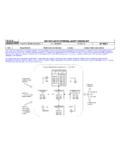
1 Each ISO 9001:2015 'shall' requirement has been re-phrased as a question to elicit a response that can be represented as an 'x'. Answer questions 1 to 305 to determine comformance. The Audit results are summarized in the ' Audit Results' worksheet. The general guidance and examples shown in Column 'E' should be referred to when undertaking an Internal Audit as described by ISO 9001:2015 , Clause guidance is not intended to add to, subtract from, or in any way modify the stated requirements of ISO 9001:2015 . The examples shown are things to consider when asking Audit the questions and looking for objective Audit evidence to record.
2 Any issues that are identified during the Internal Audit must be documented against the current ISO 9001:2015 requirements. Provide a reference to documented information to justify each Audit finding. Describe the nature of any minor or major nonconformance. Note any process or practice that seems weak, cumbersome, redundant or complex - but which is still conforms. An OFI may be an improvement to the QMS or something that could prevent future problems in an otherwise conforming NoClause TitleQuestion NoAudit QuestionGuidance & SuggestionsConformsMinor NCMajor NCOFIA udit Evidence & NotesOpportunities to ImproveAudit Score 0 Entries yet to be entered 0 ErrorsSection SubscorePossible Subscore% CompliantOFI Count4 Context of the Context1 Has your organization determined external and Internal issues relevant to its purpose and its strategic direction that affect its ability to achieve the intended result(s)
3 Of its quality management system?Sources of evidence could come from SWOT or PESTLE analysis results, business strategy plans; quality plans; information provided on your organization s website; annual reports; management meeting minutes; documented procedure; and lists of external and Internal issues and conditions. Records of meetings where context is routinely discussed and monitored, as part of the structured management review process or within each of the respective function of the organization (Purchase, HR, Engineering, Sales, Finance etc.).Interviews with relevant top management in relation to the organization s context and its strategic direction are also a good source of compliance evidence, such as: individual strategy or tactical plan documents written to underpin the organization s policies and provide a road map for achieving future Context2 Does your organization monitor and review information about these external and Internal issues?
4 External issues, examples could include:1. Reports relating to the your organization's competitive environment, new technologies, new markets, customerexpectations, supplier intelligence, economic conditions, political considerations, investment opportunities, social factors;2. Identification of factors relating to changing legislation and regulation;3. Feedback relating to product/service performance and lessons learned;4. Register of identified external risks and their issues, examples could include:1. Organizational structure, identification of roles/responsibilities and governance arrangements;2.
5 Reports on how well the organization is performing, statements relating to mission, vision and core values;4. Feedback obtained from employees, survey results;5. Information and processes for capturing and sharing knowledge and lessons learned;6. Organizational capability studies: load/capacity, resource requirements to achieve demand;7. Register of identified Internal risks and their Interested Parties3 Does your organization determine the interested parties that are relevant to the quality management system?Examples of interested parties include: customers, partners, end users, external providers, owners, shareholders, employees, trade unions, government agencies, regulatory authorities, and the local Interested Parties4 Does your organization determine the requirements of these interested parties that are relevant to the quality management system?
6 Include those parties that add direct value to your organisation, or who are affected by your organisation's the activities. Use of surveys, networking, face-to-face meetings, association membership, attending conferences, lobbying, participation in benchmarking, etc., in order to gain stakeholder information and their requirements. Interested Parties5 Does your organization monitor and review information about these interested parties and their relevant requirements?Records of meetings where interested parties and their requirements are routinely discussed and monitored, as part of the structured management review process, or within each of the respective function of the organization (Purchase, HR, Engineering, Sales, and Finance etc.)
7 System Scope6 Does your organization determine the boundaries and applicability of the quality management system to establish its scope?Consideration of boundaries and applicability of the QMS includes:1. Range of products and services;2. Different sites and activities;3. External provision of processes, products and System Scope7 When determining this scope, has your organization considered the external and Internal issues referred to in that issues relating to organizational context and the needs of interested parties encompassed in the scope. A lack of a documented process will require more reliance on objective evidence from interviews with Top management and the evaluation of external and Internal issues (see ).
8 System Scope8 When determining this scope, has your organization considered the requirements of relevant interested parties referred to in that issues relating to organizational context and the needs of interested parties encompassed in the scope. A lack of a documented process will require more reliance on objective evidence from interviews with Top management and the evaluation to the requirements of relevant interested parties (see ). System Scope9 When determining this scope, has your organization considered all relevant products, services and work-related activities, functions and physical boundaries to the quality management system?
9 Obtain evidence that clearly defines what your organisation sells, produces, or provides services for. Link this to the relevant standards or ACOPs that they are governed System Scope10 Has your organization applied all the requirements of ISO 9001:2015 if they are applicable within the determined scope of the quality management system?Describe the application of iso 9001 within the scope was determined, and how has it been applied by your System Scope11 Does the scope state the types of products and services covered, and provide justification for any requirement of ISO 9001:2015 that your organization determines is not applicable to the scope of its quality management system?
10 Describe how the application of iso 9001 within the scope was determined, and how any clause exclusions are justified. There must be alignment between the documented scope of the organization s QMS and their agreed scope of System Scope12Is the scope of your organization s quality management system available and maintained as documented information and available to interested parties and workers? (See )Verify objective evidence that the scope of documented and available to interested parties. A statement from your organization that the scope will be provided upon request may be accepted as objective System Processes13 Has your organization established, implemented, maintained and continually improved its quality management system, including the processes needed and their interactions, in accordance with the requirements of ISO 9001:2015 ?