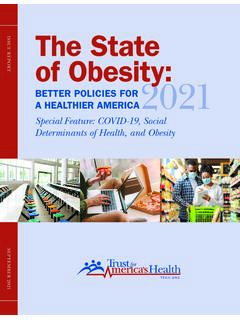
Transcription of ISSUE REPORT DISEASES, DISASTERS, AND BIOTERRORISM
1 Ready or Not: ISSUE REPORTMARCH 2022 PROTECTING THE public S HEALTH FROM DISEASES, DISASTERS, AND BIOTERRORISMSPECIAL SECTION: Lessons of the Pandemic s Tragic Death Toll: What Needs to be Done to Save Lives During the Next public Health Emergency?20222 TFAH BOARD OF DIRECTORS Gail Christopher, of the Board of DirectorsTrust for America s HealthExecutive DirectorNational Collaborative for Health EquityFormer Senior Advisor and Vice Kellogg FoundationDavid Fleming, Chair of the Board of DirectorsTrust for America s HealthTFAH Distinguished Visiting FellowTrust for America s HealthRobert T. Harris, , FACPT reasurer of the Board of DirectorsTrust for America s HealthSenior Medical DirectorGeneral Dynamics Information Technology Theodore Spencer, of the Board of DirectorsTrust for America s HealthCo-FounderTrust for America s HealthStephanie Mayfield Gibson, COVID-19 Response InitiativeResolve to Save LivesCynthia M.
2 Harris, Dean for public Health andDirector and ProfessorInstitute of public HealthFlorida A&M UniversityDavid Lakey, Chief Medical Officer and Vice Chancellor for Health Affairs The University of Texas SystemOctavio Martinez Jr., , MPH, MBA, FAPAE xecutive Director Hogg Foundation for Mental Health The University of Texas at Austin John A. Rich, , MPHCo-DirectorCenter for Nonviolence and Social JusticeDrexel University School of public HealthEduardo Sanchez, , MPHC hief Medical Office for PreventionAmerican Heart AssociationUmair A. Shah, , MPHS ecretary of the HealthWashington StateVince Ventimiglia, JDPresidentCollaborative AdvocatesLeavitt PartnersTRUST FOR AMERICA S HEALTH LEADERSHIP STAFFJ. Nadine Gracia, , MSCEP resident and CEOA cknowledgementsTrust for America s Health (TFAH) is a nonprofit, nonpartisan public health policy, research, and advocacy organization the promotes optimal health for every person and community and makes the prevention of illness and injury a national opinions, findings, conclusions, or recommendations expressed in this REPORT are those of the authors and do not necessarily reflect the views of the funders.
3 REPORT AUTHORSMatt McKillop, MPP Senior Health Policy Researcher and AnalystRhea K. Farberman, APRD irector of Strategic Communications and Policy ResearchDara Lieberman, MPP Director of Government RelationsThe National Health Security Preparedness Index (NHSPI) is a joint initiative of the Robert Wood Johnson Foundation, the University of Kentucky, and the University of Colorado. TFAH wishes to recognize and thank Glen Mays and Michael Childress of the NHSPI for their collaboration and or Not and the NHSPI are complementary projects that work together to measure and improve the country s health security and emergency preparedness. TFAH looks forward to a continued partnership in order to protect the public s REVIEWERSThis REPORT has benefited from the insights and expertise of the following external reviewers.
4 Their review is not necessarily an endorsement of its findings or recommendations by the reviewer or their organization. TFAH thanks the reviewers for their time and Allen Vice President for Health SecurityAssociation of State and Territorial Health Officials (ASTHO)Stephanie Mayfield Gibson, Director, COVID-19 Response InitiativeResolve to Save LivesJoneigh Khaldun, , MPH, FACEPVice President and Chief Health Equity OfficerCVS Health Stephen Redd, , former Deputy Director of public Health Service and Implementation Science Centers for Disease Control and PreventionIrwin Redlener, DirectorNational Center for Disaster PreparednessDirectorPandemic Resource and Response Initiative (PRRI)Senior Research ScholarEarth Institute, Columbia UniversityReady or Not2022 TABLE OF CONTENTSMARCH 2022 Table of ContentsExecutive Summary.
5 4 SPECIAL SECTION: Lessons of the Pandemic s Tragic Death Toll: What Needs to be Done to Save Lives During the Next public Health Emergency? ..11 INTERVIEW: The Critical Role of public Health Laboratories During COVID-19 and Beyond. An Interview with Scott Becker, MS, CEO, Association of public Health 1: ASSESSING STATES Indicator 1: Nurse Licensure Compact ..19 Indicator 2: Comprehensive public Health Indicators 3 and 4: Indicator 5: public Health Funding ..25 Indicator 6: Community Water System Indicator 7: Access to Paid Time Indicator 8: Flu Vaccination Rate ..31 Indicator 9: Patient Safety in Hospitals ..33 Indicator 10: public Health Laboratory Surge Capacity ..35 Indicators Performance Matrix by State ..38 SECTION 2: RECOMMENDATIONS FOR FEDERAL AND STATE POLICY Priority Area 1: Provide Stable, Sufficient Funding for Domestic and Global public Health Priority Area 2: Prevent Outbreaks and Pandemics.
6 43 Priority Area 3: Build Resilient Communities and Promote Health Equity in Priority Area 4: Ensure Effective Leadership and Priority Area 5: Accelerate Development and Distribution of Medical Countermeasures ..50 Priority Area 6: Ready the Healthcare System to Respond and Recover ..52 Priority Area 7: Prepare for Environmental Threats and Extreme Weather .. A: Year in Review: Overview of the Year s Major public Health Emergencies, Threats, and B: Methodology .. or Not2022 EXECUTIVE SUMMARYMARCH 2022 Executive SummaryAs this REPORT was being prepared, over 900,000 people in the United States and nearly 6 million worldwide had died due to COVID-19,1 and the world had experienced two years of economic and social disruption. In addition, 2021 saw record heat in many states, extensive flooding, a highly active Atlantic hurricane season, and unusual and deadly December tornados.
7 These events led to nearly unprecedented levels of illness, social upheaval, and economic hardship, including overwhelmed hospitals, job loss, property loss, children s learning loss, and mental health concerns. During 2021, the nation made progress in many areas in its response to the pandemic. As this REPORT was being produced, 62 percent of the nation s population was fully vaccinated,2 averting an estimated million COVID-19 deaths and over 10 million COVID-19-related The Biden Administration restored the White House Directorate on Global Health Security and Biodefense and created the Presidential COVID-19 Health Equity Task Force (see sidebar on pg. 15). And the approval of new treatments for COVID-19 has increased the likelihood of survival for many the same time, major challenges remained.
8 Hospital systems in many states were overwhelmed during pandemic waves. Testing was difficult to access during surges at-home tests were particularly difficult to find and in some cases testing was expensive, misinformation was abundant, and public patience with and trust in public health guidance wore thin. Of great concern, lawmakers in many states introduced or enacted laws to restrict the authority of public health In addition, according to The New York Times, approximately 500 public health officials nationwide had left the field since the start of the pandemic. Some Editor s note: as of January 16, 2022, the Centers for Disease Control and Prevention (CDC) defined fully vaccinated as a person who has received their primary series of COVID-19 vaccines. CDC is also using Up to Date to denote that a person has received all recommended COVID-19 vaccines including any booster dose(s) when TFAH , some left due to threats and harassment, some due to firings when public health guidance clashed with what elected officials wanted to addition, the pandemic has illuminated two stark realities: the nation and the world s public health systems are inadequate and in immediate need of significant and sustained funding.
9 And, once again, the nation s health inequities led to some population groups, particularly communities of color and low-income communities, experiencing a disproportionate burden during the pandemic, with less access to resources like vaccines during the response, and having more barriers to ,9To better meet the challenges of future public health emergencies, including climate change, the nation must address underlying drivers of economic and health inequities, including ongoing discrimination, structural racism, and social determinants of health. Investments in public health infrastructure alone, while critical, will not make the United States more resilient. Equity must be an explicit and foundational principle in all public health preparedness, response, and ,9 The COVID-19 pandemic s impact including its high death tolls and extreme economic disruption was, at least to some degree, an avoidable tragedy.
10 But with this tragedy comes opportunity. The pandemic has shined a bright light on what s needed: robust, flexible, and sustained investment in public health infrastructure, modernization of data systems and surveillance capacity, increased public health laboratory capacity, sustained growth and increased diversity in the public health workforce, and addressing the social determinants of health. Today, only half of all residents are protected by a comprehensive local public health system,10 and it is estimated that state and local health departments need to hire a minimum of 80,000 additional full-time workers to be able to meet their communities basic public health annual REPORT , Ready or Not: Protecting the public s Health from Disease, Disasters, and BIOTERRORISM , has tracked the nation s public health emergency preparedness since 2003.