Transcription of It's 1-2-3 MAGIC - Locum GP
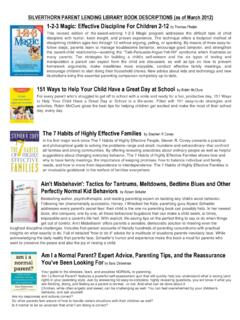
1 It's 1-2-3 MAGICIt's 1-2-3 MAGICW inner of the National Parenting Publications Gold Award and with over 875,000 copies sold, the 1-2-3 MAGIC program is a step by step guide on effective discipline for kids aged 2-12. Written by Dr. Thomas Phelan, a clinical psychologist with over 30 years experience working with children, it offers the busy parent tried and tested techniques to help raise happy, self confident kids. Parenting is done in three straightforward steps:1)Controlling obnoxious behaviour: using 1-2-3 for STOP behaviour2)Encouraging good behaviour: using START techniques to encourage good behaviour3)Strengthening your relationship with your childWhen you start the program half of children will be immediate cooperaters, the other half will be immediate testers. With the testers their behaviour will get worse when you first start the program as they'll want to see if you really mean business. Within 7-10 days if you CONSISTENTLY use the techniques taught here, most of these testers will fall into we look at ways of changing your child's behaviour, we have to get rid of a very big myth:KIDS ARE NOT LITTLE ADULTS!
2 !!!Let's face it. Kids are born unreasonable and selfish. Our jobs as parents/teachers is to turn them into responsible and considerate adults. To do this a lot of parents use words and reasoning to try and rationalize with the kid. This only leads to the TALK-PERSUADE-ARGUE-YELL-HIT a situation where little Johnny is yet again teasing his younger sister. You sit Johnny down and explain to him why it's wrong to tease his sister - it upsets her feelings and how would you feel if someone teased you? Johnny innocently looks up, blinks twice and says Gee dad, I never thought of it like that. Thanks for explaining it to me that way. I won't do it again. GET REAL!!! If you have a kid like that I want you to go and pour yourself a very big glass of champagne, sit down and put your feet up you have that 1 in a million child that the rest of us dream about. For the of the rest of us its not going to be that simple and we are going to have to work with Johnny to change his real key to parenting is to be gentle, consistent, decisive and calm.
3 With 99% of parents who scream hit and shout, it's the parent who is actually having the temper tantrum not the a sign that the parent:a) doesn't know what to ) is so frustrated they can't see ) the adult has anger management explanation if REALLY necessary as to why something is wrong is fine. Too much talking from the parent only IRRITATES and DISTRACTS kids. Remember that kids have a real chip on their shoulders. Adults are bigger, stronger, more intelligent, and more skilled than their kids. It's the adults who have all the power and that really bugs kids out. No one wants to feel unimportant. If the kid can sense he's pushing your buttons and making you all hot under the collar, suddenly HE'S the one with the power; and let me tell you that feels real good! He's not going to stop until he gets what he wants. The key? The parents need to follow the NO TALKING and NO EMOTION RULE which we will go onto next when we look at the first step in our 1-2-3 program controlling obnoxious ONE Counting obnoxious behaviourWhen we count obnoxious behaviour we want the kids to:1)think about what they're doing2)take responsibility for their own 's how to do it.
4 Say little Johnny asks you 30 minutes before dinner for a candy. You say no cause it will spoil his appetite and he won't finish his dinner. Johnny then starts having a temper tantrum shouting, banging cupboards etc. Mum CALMLY[no emotion] looks down at the little tyke and says That's 1! and holds one finger up. Five seconds later if he's still in full swing with his tantrum mum again CALMLY [no emotion] says That's 2! and holds up the two fingers. If he still doesn't shape up we say That's 3 take a timeout! A timeout is usually one minute per age of the child. Its best that they go to their bedrooms. Some parents use the timeout chair but their bedroom is best as they're out of sight so they can't try and provoke you. Remember no electronic equipment, video games, telephone, friends etc for the period of the timeout. The other option is to use a Timeout Alternative loss of a privilege or toy for a period of time, bedtime 15 minutes early, 25pence off allowance 's review what happened in the example above.
5 We gave the kid two chances to shape up and he blew it. He now has to face the next step is CRITICAL and is usually where parents go and bottle it. When he's come back from his timeout there is to be NO TALKING there's to be no lectures, no apologizing and no discussions. YOU MUST REMAIN is the basis of the NO TALKING and NO EMOTION rule that is KEY to the whole program. By not showing emotion, little Johnny is not going to have the feeling of control and POWER he may get, from pushing your buttons. Sure deep down you might be mad as heck- you may have had a long day, be tired etc etc but YOU MUST NOT SHOW THAT HE IS GETTING TO YOU. The one exception to the no talking rule is when they've done something serious and it's necessary for the parent to explain to them why what they've done is wrong using a bad parents say the program starts off working for them and then the kid seems to get immune to it and it no longer works. The usual reason is the parent has slipped up and forgotten the NO TALKING and NO EMOTION rule.
6 I can't emphasize this enough it's the key to everything. COUNT CALMLY, NO EMOTION and NO the no talking rule we are trying to keep the child's focus on the need for good behaviour. If you start talking after the timeout you raise the possibility for a really enjoyable argument and let's face it some kids would sooner cut off a leg than lose an argument of words. The real MAGIC is not the counting part, it's the PAUSE between the counts. It's in those few seconds between counts that you are giving him the opportunity to take responsibility for his behaviour. If you start talking and begging the child to be reasonable not only have you 1) lost control of the situation but more importantly you are 2) thinking for the child and 3) taking responsibility for his behaviour. That's not going to get us the child behaves you praise him and enjoy his company. If he does something bad again you start counting from 1 after his timeout. There are no fractions no 2 , 2 ! ITS 1-2-3 , No TALKING and NO off conversation:Its only fair to warn the kids when you first start the program that there's going to be a few changes around the house.
7 The explanation may go way over there heads but its worth doing. Both parents, even if they live separately should sit down TOGETHER with the kids and have a conversation that goes like the following: Listen guys there are times when you do things we don't care for, like arguing, whining and teasing. From now on we are going to do something a little different. When we see you doing something you're not supposed to, we'll say That's 1! That's a warning and it means you're supposed to stop. If you don't stop we'll say That's 2! If you still don't stop well say That's 3 take 5! That means you have to go to your room for a timeout or a kind of rest period. When you come out we don't talk about what happened unless it's really necessary. We just forget it and start over. If you do something really serious like swearing or hitting we'll say That's 3 take 10 or 15! - you go straight to your room and the time will be longer. Six kinds of testing and manipulation:Kids use the following six tactics to get to you: badgering, temper, threats, martyrdom, buttering up, and physical tactics.
8 If a kid always seems to be using the same tactic on you it's usually a sign that that tactic is working for him it's particularly effective at getting under your skin. If a kid keeps swapping tactics to try and annoy you that's usually a better sign the parent is following the NO EMOTION rule and little Johnny doesn't seem to be having much luck at getting you all hot and bothered. Well done- your half way there!For serious misbehaviour use the MAJOR/MINOR system. This is where the offence is too serious to count lying. Have a list of offences and what the consequences will be worked out beforehand. What we want to do is stop obnoxious behaviour before it sets in and becomes more difficult to manage when they're with more destructive behavioural problems have two major motives: 1) hostile/vengeful tendencies and 2) are thrill seeking ( smoking, cutting school). These kids can go on and become what the professionals label as having Oppositional Defiant Disorder. There is probably some genetic basis, but this disorder can be caused as well as seriously aggravated by sloppy, inconsistent, angry and overly wordy parenting.
9 Left unchecked they can graduate to having Conduct Disorder the new politically correct term for juvenile delinquent. For most parents using the counting 1-2-3 system will be enough, but for kids with more serious behavioural problems parents should use the Major/Minor of the techniques above will only work if used CONSISTENTLY. If mum and dad live apart it is best for both parents to use the program, otherwise the kids will try and play one parent off against the other. If the other parent won't take things on board it's still worth doing the program it's just going to be much much harder. The program is even more effective if it can be used at school as well, so have a word with the if you are in doubt especially in the beginning, it is best to COUNT the behaviour. The only exceptions to this are kids who use buttering up/passive pouting, when it's usually only appropriate to count them if they start becoming aggressive when they are doing it. If a child goes to his room and continues to scream while he's there the timeout doesn't start until he's quiet.
10 If he tries to leave the room, you put him back in there and hold the door shut if need be. If they're older and physically too big/strong and you're worried that they're going to resist you, use a timeout alternative dock a privilege etc. Below are a couple of examples for managing the more difficult situations: Lying:People lie to impress other people or to avoid getting into trouble. Let's say you've found out that little Johnny has been in trouble at school. Avoid asking him how school went to see if you can catch him out in the lie. You're only giving him extra practice at becoming a better liar. Don't question him out of the blue. Instead say Tell me what happened, but not right now. Think about it awhile and we'll talk in 15 minutes. Another option is to tell the youngster what you know and get them to come up with their own punishment. Finish off with saying I'm sure you'll do better next time. Sibling rivalry:A quick mention on this one. The two most stupid questions you can ask when you walk in and your two kids are screaming at each other is What happened and who started it?