Transcription of JOHN DEWEY’S EDUCATIONAL THEORY AND EDUCATIONAL ...
1 (IJCRSEE) International Journal of Cognitive Research in Science, Engineering and EducationVol. 4, , INTRODUCTIONThe American scholars john dewey and Howard Gardner, although living and working in different epochs, have built theories that ini-tiated EDUCATIONAL reforms in the school system in the Unites States and beyond. At the begin-ning of the 20th century john dewey sharply criticised the traditional old school , with a large number of passive students and with uni-form curriculum and teaching methods, which center of gravity is in the teacher, in the text-book, anywhere and everywhere except in the immediate instincts and activities of the child himself ( dewey , 1915, p. 35). Based on these observations, he created an authentic compre-hensive and coherent EDUCATIONAL THEORY that marked the 20th century and dramatically shaped the EDUCATIONAL reform process at el-ementary schools in the United States, but also in Europe and Asia.
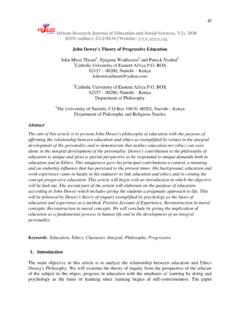
2 It promotes a child-cen-tered approach in education, which is founded on several key principles ( dewey , 1915, 1966, 1974c): Education is a necessity of life, so-cial process of continuing change and reconstruction of the individual experience ; being interpreted within the concept of development, educa-tion is a process of living and not a preparation for future living. School is an embryonic form of john dewey S EDUCATIONAL THEORY AND EDUCATIONAL IMPLICATIONS OF HOWARD GARDNER S MULTIPLE INTELLIGENCES THEORYDr. Elena Achkovska Leshkovska, Institute of psychology, Faculty of Philosophy, University Ss. Cyril and Methodius-Skopje, Republic of MacedoniaEmail: Dr. Suzana Miovska Spaseva, Institute of pedagogy, Faculty of Philosophy, University and Methodius-Skopje, Republic of MacedoniaEmail: suzana@ Author Dr.
3 Elena Achkovska Leshkovska. Institute of psychol-ogy, Faculty of Philosophy, University Ss. Cyril and Methodius-Skopje, Republic of MacedoniaEmail: This work is licensed under a Creative Commons Attri-bution - NonCommercial - NoDerivs The article is published with Open Access at A R T I C L E I N F OStudies and articlesReceived: November, : December, : December, :929 Гарднер Х. :929 Д уи . : john dewey , Howard Gardner, Education, EDUCATIONAL B S T R A C TSince 1983, when Howard Gardner published his THEORY of multiple intelligences, educators have begun to incorporate this new model into school programs. However, the idea of multimodal teaching is hardly a new concept. Many pioneers of modern education, such as: J.
4 J. Rousseau, Pestalozzi, M. Montessory, J. dewey , suggested EDUCATIONAL models that oppose uniformity and predominantly verbal teaching. The aim of the research presented in this paper is to identify and compare compatible elements of EDUCATIONAL ideas of john dewey and Howard Gardner. The research is based on historical-comparative method and content analysis technique and is focused on exploring three key elements of intersection: curriculum, methods of teaching and learning, and teachers role. Regarding the curriculum, both authors prefer integrated and thematic curriculum based on real-life context. They also agree on student-centred teaching where implementation of variety of active methods of learning will give opportunity to students to express their specific identity.
5 Teacher s role in both concepts is to link students personal experiences and characteristics to the material being studied and to the school life in general. The findings imply that EDUCATIONAL implications of Gardner s THEORY can be considered as a continuation of dewey s progressive vision of classroom teaching and school organization. 2016 IJCRSEE. All rights reserved.(IJCRSEE) International Journal of Cognitive Research in Science, Engineering and EducationVol. 4, , life and an instrument for social change and progress. That means that the school life grows out of all the aspects of the social life and that the child s experience de-velops in transaction with the com-munity he lives in.
6 Activity is the fundamental charac-teristic of the child s nature , which is expressed through his instincts, experience , interests and individu-ality. They represent a huge educa-tional potential and starting point of the process of learning, but are not an end in itself: they need to be con-trolled and guided toward realiza-tion of predetermined decades after dewey had an-nounced his EDUCATIONAL THEORY , Gardner (1983) introduced the THEORY of multiple intel-ligences (MI), challenging the traditional con-cept of general intelligence as a single entity. On the basis of the neurological and cultural research, he described an individual s cogni-tive abilities in terms of seven relatively inde-pendent but interacting intelligences: linguis-tic, logical-mathematical, spatial, musical, bodily-kinesthetic, intrapersonal and inter-personal.
7 Later he added the eight, naturalist intelligence, and considered the possibility of including existential one as a ninth. The key points of the concept are: 1. each person pos-sesses all intelligences, but they function to-gether in ways unique to each person; 2. most people can develop each intelligence to an adequate level of competency; 3. intelligences usually work together in complex ways and 4. there are many ways to be intelligent within each category (Armstrong, 1994). Gardner himself offered very few sug-gestions for EDUCATIONAL use of the MI THEORY , since psychology does not directly dictate education but, it merely helps one to under-stand the conditions within which education takes place (Smith, 2002, 2008).
8 However, it has had an intense impact on EDUCATIONAL practice and during the late 80 s a number of schools in North America have structured cur-ricula according to its key principles. The the-ory inspired educators to question their work and encouraged them to suggest approaches to curriculum, pedagogy, assessment, learn-ing differences, use of computers, place of the arts indeed, almost any issue in which edu-cators are interested (Gardner, 2011, p. 6). The experience of scholars and practitioners on implementation of MI ideas with various populations, age groups and EDUCATIONAL set-tings was presented in the book Multiple Intel-ligences Around the World (2009). Of course, along with the good practices, a lot of misin-terpretation occurred, that provoke the author to delineate the most common misunderstand-ings of his THEORY (Gardner, 1993, p.)
9 68).Although Gardner didn t create edu-cational THEORY , he reflected on the different trends and contemporary status of the edu-cation in American society. In this context, he emphasized the need of changing the American education toward student-centred teaching: American education is at a turn-ing point. There are considerable pressures to move very sharply in the direction of uni-form schooling ; there is also the possibility that our EDUCATIONAL system can embrace in-dividual centred schooling (Gardner, 1993, p. 68). Gardner himself declared that much of his writings on education have been iden-tified with EDUCATIONAL tradition of dewey and so called progressive or neo-progressive movement.
10 He accepted his alternative edu-cational vision which is centred on under-standing so that an individual understands the concept, skill, THEORY or domain of knowl-edge to the extent that he or she can apply it to a new situation (Gardner, 1999, p. 118-119). In fact, dewey and Gardner shared the same need for EDUCATIONAL reform claiming that the established teaching methods at their times are neither correct nor beneficial for students. Also, both authors ideas were subject to criti-cism and unenthusiastic responses along with the positive reactions. 2. MATERIALS AND METHODSThe review of the part of the literature written by Howard Gardner and other authors who overview his ideas and their EDUCATIONAL implication, shows that on several occasions the relation between dewey s and Gardner s thoughts on education has been pointed out.